Lecture 1a
Overview
Professor Schniter introduces ECE 5307 as a machine-learning course that pairs mathematical foundations, especially linear algebra, probability, and statistics, with practical Python, Jupyter, and GitHub work. He explains the course structure and project expectations, then begins a linear algebra review covering notation, transposes, matrix dimensions, matrix multiplication, and inner and outer products.
Key takeaways
- Linear algebra is the central language for the course's machine-learning material, so reviewing it early is essential for understanding later methods.
- The course deliberately links theory and implementation: weekly math homework prepares students for midterms, while Python labs and the final project develop coding skills.
- Matrix multiplication requires matching inner dimensions, maps an M by P matrix and a P by N matrix to an M by N result, and generally cannot be reordered.
- The distinction between aᵀb and abᵀ is fundamental: the inner product returns a scalar, while the outer product returns a matrix.
- Machine-learning data matrices commonly store samples in rows and features in columns, a convention that clarifies how datasets are represented and processed.
- GitHub and Jupyter support the practical course workflow, with private repositories for individual labs and a shared group repository for the final project.
Chapters
- The course covers regression, classification, generation, clustering, and dimensionality reduction, emphasizing the math behind these methods.
- Students need calculus, linear algebra, and basic probability and statistics; programming experience is required, but Python experience is not.
- Professor Schniter holds office hours Wednesdays from 1 to 3, while TA Hyam grades coding labs and offers several additional office-hour sessions.
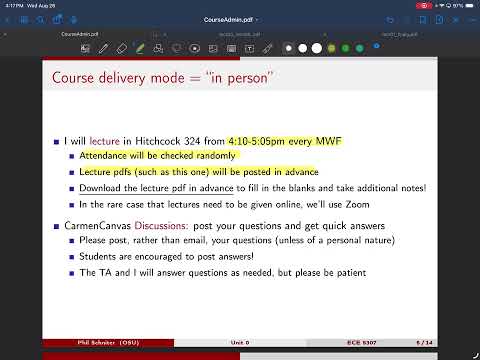
- Lectures meet Monday, Wednesday, and Friday from 4:10 to 5:05 p.m.; attendance is checked randomly through questions during class.
- Lecture PDFs are posted in advance with blanks for students to complete, encouraging active note-taking and attention.
- Questions about assignments and coding should go to the relevant CarmenCanvas discussion so classmates can share solutions and troubleshooting advice.
- Weekly analytical homework is designed to build the math skills needed for midterms, which together account for 50% of the grade.
- Weekly coding labs use Jupyter notebooks with short code-completion tasks and demonstration notebooks; students can learn Python by adapting examples.
- Four in-person midterms test math rather than coding, allow one page of notes, and prohibit calculators, phones, and other electronic devices.
- Midterms focus on recent course units rather than being cumulative, and their weights increase over the semester.
- The first midterm covers prerequisite linear algebra only, with the aim of prompting students to review it early.
- Attendance contributes 5% of the grade, and students are asked to flag midterm conflicts as soon as possible.
- Undergraduate grades are curved toward roughly one-third A, one-third B, and one-third C grades; graduate grades aim for roughly half A and half B.
- The final project is due on the last day of class, leaving finals week free of a final exam or project deadline.
- Teams of three will apply course methods to an initially unfamiliar real-world dataset and a task such as classification or regression.
- A private Kaggle competition lets teams compare results; each teammate may independently handle one of three method families or collaborate more closely.
- Teams can be student-selected or assigned by Professor Schniter, who plans to match ungrouped students with peers of similar cumulative averages.
- The project submission includes Python code and a PDF describing the design process; suggested books are optional, with free theory and deep-learning texts among the options.
- CarmenCanvas handles grades, announcements, discussions, and PDF submissions, while GitHub hosts lecture PDFs, demo code, and programming assignments.
- Each lab has a private repository containing a code skeleton and possibly data files; students can work in Google Colab or on a local machine and push changes back to GitHub.
- The group final project uses a shared repository, and optional course materials provide Python and NumPy practice.
- Jupyter notebooks combine explanatory text, runnable code cells, and outputs, making them the format for labs and demonstrations.
- Professor Schniter warns that machine learning is math-heavy and that linear algebra is the prerequisite students most often struggle with.
- Machine-learning concepts are expressed in the language of linear algebra, so gaps in that subject can make later material difficult to follow.
- Students are urged to invest in linear algebra early and work through weekly homework rather than relying on answer-generating tools.
- Active lecture participation means taking notes and asking questions instead of multitasking on phones or unrelated coursework; academic misconduct on midterms must be reported.
- Linear algebra represents systems of equations compactly, as in the example written as Ax = b and solved by multiplying by A inverse when that inverse exists.
- Scalars use nonbold symbols, vectors use bold lowercase symbols, and matrices use bold uppercase symbols; handwritten vectors are underlined.
- Named vectors are column vectors by default, and the transpose changes a column into a row or swaps a matrix's rows and columns.
- The transpose of a transpose returns the original quantity, while transposing a matrix product reverses the factors' order.
- A matrix can be described by naming its columns as column vectors or its rows as transposed column vectors.
- In a machine-learning data matrix, columns often represent features and each data sample occupies a row.
- The notation distinguishes scalars from vectors and matrices, while definitions determine exactly what symbols such as a₁ refer to.
- A small triangle above an equals sign marks a definition rather than a result derived from other statements.
- To compute an output entry, take the corresponding row from the first matrix and column from the second, multiply matching elements, and sum them.
- For A with dimensions M by P and B with dimensions P by N, the shared inner dimension P must match and AB has dimensions M by N.
- The entry in row i and column j is the sum over k of AᵢₖBₖⱼ, a componentwise rule that generalizes the worked examples.
- Matrix multiplication is not commutative: AB generally differs from BA, and one product may not even have compatible dimensions.
- For column vectors a and b, aᵀb is an inner product that sums matching entries and produces a scalar.
- The product abᵀ is an outer product that produces a matrix, demonstrating why reversing factors can change both the result and its dimensions.
- Writing matrices as rows or columns expands a product into sums of outer products or into scalar row-by-column products.
- When a matrix multiplies a matrix expressed by columns, each output column is the first matrix multiplied by one input column; expressing the first matrix by rows similarly forms the output rows.
Transcript excerpt
0:02 All right, welcome to uh ECE 5307 uh intro to machine learning. I'm Professor Schneider and today we're going to start by going through the material on the syllabus and then we'll actually get started into some of the material um in the second half. [clears throat] So uh I'm the professor uh for this class. There is a TA, Hyam. He's going to be the one that is grading labs. [clears throat] I'm going to have office hours uh every Wednesday from 1 to 3. And he has a whole bunch of office hours um in Dre 3:31. He has office hours Wednesday night, Thursday night, and Friday
0:51 afternoon. >> [clears throat] >> These times work pretty well for a lot of people because a lot of people have classes and things during the day. Um, but hopefully between all of our office hours, uh, if you if you want to come to office hours, you have some options. There's also going to be a grader that's going to be grading the homework. He is not allowed to have office hours but um if you have questions on his homework grading you can contact him by email. So um so [clears throat] the basic goals of this course are we want to understand the basic forms of machine learning. These are things like regression, classification, uh generation, clustering,
1:39 dimensionality reduction and so on. And in particular, we want to understand the math behind these methods. [clears throat] So these are like concepts from linear algebra, probability, statistics. But then we also want to gain experience with standard coding tools, things like um Python and all of its uh packages as well as um GitHub. >> [clears throat] >> So the idea here is that if all you can do
This is the start of the transcript. Save this video free for the whole transcript, searchable and time-coded.
In this course
Related notes
Summary, takeaways, and chapters were generated by AI from the video's transcript and may contain errors. The video belongs to its creator, Prof. Schniter.