L5 Hermitian Matrix, Real Eigenvalue, Matrix Diagonalization, Eigenbasis
 Watch on YouTube →
Overview
The lesson develops Hermitian matrices as matrices equal to their conjugate transpose, then proves that their eigenvalues are real using bra-ket inner products. It connects eigenvalue calculations to diagonalization through the characteristic equation det(A − λI) = 0, and works through the Pauli X matrix to show how its eigenvectors form a basis in which the matrix is diagonal.
Key takeaways
- A matrix is Hermitian when A = A†, where A† is formed by complex conjugation followed by transposition.
- For a Hermitian matrix, the eigenvalue equation and the conjugate-inner-product identity force each eigenvalue λ to satisfy λ = λ*, so its spectrum is real.
- Finding eigenvalues reduces to solving det(A − λI) = 0, the condition that the homogeneous system (A − λI)|λ⟩ = 0 has a nonzero solution.
- When a matrix's eigenvectors form a basis, its representation in that eigenbasis is diagonal, with the corresponding eigenvalues on the diagonal.
- The Pauli X matrix has eigenvalues +1 and −1 and normalized eigenvectors (1/√2)(1, 1) and (1/√2)(1, −1), so it is diagonal in the plus-minus basis.
Chapters
- Vectors represent physical states, while operators represent actions that change those states.
- A matrix acts on a column vector to produce another vector, providing the linear algebra representation of an operator.
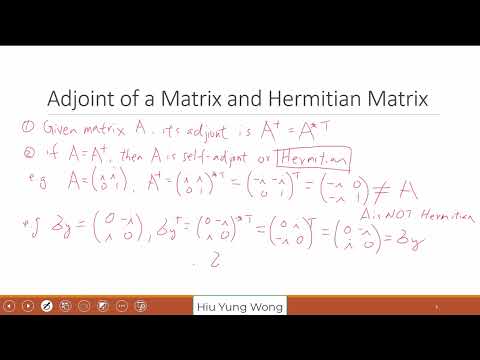
- The adjoint of a matrix A is written A† and is obtained by taking the complex conjugate and then the transpose.
- The adjoint operation reverses itself: taking the adjoint of A† returns A.
- A matrix is Hermitian, or self-adjoint, when A = A†.
- The example matrix with entries involving i changes under conjugate transpose and is not Hermitian.
- The Pauli Y matrix, with off-diagonal entries −i and i, equals its adjoint and is Hermitian.
- In quantum mechanics, observable quantities such as velocity must have real measurement outcomes.
- Hermitian operators are important because their eigenvalues, which represent possible measurement outcomes, are real.
- Let |λᵢ⟩ be an eigenvector of A with eigenvalue λᵢ, so A|λᵢ⟩ = λᵢ|λᵢ⟩.
- Taking the inner product with ⟨λᵢ| turns the eigenvalue equation into a scalar relation involving ⟨λᵢ|A|λᵢ⟩.
- Complex conjugation of an inner product swaps bra and ket and replaces an operator A with its adjoint A†.
- For Hermitian A, A† = A, so the two expressions for ⟨λᵢ|A|λᵢ⟩ imply λᵢ = λᵢ*.
- Since an eigenvalue equal to its complex conjugate is real, every eigenvalue of a Hermitian matrix is real.
- If A acts on a ket as A|α⟩, the corresponding bra is ⟨α|A†.
- The adjoint therefore gives the operator action consistent with the bra-ket duality used in inner products.
- Two matrices are equal if they produce the same output for every input vector.
- A zero vector has every component equal to zero; it is distinct from the computational basis state |0⟩.
- The bra corresponding to c|α⟩ + d|β⟩ is c*⟨α| + d*⟨β|, with complex conjugation applied to the coefficients.
- Associativity allows ⟨β|A|α⟩ to be evaluated as either ⟨β|(A|α⟩) or (⟨β|A)|α⟩.
- Associativity does not permit swapping A and a vector; matrix and vector operations generally do not commute.
- The conjugate of ⟨β|A|α⟩ is ⟨α|A†|β⟩.
- This identity combines the inner-product rule that swaps bra and ket with the adjoint rule for the operator.
- The relation is useful for proofs involving Hermitian matrices and quantum operators.
- Writing A|λ⟩ = λ|λ⟩ as (A − λI)|λ⟩ = 0 produces a homogeneous system of linear equations.
- A nonzero eigenvector exists only when A − λI is singular, so its determinant must vanish.
- Solving det(A − λI) = 0 gives the eigenvalues of an n by n matrix.
- When eigenvectors of A form a basis, each eigenvector is represented by a coordinate vector with a single 1 in its position.
- In that eigenbasis, A is diagonal and its eigenvalues occupy the corresponding diagonal entries.
- Changing basis changes a matrix's representation, not the underlying linear operator.
- In the computational basis, the Pauli X matrix is [[0, 1], [1, 0]].
- The characteristic equation det(σₓ − λI) = λ² − 1 = 0 gives eigenvalues +1 and −1.
- The normalized eigenvectors are |+⟩ = (1/√2)(1, 1) and |−⟩ = (1/√2)(1, −1).
- Using |+⟩ and |−⟩ as the basis makes σₓ diagonal, with +1 and −1 on the diagonal.
- In this basis, |+⟩ has coordinates (1, 0) and |−⟩ has coordinates (0, 1).
- Applying the diagonal representation to (1, 0) returns (1, 0), confirming that |+⟩ is an eigenvector with eigenvalue +1.
Transcript excerpt
0:07 So after this class I hope you will have finished reading chapter 1 to 10 looks like a lot but should be pretty quick right but it should not be difficult okay please read that it basically is just what I say in the class but if you have extra time take a look we have been talking about the operator right again we say that we use vector to represent the state the physical state of a system and to manipulate the state right how do we change the state uh we use operator which is a physical action we represent that physical action as an operator right like I'm standing in front of the mirror I my state is standing still upright and someone push
0:55 me maybe cause a rotation right that become uh upside down that is an operator right. So to change the vector of course we need matrix right. So there are few very important matrices in quantum mechanics or linear algebra that we need to learn. The first of them is the so-cal herian matrix. Before that let's discuss something called adjoin matrix of a matrix. Okay. So let's just look at this. So given matrix A right this is just any matrix A. So it's a matrix something times
1:45 something right is adjint. Okay. So this is a word you need to learn at joint is labeled as a dagger. Okay, it's just a relationship just a uh a dagger is another matrix. is the adjint of a just like inverse matrix right you have a and then you say is inverse is a to the power minus one make sense but this is just a new uh definition another definition called adjoin right is adjoin is a dagger and what is a dagger you
This is the start of the transcript. Save this video free for the whole transcript, searchable and time-coded.
Related notes
Summary, takeaways, and chapters were generated by AI from the video's transcript and may contain errors. The video belongs to its creator, Quantum Computing, TCAD, Semicond by Hiu-Yung Wong.