GERO 200 f2026 Module 13 Durable Power of Attorney Financial Elder Abuse Video 2026 11 15
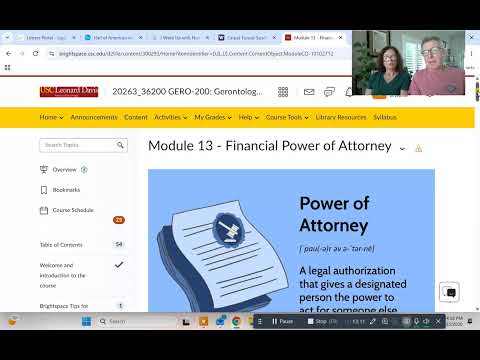
Overview
John Walsh explains how a durable financial power of attorney lets a trusted agent manage specified financial tasks if a person becomes incapacitated, potentially avoiding a costly, slow conservatorship. He then examines elder abuse, especially financial exploitation by trusted people, sharing safeguards, risk factors, the limits of Adult Protective Services when an adult retains capacity, and ways to reduce isolation.
Key takeaways
- A durable financial power of attorney must be signed while the principal has capacity and can help avoid a court conservatorship if incapacity occurs.
- An agent under a power of attorney has a duty to use the principal's money for the principal, while adding that person as a joint account owner can give them the ability to withdraw funds as an owner.
- Independent monitoring of statements and credit-card activity adds oversight when a relative or professional agent manages finances.
- Elder abuse is often perpetrated by people with trusted access: the lecture cites 1 in 10 surveyed older adults reporting abuse in the prior year and family members accounting for about 90% of abusers.
- Adult Protective Services may investigate and offer services, but John Walsh's example shows that an adult who appears to retain capacity can refuse assistance.
- Transportation, walkable senior-friendly communities, nearby healthcare, and video calls through FaceTime or Zoom can reduce isolation and strengthen older adults' social connections.
Chapters
- A financial power of attorney names an agent to handle financial affairs, such as paying bills, if the principal can no longer do so.
- The principal must have cognitive capacity when signing; without the document, relatives may need to seek a court-ordered conservatorship.
- Conservatorship can involve substantial paperwork, attorney fees, and delays, while advance planning lets the person choose who will act.
- A conventional power of attorney ends if the principal becomes incapacitated, so it may suit temporary needs such as travel or help paying bills.
- A springing power of attorney takes effect after a defined event, often incapacity; the document should specify how that event is established, such as requiring a doctor's assessment.
- A durable power of attorney remains effective through incapacity; it can begin at signing or be structured to spring into effect later.
- The document can grant narrow or broad authority, including paying bills, handling insurance, or buying and selling real estate or vehicles.
- Choose an agent who is trustworthy, organized, financially responsible, and not vulnerable to gambling or substance-use pressures.
- Adding an agent as a joint bank-account owner gives them ownership rights and can let them withdraw the funds; an agent under a power of attorney must use funds for the principal's benefit.
- John Walsh describes using a credit union's separate login access for an agent to monitor spending and pay bills without adding the agent as an account owner.
- Have someone independent review bank statements and credit-card charges; to revoke authority, sign a replacement document, notify the former agent, and alert financial institutions.
- The lecture cites research reporting that 1 in 10 surveyed older adults experienced some form of abuse in the prior year, with financial abuse by a family member identified as the most common form.
- Examples include opening credit cards in an older adult's name, taking Social Security payments, writing unauthorized checks, or transferring money using an ATM PIN.
- The lecture states that about 90% of abusers are family members; abuse can also involve paid caregivers or care-facility staff.
- Abuse is often not reported because victims may fear losing care, causing family conflict, or getting a relative in trouble; dementia can also make reports easier to dismiss.
- Risk factors for an older adult include disability, dependence on others, poor physical health, depression, and low income; risks for an abuser include substance use, mental-health problems, and financial dependence on the older person.
- Warning signs can include unexplained bruising, missing medication, suspicious withdrawals, isolation, or someone else controlling calls and messages.
- John Walsh describes contacting Los Angeles County Adult Protective Services after an older relative's companion blocked post-surgery help; APS and police could offer services but could not force them on an adult who appeared to have capacity.
- Making a report can create a record that may help if abuse escalates, even when the older adult initially declines assistance.
- Loneliness can increase vulnerability to exploitation and is associated in the lecture with faster physical and mental decline and higher dementia risk.
- The lecture compares loneliness's health impact to smoking 15 cigarettes a day and distinguishes unwanted loneliness from being comfortably alone.
- Risk factors for isolation include being over 80, chronic illness, low income, limited transportation, distant family, and changing family structures.
- Suggested responses include senior transportation to appointments and senior centers, walkable communities with nearby healthcare, multigenerational housing, and tablets or phones for FaceTime and Zoom.
Transcript excerpt
0:00 Hey JR200, it's us. It's Sunday, November 15th. >> It's us. >> It's him, too. The >> point my sweet baby boy. >> And uh we're here to do the second to last. Is it the second to last thing? >> Yeah, it is. >> Yeah. So, we've only got one more after this. So, you're almost to the finish line. Yay team. >> And you've done all the hard work already. Now you just, you know, the only thing you have to do is you just have to power through on the discussions and the and the quizzes and the last midterm exam and you're done. >> Absolutely. And I will send out a review before the um last second exam. >> Okay. >> So, all righty. So, today we're talking about financial power of attorney. Last week we talked about power of attorney for healthc care decisions. So, um, for financial power of attorney, this is a a
0:50 pretty important document because, wait a minute, who's [laughter] >> I thought we were going to have everybody on on camera. Anyway, um so the financial power of attorney is a pretty important document because if you get to the point in your life or your grandmother or your auntie or uncle gets to the point where they're not able to handle their own financial affairs, including paying their own bills, they may need to have a power of attorney in place that was signed when they were competent and had the the um the brain power, the cognitive ability to sign that document to give someone else the authority to act for them. And so the reason this is can be a good idea is that if you don't have a power of attorney for health care and you don't
This is the start of the transcript. Save this video free for the whole transcript, searchable and time-coded.
In this course
Related notes
Summary, takeaways, and chapters were generated by AI from the video's transcript and may contain errors. The video belongs to its creator, John Walsh.