EDF9850_Lecture6
 Watch on YouTube →
Overview
Lesa Hoffman extends multilevel modeling from nested data to crossed and cross-classified designs, where observations can share multiple non-nested groups such as schools and neighborhoods, or subjects and items. She explains how to partition variance, add contextual effects and random slopes, and model time-varying classrooms, including fixed- and random-effects approaches that switch classroom effects on only when relevant or allow them to persist over time.
Key takeaways
- Cross-classified models are appropriate when observations share multiple non-nested groups, such as children grouped by both school and neighborhood or responses grouped by both subject and item.
- A level-one predictor such as child IQ may require separate contextual terms for each crossed grouping dimension, such as school mean IQ and neighborhood mean IQ.
- One observation per subject-item combination leaves pair-specific variation in the residual, while repeated observations per pair can make a subject-by-item random intercept estimable.
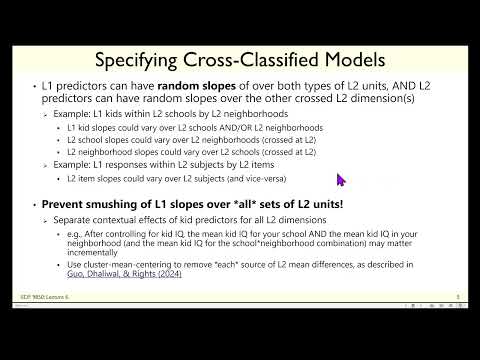
- Crossed designs allow random slopes across either grouping dimension, including school-level predictor effects that vary by neighborhood and item-feature effects that vary by subject.
- For time-varying classrooms, occasion-specific 0/1 switch variables can activate classroom effects only when a student belongs to that class, or keep prior effects active to represent transfer across grades.
- The number of units in each dimension limits which random effects are practically estimable; more subjects, items, schools, and neighborhoods provide more information for detecting variance.
Chapters
- A multilevel-model level represents a sampling dimension with remaining outcome variability after predictors and fixed slopes are accounted for.
- Crossed random effects apply when upper-level units are not nested within one another; multiple-membership models instead cover people belonging to several clusters.
- Don Hedeker's workshops are suggested for multiple-membership models, while R, SAS, and Stata are mentioned as possible software contexts.
- Children can share a school and a neighborhood without all schoolmates living in the same neighborhood, creating two crossed level-two dimensions.
- Include school- and neighborhood-level summaries, such as school type and neighborhood mean socioeconomic status, to explain differences across groups.
- A child-level predictor such as IQ can have separate school and neighborhood contextual effects, preventing its individual and group-level associations from being smooshed together.
- With one observation per subject-item pair, subject and item random intercepts capture their respective mean differences and the pair-specific residual; repeated pair observations can support an additional subject-by-item random intercept.
- Child-level predictor slopes can vary across schools, neighborhoods, or both; a school-level predictor can also have a slope that varies across neighborhoods.
- In repeated-measures studies, response characteristics can vary across subjects or items, such as the effect of item difficulty varying by subject.
- When students change classrooms across occasions, occasions are crossed with classroom and student rather than classrooms forming a level nested above students.
- Classroom dependency may be acute, affecting only the score recorded in that classroom, or persistent, carrying forward effects such as kindergarten preparation into later grades.
- Restructure each student's time-varying classroom IDs into separate occasion-specific columns, then create 0/1 intercept switches that activate the relevant classroom effect on each row.
- For persistent classroom effects, switches can remain on for later occasions; a decay pattern such as 1, 0.5, 0.25 can represent diminishing influence over time.
- Treat classrooms as fixed categorical effects when the goal is dependency control and there are few clusters, or as random effects when estimating variation across classrooms is useful.
- Hoffman's example uses three occasions and classroom switches in SAS; she notes that model fit criteria such as AIC and BIC can compare non-nested coding schemes.
Transcript excerpt
0:00 Hello folks and welcome back to my home office. I am here today to record an hopefully shorter video than usual for lecture six. It's only eight slides, so I can only talk so long. Away we go. So the topic of this very brief lecture is to extend multi-level models for nested sampling designs into multi-level models for cross sampling designs or crossclassified as some folks say. You can think of those as synonyms for all intents and purposes. And I wanted to highlight just a few things. Examples of cross-sectional instances of this longitudinal as well as what random slopes are possible and what kind of smooshing we want to avoid in models for cross-classified sampling. So, as a reminder of where we've been, when we
0:50 use the word level in the description multi-level models, a level refers to a dimension of sampling in the outcome variable that has leftover remaining variability after including the model predictors and giving them fixed slopes. So the idea of children nested in schools, potentially occasions nested in persons, we've seen many instances of that this semester. And the key idea is that the outcome is measured at the lowest level always. And the upper levels above that are determined based on which dimensions of sampling still have leftover variance. So we have two-level models, we can have three-level models. And what this extension is talking about is situations in which we have more than two
1:37 dimensions of sampling but the upper level dimensions are not nested within each other. Instead they are crossed. So crossed random effects is the term that I typically default to. Crossclassified models is an alternative. And there is also something very close to this but a little bit different known as multiple membership models. And this is for situations in
This is the start of the transcript. Save this video free for the whole transcript, searchable and time-coded.
Related notes
Summary, takeaways, and chapters were generated by AI from the video's transcript and may contain errors. The video belongs to its creator, Lesa Hoffman.