EDF9850_Lecture4_Part1
 Watch on YouTube →
Overview
Lesa Hoffman explains how multilevel models use random slopes to represent cluster-to-cluster variation in level-one relationships, and how cross-level interactions can explain that variation. She emphasizes cluster-mean centering to keep within- and between-cluster effects distinct, then demonstrates random-slope testing, interpretation, and effect-size assessment with a student verbal ability and language example.
Key takeaways
- Cluster-mean centering is essential for a clean random slope: it ensures that the slope variance represents differences in the within-cluster relationship rather than a mixture of within- and between-cluster variation.
- A random slope adds more than one parameter to a random-intercept model: it adds the slope variance and its covariance or correlation with the intercept.
- In Hoffman's student example, the verbal-language slope is about 2.45, the random-slope variance is 0.224, and an approximate 95% range of school-specific slopes is 1.5 to 3.4.
- Cross-level interactions explain random-slope variation by linking a cluster characteristic to a level-one slope; the mixed-grade interaction in the example is about +0.32.
- A statistically supported random slope does not identify why clusters differ; the model needs explanatory cluster-level predictors and interactions, and their practical value should be assessed with effect sizes.
Chapters
- A null two-level model separates person-level residual variance from cluster-level random-intercept variance; ICC1 summarizes the expected similarity of outcomes within clusters.
- Level-two predictors explain cluster mean differences, while level-one predictors can contain both within- and between-cluster variation.
- Cluster-mean centering isolates within-cluster variation, and adding the cluster mean as a level-two predictor isolates between-cluster variation.
- Grand-mean or constant centering does not remove between-cluster variation; a cluster-mean term is needed to distinguish within, between, and contextual effects.
- A fixed slope assumes a level-one relationship is identical across clusters, while a random slope adds a cluster-specific deviation around the fixed slope.
- Clusters can have varying slopes even when the average fixed slope is near zero, for example when some clusters show positive effects and others negative effects.
- The fixed slope remains in a random-slope model because it is the mean around which cluster-specific slopes vary.
- A level-two cluster characteristic can potentially explain why a level-one predictor's slope differs across clusters.
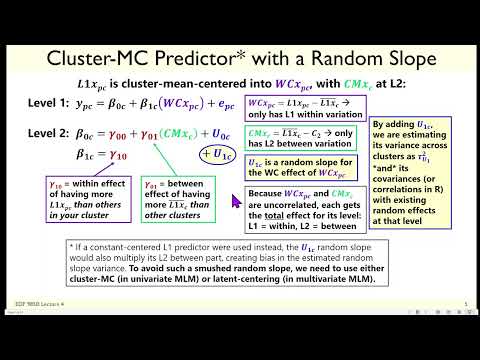
- For a level-one predictor X, cluster-mean centering subtracts each cluster's mean so the random slope applies only to within-cluster variation.
- If X is only grand-mean centered, its random slope multiplies both within- and between-cluster variation, forcing one variance component to represent both.
- Adding a random slope to a random-intercept model adds both the slope variance and its covariance or correlation with the intercept.
- Random-effect correlations can be estimated directly by software such as R; they are not automatically included by every program.
- Hoffman's example predicts student language from student verbal ability, with verbal ability cluster-mean centered and school-level predictors for homework, mixed-grade classrooms, and school mean verbal ability.
- In the R model specification, the within-cluster verbal predictor appears as both a fixed effect and a random slope alongside the school random intercept.
- The estimated within-school verbal slope is about 2.45, with random-slope variance of 0.224 and a negative correlation with the random intercept.
- A likelihood-ratio test gives a chi-square value of 19 on 2 degrees of freedom, supporting the added slope variance and intercept-slope covariance.
- A random-effect interval uses the fixed slope plus or minus roughly two random-effect standard deviations; the example yields an expected school slope range of about 1.5 to 3.4.
- Because the example interval stays above zero, verbal ability is expected to have a positive relationship with language in about 95% of the schools represented.
- Slope reliability scales random-slope variance against residual variation and predictor variance; Hoffman describes using it to inform simulation-based power analysis.
- Adding a random slope changes fixed-effect standard errors and denominator degrees of freedom because the model accounts for slope variability across clusters.
- Random slopes represent a distinct source of cluster differences beyond random-intercept differences in cluster means.
- They also create predictor-dependent outcome covariance and quadratic heterogeneity in outcome variance, involving the predictor squared times slope variance and the intercept-slope covariance.
- Random-slope variance remains unexplained variation unless predictors account for why clusters have different slopes.
- A cross-level interaction combines a level-two cluster characteristic with the level-one predictor whose slope varies.
- The example adds interactions between student verbal ability and three school characteristics: homework, mixed-grade classrooms, and school mean verbal ability.
- With those interactions in the model, the student verbal main effect is conditional on homework equal to 2, no mixed grades, and school mean verbal ability equal to 10.
- Homework has an estimated interaction of about -0.06 and school mean verbal ability about -0.04, both suggesting a less positive verbal slope as those school characteristics increase.
- The mixed-grade interaction is about +0.32, indicating a stronger positive verbal-language relationship in mixed-grade schools; the interactions explain little of the random-slope variance overall.
- Level-two predictors have fixed effects, while level-one predictors can have fixed slopes and random deviations that allow their effects to vary across clusters.
- Test random slopes with likelihood-ratio comparisons that add the slope variance and relevant random-effect covariances; under REML, compared models must have identical fixed effects.
- Add a fixed slope and its random slope in separate steps when conducting REML comparisons.
- Describe random-slope strength with an interval based on the fixed effect and random standard deviation, or with a slope-reliability index.
Transcript excerpt
0:01 Hello folks and welcome back to my home office. I am here today to introduce unit 4 all about random slopes and cross level interactions. As you can probably guess, given that this slide deck has 61 slides in it, it's a big topic. We're going to be covering this for several weeks and so don't worry if it doesn't sink in at first. We will repeat as needed. So away we go. So first a review where we've been this semester. Unit two introduced us to multi-level models for clustered data as well as level two predictors. So the key idea here is that we are splitting up variance in an outcome and allocating different kinds of variance that arise due to different kinds of sampling. So if we have people nested in clusters as the current
0:48 context here, then we have people differences in an outcome. We have cluster differences in an outcome. People differences are represented by this level one residual here with sigma squar sub e as its variance. Cluster differences are represented by this random intercept with variance across clusters as to squar subu 0. And gamma 00 is the fixed effect or the mean of the cluster means. So this is what's known as an empty or null two-level model because we have not included predictors. And the purpose of partitioning variability is not just ascertaining how much variance is of what kind. It's also to introduce an expected correlation of the outcomes of people from the same cluster.
1:37 So that correlation is captured by intraclass correlation one which is a ratio of the level two cluster random intercept variance over that plus the level one people residual variance. So the ICC1 value tells you on average how correlated outcomes from the same cluster should be. You can also think of
This is the start of the transcript. Save this video free for the whole transcript, searchable and time-coded.
Related notes
Summary, takeaways, and chapters were generated by AI from the video's transcript and may contain errors. The video belongs to its creator, Lesa Hoffman.