EDF9850_FA2
 Watch on YouTube →
Overview
Lesa Hoffman explains how multilevel models separate within-cluster and between-cluster variation, emphasizing that fixed effects explain variance while random effects partition it into sources such as residual and random-intercept variance. She shows why uncentered level-one predictors can produce a “smooshed” slope, how ICCs flag the risk, and how cluster-mean centering separates within- and between-cluster effects for clearer interpretation.
Key takeaways
- Fixed effects explain outcome variance, whereas random intercepts partition residual variance into within-cluster and between-cluster components without identifying the causes of cluster differences.
- When a grouping factor has only three units, such as three blood-processing centers, a fixed effect is generally preferable to an unstable estimate of random-effect variance.
- An intermediate ICC1 for a level-one predictor means it contains both person-level and cluster-level variation, so a single uncentered slope may blend two distinct effects.
- Cluster-mean centering creates a person deviation and a centered cluster mean, allowing separate estimates of within-cluster and between-cluster relationships.
- A significant random slope shows that a predictor’s relationship with the outcome varies across clusters; it does not explain why those cluster-specific relationships differ.
Chapters
- Level-two predictors target cluster-level variance, while level-one predictors can relate to both within-cluster and between-cluster variance.
- Hoffman distinguishes fixed effects, which explain variance, from random effects, which divide residual variance into sources without explaining why clusters differ.
- With only three blood-processing centers, estimating random-effect variance would be unstable; treating center as a fixed categorical covariate is more appropriate.
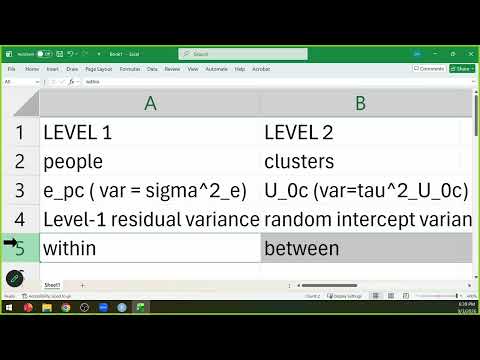
- Hoffman reviews level-one residual variance, commonly represented by sigma squared, and level-two random-intercept variance, represented by the variance of the cluster intercept.
- Within and between labels need a reference unit, such as person or cluster; intra-cluster and inter-cluster describe variation within or across clusters.
- When reporting ICC1, spell out the variance split, for example, 80% between clusters and 20% between people within the same cluster.
- A smooshed effect uses one slope for two relationships: why people differ within clusters and why cluster means differ.
- Examples include employee job satisfaction alongside coworkers’ satisfaction, and a student’s performance alongside the academic context of the school.
- A level-two predictor has ICC1 of 1, while a purely person-level predictor has ICC1 of 0; an intermediate ICC for a level-one predictor signals possible cluster variation and a need to investigate.
- Because level-one samples carry more information and their estimates receive greater weight, a smooshed slope can be pulled toward the within-cluster relationship while misrepresenting the between-cluster effect.
- Hoffman contrasts her view with Raudenbush and Bryk: random-slope variance indicates that predictor effects vary across clusters, but does not explain why.
- For example, schools may differ in the size of gender differences in mathematics, but a random slope alone does not identify why some schools are more egalitarian.
- Random intercepts describe cluster mean differences; random slopes describe cluster differences in predictor effects, creating additional variance components.
- Compute each cluster’s mean of a level-one predictor, repeat that mean on the cluster’s rows, then subtract it from each person’s original value to create a within-cluster deviation.
- A within-cluster deviation of zero means a person is at their cluster average; positive and negative values indicate higher or lower values than peers.
- Center the cluster means at a meaningful reference, such as the grand mean, so the between-cluster coefficient compares clusters above or below the average.
- The two constructed predictors stay in their respective lanes: the person deviation estimates the within-cluster slope, and the centered cluster mean estimates the between-cluster slope.
- Removing a nonsignificant within-cluster predictor while retaining a significant cluster mean can express that cluster differences matter even when individual differences relative to peers do not.
- Hoffman prefers retaining both centered predictors when possible, because omitting the cluster mean makes the within effect’s reference point less clear and complicates plots.
- A faculty member’s teaching revenue can be evaluated relative to colleagues, departments, and colleges, illustrating that effects depend on the comparison level.
- Housing value also illustrates context: an inexpensive home in a wealthy neighborhood may gain value beyond what its own features and age predict.
Transcript excerpt
0:00 ing again. So, thank you for being very diligent on this as well. I was pleasantly surprised at at the level of depth and and conversation that we had in your answers. So, yay. I'm happy. So, all of you got the first question right and then some. So, in a two-level model, what's the point of level two predictors? They explain C cluster variance, random intercept variance. What's the point of level one? It's supposed to explain level one residual variance. However, that's what's coming next is that level one predictors actually can explain both because of the cluster variance that's embedded within them. And that's the tricky part is figuring out how to set all of that up correctly. Um, I had one person ask, is it okay to say that these predictors explain variance? And I know why you're asking that question because
0:47 I went on a rant about how random intercepts do not explain variance. Yes, it is. Okay. Fixed effects explain variance. That is how it works in single level models. That is how it works in multi-level models. That has not changed. Random effects do not explain variance. They make new piles. So yes, we can talk about when you input predictors and you give them fixed slopes, they are explaining variance. The question is what kind? In specifying your model, you have to think carefully about what level of analysis the predictor is at and what its target source of variance is going to be. Um, in terms of fixed versus random, so we've talked about this a little bit in a few different places. Let's say that
1:35 you're um can Jod, can I use the article that you sent me as an example? Okay, so Jod sent me this article where um there
This is the start of the transcript. Save this video free for the whole transcript, searchable and time-coded.
In this course
Related notes
Summary, takeaways, and chapters were generated by AI from the video's transcript and may contain errors. The video belongs to its creator, Lesa Hoffman.