ECO 100 - Lecture 12 - Fall 2026
 Watch on YouTube →
Overview
Matthew Baker introduces market power by contrasting competitive firms, which take the market price as given, with firms that choose price and quantity along a downward-sloping demand curve. Using Elsa’s hair-styling business and a grilled-cheese example, he shows why marginal revenue falls below price and why a monopolist produces where marginal revenue equals marginal cost, resulting in less output, higher prices, and deadweight loss than competition. The lecture closes by setting up questions about monopoly policy, entrepreneurship, patents, and copyright.
Key takeaways
- A firm with market power faces a downward-sloping demand curve, so selling more generally requires lowering the price on every unit, not just the next one.
- In Elsa's example, each styling costs $50; charging $80 for two stylings yields $60 profit, more than the $50 from one styling or $30 from three.
- The profit-maximizing output rule applies to both competitive firms and monopolists: produce while marginal revenue exceeds marginal cost, with the competitive case using price as marginal revenue.
- In the grilled-cheese example, four units at $6 yield $14 profit; the fourth unit adds $3 revenue against $2.50 cost, while the fifth adds only $1 against the same cost.
- A monopolist restricts output relative to competition to maintain a higher price, leaving mutually beneficial trades unmade and creating deadweight loss.
- Market power creates a policy tradeoff: monopoly can harm consumers and reduce total surplus, while entrepreneurs pursuing temporary monopoly positions may generate innovations supported by patent and copyright laws.
Chapters
- Matthew Baker introduces market power and monopoly as an extension of the firm's production decision model.
- Homework 11 and Chapter 11 readings are available, while exam, homework, and attendance grades have been posted on Brightspace.
- The next exam is tentatively planned for November 11, about three weeks away.
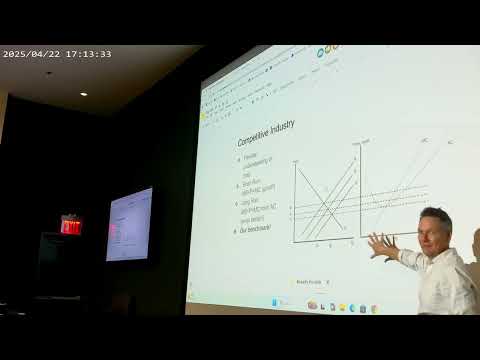
- In the short run, a competitive firm chooses output where market price equals marginal cost and earns positive profit when price exceeds average cost.
- Positive profit attracts new firms, shifting industry supply outward and lowering the market price.
- Entry continues until firms earn zero economic profit, with price equal to marginal cost and average cost in long-run equilibrium.
- In the competitive short run, units are produced when their marginal benefit to consumers exceeds their marginal production cost.
- In the long run, socially justified units are produced at minimum average cost as well.
- Baker uses competition as a benchmark for evaluating markets such as coffee, cell phones, and automobiles.
- Competitive outcomes depend on free entry and exit, many small firms, similar products, and informed firms and consumers.
- Restricted entry, a small number of large firms, differentiated products, or limited consumer information can give firms market power.
- Market power lets firms choose a price and quantity along their demand curve rather than simply accepting a market price.
- Baker models his daughter Elsa charging $100 for one styling, $80 to attract two customers, and $60 to attract three.
- With each styling costing $50 and a competitive price of $60, Elsa would provide three stylings, earning $10 per unit.
- If Elsa's styling is unique, she faces her own downward-sloping demand and must lower her posted price to sell additional appointments.
- At one styling for $100, total revenue is $100, total cost is $50, and profit is $50.
- At two stylings for $80 each, revenue is $160, cost is $100, and profit reaches $60.
- At three stylings for $60 each, revenue is $180, cost is $150, and profit falls to $30, so two stylings maximize profit.
- Marginal revenue is the additional revenue from selling one more unit, calculated as the change in total revenue.
- For Elsa, moving from one styling at $100 to two at $80 raises revenue by only $60, not $80.
- Moving from two stylings at $80 to three at $60 adds only $20 in revenue because the lower price also applies to earlier sales.
- A seller chooses among price-quantity combinations on its demand curve, not an unattainable combination such as high price and high sales.
- Advertising and a reputation for quality can shift demand outward, but the seller still faces a demand constraint.
- Baker defines price discrimination as tailoring prices to customers and discusses gyms, airline tickets, VPN use, and university sticker prices as examples.
- In Baker's haircut schedule, lowering the price from $16 to $14 sells a third haircut and increases total revenue from $32 to $42.
- The third haircut brings in $14, but lowering the price on the first two haircuts costs $4, leaving marginal revenue of $10.
- The example shows why marginal revenue is below price whenever selling another unit requires cutting the price on all units.
- Baker's grilled-cheese demand schedule gives prices from $9 at one unit down to $3 at seven units, with total revenue calculated as price times quantity.
- Each sandwich has a constant marginal cost of $2.50, allowing total cost and profit to be compared across output levels.
- Four units sold at $6 each produce total revenue of $24, total cost of $10, and maximum profit of $14.
- At four grilled-cheese units, marginal revenue is $3 and marginal cost is $2.50, so producing the fourth unit increases profit.
- The fifth unit adds only $1 of marginal revenue against $2.50 of marginal cost, so it would reduce profit.
- The general decision rule is to expand output when marginal revenue exceeds marginal cost and stop where marginal revenue and marginal cost are approximately equal.
- The lecture represents industry supply with marginal cost and adds a marginal revenue curve below the downward-sloping demand curve.
- Unlike a competitive firm, a monopolist faces the market demand curve directly because one firm controls industry sales.
- Baker compares monopoly with competition by imagining that the same production facilities are coordinated under one owner, without changing production technology.
- Competition produces where demand intersects supply, while a monopolist chooses output where marginal revenue equals marginal cost and then sets price from the demand curve.
- The monopoly outcome has a higher price and lower quantity; producer surplus rises while consumer surplus falls.
- The forgone trades between the monopoly quantity and competitive quantity create deadweight loss because consumers would pay more for those units than they cost to produce.
- Baker previews policy responses and the tension between monopoly harms and entrepreneurs seeking temporary market power through innovations protected by patents and copyrights.
Transcript excerpt
0:00 Lecture 12. Let's Let's get it going here at 10:02, our usual starting time with allowance for time for people to settle down. Anyways, so today we're going to start talking about market power and monopoly, which is really our first extension of this model of the firm that we've developed, right? This model really of firm decision-making about how much to produce. And it's kind of exciting. It's in some ways it's also me starting to answer some of those questions that you have about you know, how you determine what the price of your product would be, say, if you were to start a business and all that. It'll also This is I mean, come on. It'll also help us set up a lot of things we talk about later in this
0:48 semester concerning, believe it or not, economic growth, things like that. So, there is a new chapter up on Top Hat. Did I open up the problem set? I think I did. So, there should be a problem set and and some new readings. Okay, yeah, there is. Homework 11 and chapter 11. Oh, the other thing is I did get all of your grades up and posted from both your exam and your homework and your attendance, all that stuff. So, of course, look at it all. Make sure that it's right. I do make mistakes as many of you have observed with the with the grading of the exams. So, check it all over. The one thing that's not up there yet is the market price challenge. That's because I'm trying to do something a little bit
1:35 more interesting with the grading and presentation of that. So, stay tuned and I'll I'll hopefully have something for you on that as well. And people seem to like it, so maybe
This is the start of the transcript. Save this video free for the whole transcript, searchable and time-coded.
Related notes
Summary, takeaways, and chapters were generated by AI from the video's transcript and may contain errors. The video belongs to its creator, Matthew Baker.