CSCD 420 Oct 29 2026
 Watch on YouTube →
Overview
Chris Cain reviews the context-free pumping lemma and demonstrates how to disprove context-freeness for languages including WW, {a^(n!)}, and {a^n b^j : n = j²}. He emphasizes choosing constrained test strings, covering every possible pumping region, and using concrete examples to discover the algebra needed for a proof.
Key takeaways
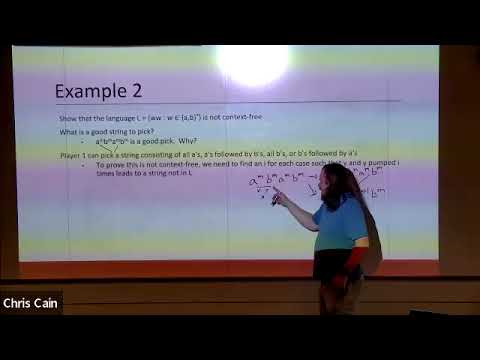
- For a context-free pumping-lemma proof, choose a string whose repeated counts or ordering make any local change detectable, as with a^m b^m a^m b^m for WW.
- When pump placements create many subcases, combine cases that share the same invariant instead of repeating the full proof for each one.
- For {a^(n!)}, pumping changes fewer than m symbols, which cannot bridge the gap from m! to the previous factorial, (m - 1)!.
- For {a^n b^j : n = j²}, moving from j = m to j = m + 1 requires 2m + 1 additional A's and one B, exceeding the pumping-length bound m.
- Concrete substitutions such as m = 3 can expose a numerical pattern; generalize that pattern into algebra before writing the final proof.
- A pumping proof must cover every possible pump location, including regions wholly within one symbol block and regions crossing a boundary.
Chapters
- Students who emailed Chris Cain could submit the current assignment by tonight, with updated work encouraged.
- The next assignment was moved to Thursday because the exam is scheduled for Wednesday.
- Review was planned for Monday or Tuesday, and Cain offered help with CYK data structures and project planning.
- The context-free pumping lemma models grammar recursion rather than a single loop in a DFA.
- A string is divided into five parts: a prefix, the recursive portions, and a terminal segment, with any part allowed to be empty.
- For the language WW, Cain chooses a^m b^m a^m b^m because equal counts and repeated order make the structure easy to disrupt.
- Cain groups similar cases together instead of repeating nearly identical arguments for the two copies of W.
- When the pump region lies entirely within one block of A's, pumping changes one segment without making the corresponding change in the other W.
- Pumping with any i other than 1 creates unequal A or B counts across the repeated halves.
- A pump crossing an A-to-B boundary can contain only A's, only B's, or both, creating several apparent subcases.
- The proof consolidates these cases by tracking how pumping changes the left W compared with the right W.
- For WW, any added or removed characters must be mirrored in both copies, but a local pump cannot guarantee that matching change.
- For the language {a^(n!)}, the selected test string is a^(m!).
- The pumping region contributes k + l A's, with the pumping-length constraint keeping that change below m.
- Pumping down cannot reach the previous factorial: subtracting fewer than m characters from m! leaves a value greater than (m - 1)!.
- For {a^n b^j : n = j²}, Cain selects a^(m²)b^m so the two symbol counts directly encode the square relationship.
- The order constraint, all A's before all B's, leaves few useful test-string choices.
- Pumping only A's or only B's changes one count while leaving the other fixed, immediately violating n = j².
- The difficult case has the pump portions in both symbol blocks, so pumping changes A and B counts together.
- Moving from m to m + 1 B's requires the A count to rise from m² to (m + 1)², a difference of 2m + 1 A's, plus one B.
- That required change exceeds the pumping-region bound of m, so the mixed pump cannot reach the next valid pair.
- Cain also works through the algebra for pumping down and stresses that the all-A, all-B, and mixed cases together cover every pump placement.
- Cain recommends substituting small values such as m = 3 and comparing the work needed to reach m = 4.
- The pattern of square differences, 1, 3, 5, 7, reveals that consecutive squares differ by odd numbers.
- A useful proof workflow is to instantiate the problem, identify the recurring pattern, generalize it, and then express it with variables.
- A student questions the signs in the expansion of (m - 1)², prompting Cain to clarify which A's and B's are removed.
- Pumping up is also valid and can make the need for 2m + 1 additional A's easier to explain.
- An English argument can be sufficient if it explains why the next square requires more characters than the pumping bound allows.
- Cain previews pumping lemmas for linear languages, which correspond to deterministic pushdown automata rather than nondeterministic pushdown automata.
- The class will discuss their structure but will not use them for assignments or exams.
- The pumping-lemma unit is essentially complete, with remaining practice available through assignments, exam preparation, and office hours.
Transcript excerpt
0:00 Do the next. So despite the fact there are only nine people in this classroom, it's time for us to get started. Yeah, we have less than half the class combined between in-person and online. That's interesting. >> All of us were enjoying the online classroom as well. That's half the class. >> No. >> No? >> No. Oh, you got like if combined between the two versions of you, the the version of you that's here and the version of you that's there counted as separate people, then we would have half the class. >> Oh, okay. >> All right. So last time, I guess I should start with some announcements. Assignment was technically due last night, but I received lots of emails
0:47 that I responded to. People who want to submit by tonight can absolutely do so. I just requested that people send me that email. So if you sent me an email, great. You can submit by tonight. If you think there's some work that you could still do to improve your assignment, send me an email today and submit an updated version by tonight. I would rather see your best work. >> Yeah. >> Oh, that is fine as well. I just basically want people to be able to submit by tonight if that could improve the quality of your submission. We'll get that next assignment up soon. I've already talked to the grader about it not being due next Wednesday, but next Thursday because we have the exam next Wednesday. So anticipate not having an exam and an
1:36 assignment on the same day, but please do not wait to start that assignment until after the exam. That will not go so well. So prioritize both, but the exam will happen. You'll have a little bit of time
This is the start of the transcript. Save this video free for the whole transcript, searchable and time-coded.
Related notes
Summary, takeaways, and chapters were generated by AI from the video's transcript and may contain errors. The video belongs to its creator, Chris Cain.