CSCD 420 Oct 05 2026
 Watch on YouTube →
Overview
Chris Cain reviews DFA minimization using a state-pair table, showing how finality differences and transition lookups identify distinguishable states, then how equivalent states can be merged by redirecting transitions. He introduces regular expressions through union, concatenation, and Kleene star, connecting expressions such as (A + BC)* to generated languages, recursive enumeration, and set notation.
Key takeaways
- DFA table filling starts by marking state pairs with different finality, then propagates distinguishability backward whenever a symbol sends a pair to an already marked pair.
- An unmarked state pair is equivalent only after a complete pass through the table produces no new distinguishability marks.
- Merging equivalent DFA states preserves behavior by redirecting every incoming transition from the deleted state to its equivalent state.
- In regular-expression notation, plus means union, concatenation joins strings in order, and Kleene star allows zero or more repetitions, including the empty string.
- The expression (A + BC)* generates every finite sequence of A or BC blocks, a language that can be visualized as a recursive branching tree.
- Enumerating strings from a regular expression can confirm membership when a target string eventually appears, but endless enumeration alone cannot confirm nonmembership.
Chapters
- Chris Cain offers office hours after class and availability later in the afternoon for homework help.
- The next assignment is due Wednesday; the exam is pushed back one week, with a study guide planned for Friday.
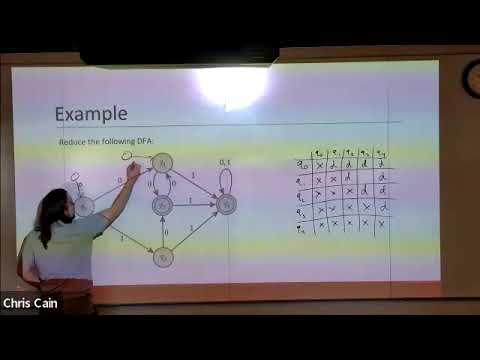
- Cain repeats the DFA minimization example because students requested a slower, more detailed walkthrough.
- The example uses states Q0 through Q4 and a half-table containing each unique pair.
- Diagonal cells and the unused half of the table are omitted because they duplicate pairs or compare a state with itself.
- The first pass marks pairs with different finality as distinguishable, such as Q0 and Q2.
- For each unmarked pair, follow an alphabet symbol from both states, then look up the destination pair in the table.
- Q0 and Q1 transition on 0 to Q1 and Q2; since Q1 and Q2 are marked distinguishable, Q0 and Q1 are distinguishable too.
- Once a pair is proven distinguishable, no other alphabet symbols need to be checked for that pair.
- Each new table pass detects pairs distinguishable by strings one symbol longer than the previous pass.
- Q1 and Q3 remain unmarked because both transitions lead to matching destinations, Q2 on 0 and Q4 on 1.
- When a full pass makes no new marks, the remaining unmarked pairs are indistinguishable.
- To merge Q1 with Q3, delete Q1 and redirect its incoming transitions, including Q0 on 0, to Q3.
- Cain offers equivalence classes as an alternate way to interpret groups of indistinguishable states in the table.
- A new exercise presents transitions as a list rather than a diagram; for example, Q0 on A transitions to Q2.
- The class begins reconstructing the DFA from its transition list before minimizing it.
- The transition-list exercise leaves the final state unclear, so the class tests Q3 and then Q2 as the final state.
- With Q3 final, every pair involving Q3 is immediately distinguishable, while Q0 and Q1 both transition to Q2 on A and B.
- When Q2 is tested as final, Q0 and Q1 still merge; pairs involving Q3 remain distinguishable.
- The exercise yields the same sole equivalent pair, Q0 and Q1, under either Q2 or Q3 as the final state.
- Cain introduces regular expressions as a way to describe patterns for text searches, such as three digits, a dash, and four digits in a phone number.
- The same regular-language framework used for formal language theory also applies to practical text search.
- Cain notes that games such as Path of Exile use regular-expression-like filters to find items by properties such as affixes and socket layouts.
- The notation uses plus for union, a dot for concatenation, and superscript star for zero or more repetitions.
- Parentheses group a substring so that star applies to the whole group rather than just the nearest symbol.
- The example (A + BC)* describes zero or more repetitions, each choosing A or BC, and includes the empty string through zero repetitions.
- For (A + BC)*, strings can be constructed by repeatedly appending either A or BC, producing examples such as A, BC, AA, ABC, and BCBC.
- The construction can be represented as a branching tree, with each step choosing A, BC, or termination.
- Cain connects the tree to recursive subroutines and explains that breaking a complex expression into components helps define a systematic generation process.
- The primitive expressions include the empty set, the empty string lambda, and individual alphabet symbols; union, concatenation, and star build more complex expressions.
- A regular expression denotes a language, the set of strings it can generate, and each string either belongs to that language or does not.
- Cain breaks an expression into component languages to create an iteration procedure; for A*(A + B), this generates any number of As followed by A or B.
- Enumeration can eventually find a particular string that is in the language, but it cannot establish that a string is absent merely by running indefinitely.
Transcript excerpt
0:01 Hello and welcome back to week three. [clears throat] How's the homework going? Kind of wanted to check in on how how we're feeling about the homework. I will have office hours for an hour after class. And I'll also surprise it. We'd be available for most of the afternoon. So feel free to just swing by. You don't need to email me if there's something going on. You can't make it to this hour of office hours. This hour of office hours. I will give you everything that you need. just slowly on by and I'll do what I can to help you out. So, we have our next assignment due on Wednesday. I'll get you a study guide by Friday for an exam that we're going to be taking a week from Friday. That is pushed back a week from what was on the syllabus, but I think the extra time will be important given that otherwise you would not have the turnaround of the
0:50 material that would have been on the exam. And I don't want to do that to you. I'd rather have you get feedback on your submissions for both of that materials before you take an exam on it. I also wanted to query the class who wants to go over this example again. I know we had this gone over last time, but given some of the conversations that I've had after class with people, it seemed like just a little bit more since I had what 10 minutes. I kind of rushed it last time. So I completely understand if people would like to see a little bit more slower drawn out version of going over this example. So I guess show of hands who would would like that. I think that's enough people that I
This is the start of the transcript. Save this video free for the whole transcript, searchable and time-coded.
Related notes
Summary, takeaways, and chapters were generated by AI from the video's transcript and may contain errors. The video belongs to its creator, Chris Cain.