CSCD 420 Oct 06 2026
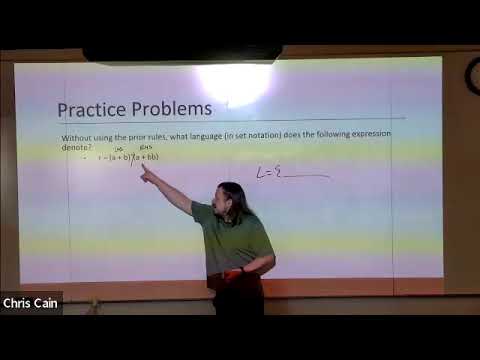 Watch on YouTube →
Overview
Chris Cain teaches regular-expression precedence and construction, then connects regular languages to regular grammars and finite automata. The class practices describing languages such as strings with at least one `00` or no consecutive zeros, and explains how to show a language is regular by constructing a DFA, NFA, or regular expression.
Key takeaways
- Regular-expression precedence is star closure before concatenation before union, matching the familiar order of exponentiation, multiplication, and addition.
- The expression `(0+1)*00(0+1)*` describes exactly the binary strings containing at least one pair of consecutive zeros.
- For binary strings with no `00`, repeating blocks `1` or `01` and optionally appending a final `0` covers valid strings without introducing adjacent zeros.
- A language is regular if it can be represented by a DFA, an NFA, or a regular expression; a construction must accept every string in the language and reject strings outside it.
- A regular grammar must consistently be either right-linear or left-linear, with at most one non-terminal in each production.
- To convert a right-linear grammar into an automaton, use non-terminals as states, split multi-terminal productions with intermediate states, and route terminal-only productions to a final state.
Chapters
- The assignment is due the next day, and Chris Cain encourages students to request help during office hours or arrange another time.
- Regular-expression operations follow the order star closure, concatenation, then union, analogous to exponentiation, multiplication, then addition.
- Concatenation may be written without a dot, so `R1R2` means the same as `R1 · R2`.
- For a practice expression, the class identifies a repeatable prefix built from `A` or `B`, followed by either `A` or `BB`.
- The empty string is the length-zero prefix; extending each prefix with both suffix choices generates the language systematically.
- Recursive generation rules help enumerate an infinite language without listing every string.
- A regular expression with repeated `AA` pairs describes an even number of `A`s, including zero.
- A required `B` followed by repeated `BB` pairs describes an odd number of `B`s.
- The resulting language consists of an even number of `A`s followed by an odd number of `B`s.
- To require at least one pair of consecutive zeros, place the literal `00` between arbitrary binary prefixes and suffixes.
- The expression `(0+1)*00(0+1)*` allows any number of `0`s or `1`s on either side of the required pair.
- The arbitrary prefix and suffix are each represented using star closure over the binary alphabet.
- The class reverses the previous constraint: accepted binary strings must contain no consecutive zeros.
- The empty string and the one-character string `0` are valid, so a solution must account for both.
- A first construction based on pairing each `0` with a following `1` misses strings made entirely of ones and strings ending in zero.
- The class tests proposed expressions against edge cases, especially the empty string, all-one strings, and strings ending in `0`.
- One valid construction repeats blocks of `1` or `01`, then optionally appends a final `0`; this prevents adjacent zeros.
- Chris Cain also shows a longer, less tidy construction and emphasizes that distinct expressions can denote the same language.
- Every regular expression denotes one regular language, and every regular language has at least one corresponding regular expression.
- To show a language is regular, construct a DFA, NFA, or regular expression and explain why it accepts all and only the strings in the language.
- An NFA can be built from a regular expression, while paths through an NFA can be used to derive an expression; cycles make the reverse conversion more involved.
- Grammar terminals are alphabet symbols, while non-terminals represent structures that are expanded into terminals and other non-terminals.
- A right-linear production has a string of terminals followed by at most one non-terminal, or only terminals.
- A left-linear production places its single non-terminal before the terminal string; one grammar cannot mix left-linear and right-linear rules.
- A grammar is right-linear when its non-terminal appears at the end of each applicable production, and left-linear when it appears at the beginning.
- The class derives a terminal string by repeatedly replacing non-terminals according to grammar rules until none remain.
- A grammar containing both a right-linear rule and a left-linear rule is not a regular grammar, even if each individual rule fits one form.
- Create an automaton state for each grammar non-terminal, designate the start-symbol state as initial, and add a separate final state.
- A production such as `B0 → aB1` becomes an `a`-labeled transition from state `B0` to state `B1`.
- A production containing multiple terminals, such as `B1 → abB0`, requires an intermediate state so each automaton edge consumes one character.
- A terminal-only production such as `B1 → b` becomes a transition on `b` from `B1` to the final state.
Transcript excerpt
0:02 Start with I want to start by saying I have seen a frighteningly few people in my office hours so far for this assignment. I don't quite know what that means but >> I haven't seen many people but I pointing to your office you had left the entire time. I had a meeting scheduled that was not technically my office hours. >> It comes out here and it's I I try to be available during that time when I when I can. Yes. But I expect that these problems are a bit more difficult and that there are most of you can probably use a nudge here or there. So again, I absolutely welcome it.
0:52 Please do feel free to stop by. If the hour that is right after this class doesn't work for you, let me know a time that does and I will try to make that happen. And these are these are not easy problems. If you think you have an easy answer to a good chunk of these, then there's probably something that you are missing and I will be happy to help you figure that out. Last time we started covering regular expressions. So I guess I should also mention that the assignment is due tomorrow. So it's time to ramp that up, get those questions in. We started talking about regular expressions and we got a little ways into that. We talked about the construction rules. We talked about primitive regular expressions and how those primitive
1:38 regular expressions could be combined into more complicated regular expressions via union rules, concatenation rules, star closure rules. But we might find at some point that we need to define precedence of these operations because just like with math if you don't have parentheses then you might have ambiguity if you
This is the start of the transcript. Save this video free for the whole transcript, searchable and time-coded.
Related notes
Summary, takeaways, and chapters were generated by AI from the video's transcript and may contain errors. The video belongs to its creator, Chris Cain.