CSCD 420 Oct 02 2026
 Watch on YouTube →
Overview
Chris Cain updates the CSCD 420 exam timeline, demonstrates the Canvas automata builder, and reviews how subset construction converts NFAs into equivalent DFAs. The class then develops DFA minimization using distinguishable-state pairs, reducing a six-state example to three states by removing an inaccessible state and merging equivalent states.
Key takeaways
- Subset construction represents each DFA state as a set of NFA states; with n NFA states, the DFA can have at most 2^n states.
- In subset construction, a DFA subset is accepting whenever it contains at least one accepting NFA state, and the empty subset serves as a trap state when reached.
- The classroom conversion from a three-state NFA produces seven reachable DFA states, one fewer than the maximum of eight because subset Q0,Q2 is never reached.
- A DFA state pair is distinguishable if some continuation string gives different acceptance outcomes; a single such string is enough to prove the pair cannot be merged.
- The table-filling minimization algorithm begins by marking pairs with different finality, then propagates marks backward through transitions until a pass makes no changes.
- The six-state minimization example drops inaccessible Q5 and merges equivalent Q1 and Q3, leaving a three-state DFA.
Chapters
- The first exam is pushed back one week; Chris Cain plans to release its study guide one week before the exam.
- The Canvas Modules area contains the Automata Builder, where students can create DFA, NFA, PDA, and DPDA diagrams.
- The builder supports diagram export and upload, test-case suites, and step-by-step debugging; students should not share completed diagram files.
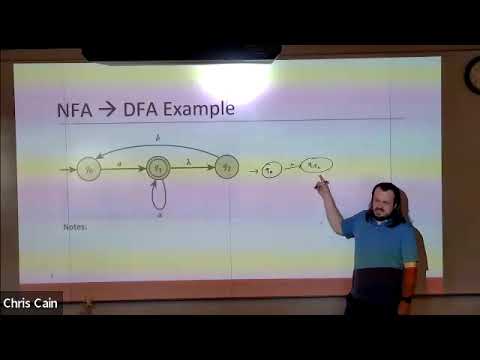
- The conversion starts with the set of NFA states reachable from the start state without consuming input, including any lambda transitions.
- For each input symbol, collect every possible destination state and represent that set as one DFA state.
- A DFA state is accepting if its set contains at least one accepting NFA state; an empty destination set becomes a looping trap state.
- The worked example creates a combined Q1,Q2 state and completes transitions for both A and B.
- The class applies the same subset-construction process to another NFA, beginning with Q0 as the only state reachable without input.
- Students work through the reachable state combinations and discuss why a DFA needs a transition for every alphabet symbol.
- Unlike an NFA, a DFA must have a total transition function, so missing destinations require an appropriate state.
- From Q0, reading 0 reaches the subset Q0,Q1, while reading 1 reaches Q1.
- Continuing the construction produces accepting subsets Q0,Q1,Q2 and Q1,Q2, plus non-accepting Q2 and the empty-set trap state.
- The completed DFA has seven states out of a possible 2^3 = 8; the missing subset is Q0,Q2.
- The construction includes reachable states even if they may later be removable through DFA minimization.
- The algorithmic notation expresses the same subset-construction steps used in the two classroom examples.
- Only subsets reachable from the initial DFA state need to be generated; unreachable combinations do not need to appear.
- DFA minimization can help simplify later problems that require reasoning backward from an automaton.
- Fewer DFA states generally reduce storage requirements and can make processing input more efficient.
- The example DFA has six states, but Q5 is inaccessible and can be removed immediately.
- Q1 and Q3 have equivalent behavior and can be represented by Q2 and Q4, reducing the automaton to three states.
- The example shows why visual inspection alone can miss equivalent states whose behavior is encoded through different paths.
- Two states are indistinguishable when every possible continuation string leads from both states to the same acceptance result.
- States are distinguishable if at least one string leads to acceptance from one state and rejection from the other.
- Minimization searches for distinguishable pairs first; pairs left unmarked after the procedure are indistinguishable and can be merged.
- Before comparing pairs, remove inaccessible states by exploring reachable states from the start state.
- The half-table records each unordered pair of states once, avoiding duplicate comparisons such as Q1,Q2 and Q2,Q1.
- The first pass marks any pair with different finality, since the empty string already distinguishes those states.
- For the five-state example, pairs including one accepting and one non-accepting state are marked immediately.
- For each unmarked pair, compare the states reached on each alphabet symbol, here 0 and 1.
- If a transition leads to a pair already marked distinguishable, mark the original pair as distinguishable as well.
- The example marks Q0,Q1 and Q0,Q3 by following a 0 transition to the already distinguished pair Q1,Q2.
- Q1,Q3 remains unmarked because both states transition to the same destinations on 0 and 1; repeated passes continue until no new pairs are marked.
- When the table reaches a pass with no new marks, the remaining pair Q1,Q3 is proven indistinguishable.
- Delete either Q1 or Q3, redirect every incoming transition to the retained equivalent state, and remove the deleted state's outgoing edges.
- The instructor chooses to remove Q3 in the worked example, yielding an equivalent three-state DFA.
- The class closes with questions about the table method and follow-up office-hour help.
Transcript excerpt
0:06 promised you all an update this morning about exam timelines and we are going to push things back a week just by the nature of where we are where we need to be for that first exam and the feedback that I want to get to everybody. So I will get you a study guide for the first exam a week from today for an exam that will take place two weeks from today. That is not what was originally on the syllabus. But if anyone has a significant desire to take that exam next week instead of in two weeks, I'll hear your argument. But I expect crickets. That's what I thought. So I'm not going to push back further exams. So currently the plan would be to take exams on weeks four, six, nine, and
0:54 and finance. I wanted to show you what the tool is that you'll be using to build automa. So I'm in our canvas. I'm in the modules. So the same place where you see our lecture videos. So where you go to join zoom or see the lecture recordings on my YouTube channel. The tools that you can use. jade lab since I haven't mentioned that in here is also an automa builder that was built by students of the authors of our textbook but the tool that was built with an actual software engineering workflow in mind is the automa builder link so if we go to that it will take us to this page
1:44 with four of the automa types that we will be building in this class we've talked about DFAs and NFAs the first two links here and we will talk about PDAs and DPDAs and NPDAS later on in the course. But if we try to build a DFA from here, we can see that
This is the start of the transcript. Save this video free for the whole transcript, searchable and time-coded.
Related notes
Summary, takeaways, and chapters were generated by AI from the video's transcript and may contain errors. The video belongs to its creator, Chris Cain.