CSCD 420 Oct 19 2026
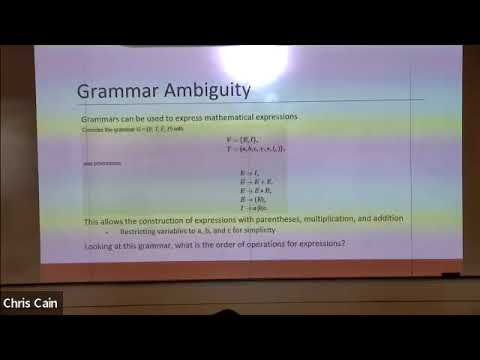 Watch on YouTube →
Overview
Chris Cain reviews context-free grammars and shows how separate nonterminals for expressions, terms, and factors encode mathematical precedence, with parentheses permitting explicit overrides. The lecture connects ambiguity to parsing difficulty, demonstrates a context-free language built from a union of matching-count conditions, introduces Backus-Naur Form (BNF) for programming-language syntax, and distinguishes grammar-based syntax checks from semantic checks such as type checking.
Key takeaways
- Use separate grammar levels for expressions, terms, and factors to encode precedence: addition belongs at the expression level, multiplication at the term level, and parentheses at the factor level.
- A single string with two parse trees proves grammar ambiguity, but proving unambiguity requires excluding multiple parse trees across an infinite set of possible strings.
- The language formed by strings where either A and B counts match or B and C counts match has overlap when all three counts match, producing two derivations for those strings.
- Ambiguity makes membership parsing harder because the parser may need to explore branching production choices; the lecture warns that such exploration can grow exponentially.
- Context-free grammars describe programming-language syntax, but they cannot enforce semantic constraints such as compatible types; compilers need a separate semantic-analysis stage.
Chapters
- Exam 2 is planned for the end of the following week, with a study guide expected Friday; Chris Cain may shift the date if needed.
- The pumping lemma assignment is described as the hardest so far, with some problems that can take 5 to 8 hours without a useful starting hint.
- Exam grades are expected by Friday at the latest, and students are encouraged to raise grading concerns so Cain can explain or reconsider them.
- Unlike regular grammars, context-free grammars do not require left-linear or right-linear productions.
- Context-free productions can recurse in the middle and include multiple nonterminals, enabling structures beyond the restrictions of regular grammars.
- A grammar can remain ambiguous even when derivations are evaluated consistently left to right or right to left, if one string has multiple parse trees.
- A grammar that uses the same expression nonterminal for addition, multiplication, parentheses, and negation does not encode which operator binds first.
- Without precedence built into the grammar, the expression parser cannot know whether to combine a plus or multiplication first.
- Parentheses can override precedence, but they do not resolve the ambiguity of unparenthesized expressions by themselves.
- The revised grammar separates expressions, terms, and factors, with addition at the expression level and multiplication at the term level.
- A factor can represent a parenthesized expression, which allows addition to occur before multiplication when the input explicitly groups it.
- For an unparenthesized expression such as A + B * C, the layered productions force B * C to form as a term before it combines with A.
- To prove a grammar is ambiguous, it is enough to find one string with two distinct parse trees.
- Proving a grammar unambiguous requires ruling out multiple parse trees for every string in its potentially infinite language.
- Grammar equivalence also requires comparing the generated strings in both directions; Cain notes that no general algorithm decides equivalence for all context-free grammars.
- The example language is the union of strings with equal numbers of A's and B's followed by an independent number of C's, and strings with independent A's followed by equal numbers of B's and C's.
- A string with equal counts of A, B, and C satisfies both parts of the union, creating two possible derivations.
- Cain uses the example to distinguish ambiguity caused by a particular grammar from ambiguity inherent in the language itself.
- Students construct separate grammars for the two sides of the union, then combine them with a start production that branches to either side.
- The A-count/B-count case requires separate nonterminals to prevent C's from appearing between the A's and B's.
- The construction illustrates a divide-and-combine approach: solve each language component first, then assemble the overall grammar.
- For the input AAABBCC, the first A does not reveal whether to choose the grammar branch matching A's with B's or the branch matching B's with C's.
- An ambiguous parser may have to explore many production choices, potentially creating an exponential search as ambiguity branches across the input.
- The string AⁿBⁿCⁿ also has two derivations in the example grammar because it satisfies both matching-count conditions.
- Backus-Naur Form uses angle-bracketed names such as <expression>, <term>, and <factor> for nonterminals, while symbols such as + and * are terminals.
- The BNF notation :: = expresses productions in the same way as an arrow in the classroom grammars.
- A while-loop production can use the terminal keyword while followed by an expression and a statement, describing the expected structure of a legal construct.
- A grammar can confirm that a declaration, variable name, assignment operator, and expression appear in a valid syntactic order without determining whether the assignment makes sense.
- Type clashes require semantic analysis, not context-free grammar rules; runtime errors such as an infinite loop are also beyond a syntax check.
- The next topic is membership: designing an algorithm to decide whether a string belongs to a language, which will also motivate the first project, expected to last about two weeks.
Transcript excerpt
0:00 Good morning. Hey, it's time to get started. Welcome back from the first exam. How did it go? It happens. Excellent. I happen to be buying a present for my memory. So, typically in this class we have exams on weeks 3, 6, 9 and finals week. And we pushed this back to week four. The plan at at the moment is still to have our second exam at the end of next week. So, that means that there will be a study guide coming your way on Friday. I, as always, reserve the right to change that and push it back a week if needed, but I'm going to try not to. And we'll see how
0:47 how things go. There is a pumping lemma assignment. This is probably the hardest assignment so far. There with There There are a few very tricky problems on there that are a little bit more complicated than they look from just the problem definition. So, feel free to swing by. I'm happy to help you get started on those. I can give you a nudge that will take what might be a 5-hour problem or 8-hour problem and turn it into a 1-hour problem. Any questions on schedule? Yeah. >> Do you know the time for the exam three?
1:34 >> Yeah, I just handed them off to the grader who was back from his bout of COVID. So, he did all of the assignment grading with COVID. If you have any questions or concerns about the grading, I'm happy to hear them. Grades, as all my classes, are not final unless or until you don't say anything to me. So, if you feel like something was unfair or if there was something that I said or something that feels unfair, please bring it to my attention. I would rather
This is the start of the transcript. Save this video free for the whole transcript, searchable and time-coded.
Related notes
Summary, takeaways, and chapters were generated by AI from the video's transcript and may contain errors. The video belongs to its creator, Chris Cain.