CPBS 7620 - Lecture 8 - Four Subspaces
 Watch on YouTube →
Overview
Nicholas Dwork proves the rank-nullity theorem for an m-by-n real matrix A by extending a basis of null(A) to a basis of R^n and showing that the images of the added basis vectors form a basis for image(A). He then derives the four fundamental subspaces and their orthogonal direct-sum relationships, establishing that rank(A) equals rank(A^T).
Key takeaways
- Extending a null-space basis of A to a basis of R^n leaves n minus nullity(A) vectors whose images form a basis for image(A).
- For every real m-by-n matrix A, rank(A) + nullity(A) = n.
- The left null space is the orthogonal complement of the column space: null(A^T) = image(A)⊥.
- The null space is the orthogonal complement of the row space: null(A) = image(A^T)⊥.
- The four fundamental subspaces form two orthogonal direct sums: R^n = image(A^T) ⊕ null(A) and R^m = image(A) ⊕ null(A^T).
- The direct-sum decomposition of R^n and rank-nullity together prove that rank(A) equals rank(A^T).
Chapters
- For an m-by-n matrix A, rank(A) is the dimension of image(A), while nullity(A) is the dimension of null(A).
- Nicholas Dwork extends a basis v1 through vk of null(A) to a basis v1 through vn of R^n.
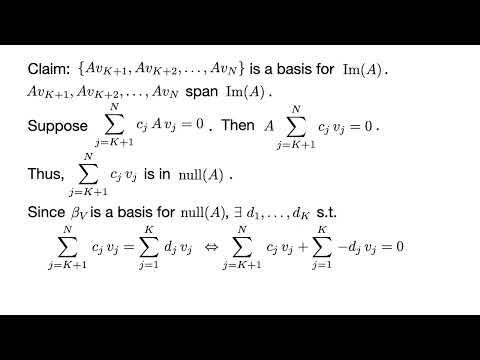
- The vectors Av(k+1) through Avn span image(A), and their linear independence follows from the independence of the extended basis.
- There are n minus k image-basis vectors, so rank(A) + nullity(A) = n.
- A direct sum U = V ⊕ W requires U = V + W and V ∩ W = {0}; its dimensions add.
- For a subspace V of R^n, R^n = V ⊕ V⊥, where V⊥ contains vectors perpendicular to every vector in V.
- A vector y lies in null(A^T) exactly when it is perpendicular to every column of A, giving null(A^T) = image(A)⊥.
- Applying that identity to A^T gives null(A) = image(A^T)⊥.
- The domain decomposes as R^n = image(A^T) ⊕ null(A), with the row space perpendicular to the null space.
- The range space decomposes as R^m = image(A) ⊕ null(A^T), with the column space perpendicular to the left null space.
- Because dimensions add in the first decomposition, n = rank(A^T) + nullity(A).
- Comparing that equation with rank-nullity, n = rank(A) + nullity(A), yields rank(A) = rank(A^T).
Transcript excerpt
0:00 Hi, I'm Nicholas Twork and in this lecture we'll discuss the four subspaces. Let A be a real matrix of size m by n, that is m rows and n columns. Recall that the rank of A is the dimension of the image of A. Also said, it's the dimension of the column space of A. And the nullity of A is the dimension of the null space of A. This picture shows the domain and range of A. On the left side is the domain Rn, on the right side is the domain Rm. Both Rn and Rm have an origin of course, denoted by this black dot. And the null space of A is a subspace of its domain, whereas the image of A is a subspace of its range. Remarkably, the rank and the nullity of A, even though they're related to the
0:46 domain and the range, have a very simple relationship which we're going to identify now. Let beta sub V equal to V1, V2 up to VK be a basis for the null space of A. We can extend this set to be a basis for all of Rn. So beta sub n is the set of the vectors from beta sub V along with V sub K plus 1, V sub K plus 2 up to V sub n. We will now show that AV sub K plus 1, AV sub K plus 2 up to AV sub n is a basis for the image of A. How do we show that? We show that these vectors span the image and that they're linearly independent. So we're going to prove the claim that the set AV sub K plus 1, AV sub K plus 2
1:36 up to AV sub n is a basis for the image
This is the start of the transcript. Save this video free for the whole transcript, searchable and time-coded.
Related notes
Summary, takeaways, and chapters were generated by AI from the video's transcript and may contain errors. The video belongs to its creator, Nicholas Dwork.