CPBS 7620 - Lecture 6 - Vectors
 Watch on YouTube →
Overview
Nicholas Dwork develops vectors as both directed arrows and lists of real numbers, showing how geometric operations correspond to component-wise arithmetic. He builds from vector length, scaling, linear independence, and dot products to derive the angle, perpendicularity, projection, and Cauchy-Schwarz relationships, then explains matrix-vector multiplication as row-wise dot products or a linear combination of columns.
Key takeaways
- A vector can be represented either as a directed arrow or as a list of real coordinates, allowing geometric operations to be computed through component-wise arithmetic.
- The Euclidean length of an n-dimensional vector is √(A₁² + … + Aₙ²), and dividing a nonzero vector by its length produces a unit vector.
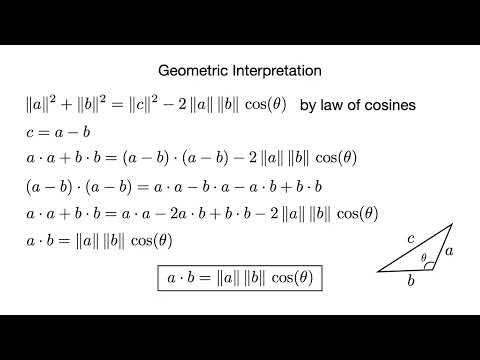
- The dot product satisfies A · B = ||A|| ||B|| cos θ, which makes perpendicularity equivalent to A · B = 0.
- Projecting A onto nonzero B produces the vector ((A · B) / ||B||²)B.
- Cauchy-Schwarz, |A · B| ≤ ||A|| ||B||, follows directly from the dot product’s angle formula and the bound on cosine.
- Matrix-vector multiplication can be interpreted as taking row-wise dot products or as forming a linear combination of the matrix’s columns using the vector’s entries as coefficients.
Chapters
- Vector addition uses the tip-to-tail rule; with coordinates, addition and negation become component-wise operations.
- The arrow with coordinates (2.7, -2) has length √(2.7² + (-2)²), approximately 3.36.
- Scalar multiplication scales each component: multiplying (2, 1.9) by 2 produces (4, 3.8).
- For an n-dimensional vector, length is the square root of the sum of its n squared components; a unit vector in the direction of A is A divided by its length.
- A linear combination of vectors A₁ through Aₖ has the form x₁A₁ + … + xₖAₖ, with real-number coefficients; vectors are linearly independent when only all-zero coefficients produce the zero vector.
- The dot product multiplies corresponding components and sums them; A · A equals the squared length of A.
- The dot product distributes over vector addition and is commutative for real vectors.
- Using the law of cosines, Dwork derives A · B = ||A|| ||B|| cos θ, so two vectors are perpendicular exactly when their dot product is zero.
- The projection of A onto B is ((A · B) / ||B||²)B, found by combining its scalar length with the unit vector in B’s direction.
- The geometric dot-product formula yields the Cauchy-Schwarz inequality: |A · B| ≤ ||A|| ||B||, since |cos θ| ≤ 1.
- A matrix multiplied by a vector computes the dot product of each matrix row with that vector, producing a vector of results.
- Equivalently, if a matrix has columns A₁ through Aₙ, multiplying it by W gives W₁A₁ + … + WₙAₙ; an element of ℝᵐˣⁿ is an m-row by n-column array of real numbers.
Transcript excerpt
0:00 Hi, I'm Nicholas Twork and in this lecture we're going to discuss vectors. Consider an arrow, a directed line segment. We'd like an arithmetic of arrows. We'd like to be able to add these things and subtract them. Let's see what we can do. Well, here's two arrows and we can define an addition geometrically by tip to tail. That is, you put the end of one arrow onto the tip of the other and then you look at the net arrow. You go from the tail of the first to the tip of the second. This is arrow addition. We can impose a coordinate system on our arrows and then we can say that this arrow has X and Y coordinates. In particular, this has a X coordinate of 2.7 and Y coordinate of -2. And so if someone were to give you the
0:48 coordinate 2.7 and -2 and they were to give you a piece of paper with this coordinate system drawn on it, you could then draw the arrow. So a list of numbers just became identical to this geometric object of arrow. And so now we can reason about vectors by reasoning about lists of numbers instead. That's convenient because computers can store lists of numbers whereas they cannot store geometric objects like arrows. We can ask, what is the size of this arrow? To figure this out, we recognize that this arrow generates a triangle, this triangle here. We see that the base has a length of 2.7 and the height has a length of two with a direction of down. And then we can use Pythagorean's theorem. 2.7 squared plus -2 squared all square rooted is the length of the
1:37 arrow. We denote the length with these double bars and sometimes we'll put a subscript two
This is the start of the transcript. Save this video free for the whole transcript, searchable and time-coded.
Related notes
Summary, takeaways, and chapters were generated by AI from the video's transcript and may contain errors. The video belongs to its creator, Nicholas Dwork.