CPBS 7620 - Lecture 2 - Functions
 Watch on YouTube →
Overview
Nicholas Dwork defines functions as mappings specified by a domain, a range, and input-output pairs, then develops image, pre-image, identity, composition, and inverse. He explains that a function is invertible exactly when it is both one-to-one and onto, illustrates how the choice of range affects that property with square-root functions, and closes with binary operations, functionals, and systems.
Key takeaways
- A function is determined by its domain, range, and ordered input-output pairings; its image contains only the range elements actually reached.
- The notation f⁻¹(B) means the pre-image of a set B, whereas f⁻¹ applied to an element denotes an inverse function when that inverse exists.
- Invertibility is equivalent to being both one-to-one and onto, which provides a way to establish an inverse without first calculating its formula.
- The same rule can change from non-onto to bijective when its range is adjusted: √x from non-negative inputs to all real outputs is not onto, but √x with non-negative outputs is onto and one-to-one.
- A binary operation on A must take two elements of A and return an element of A; real addition also stays within the non-negative numbers when restricted to that subset.
Chapters
- Dwork illustrates a function with f(x) = 2x + 1: inputs 3, 0, and π produce outputs 7, 1, and 2π + 1.
- A function is specified by its name, domain, range, and a set S of ordered input-output pairs, with each domain element assigned an output.
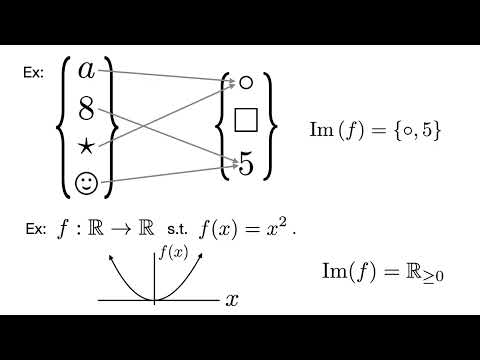
- The image is the set of outputs actually reached, so it can be smaller than the range; for f(x) = x² from the real numbers to the real numbers, the image is the non-negative real numbers.
- Functions can map non-numeric sets: A, 8, star, and a smiley can map to circle or 5.
- The pre-image f⁻¹(B) collects domain inputs whose outputs belong to a selected range subset B; the notation denotes a pre-image when applied to a set.
- The identity function maps every domain element x to itself, while composition g∘f applies f first and then g, mapping from A through B to C.
- An inverse function maps outputs back to inputs, with f∘f⁻¹ and f⁻¹∘f both equal to the identity; not every function has an inverse.
- The superscript −1 is context-dependent: f⁻¹(B) is a pre-image, while applying f⁻¹ to an element means using the inverse function.
- A function is onto, or surjective, when its image equals its range; it is one-to-one when equal outputs imply equal inputs.
- A function is invertible if and only if it is both one-to-one and onto; for f(x) = 2x + 1, the inverse is f⁻¹(y) = (y − 1)/2.
- The square-root function from non-negative numbers to real numbers is not onto, but changing its range to non-negative numbers makes it a bijection.
- A binary operation maps A × A to A; real-number addition is closed on the non-negative numbers because adding two such numbers returns another non-negative number.
- A functional returns a number from functions or from elements of Rⁿ for n ≥ 2, while a system accepts functions and returns functions.
Transcript excerpt
0:00 Hi, I'm Nicholas Towork, and in this lecture we're going to be discussing functions. A function is a mathematical machine. Something goes in, the function grinds on that thing, and outputs another thing. Here's an example. The function is f, f of x is equal to 2x + 1. In this case, if we input three, it outputs seven. If we input zero, it outputs one. If we input pi, it outputs 2 pi + 1. We input these things on the left, and the function outputs these things on the right. So, a function is a mapping from its inputs to its outputs. Rigorously, a function is a set, an ordered triple. So, a function has a name, in this case f, and then it has three elements in the ordered triple, right? The first is the set D, which we call the domain. The second is the set
0:49 R, which we call the range. And then there's the set S. What is S? S is a set of ordered pairs that assigns an output to each possible input. So, it's a subset of the Cartesian cross product of the domain with the range. And for any element in the domain, there exists an ordered pair xy in S. And the y is the output that corresponds to the input x. So, here's that example again. In this case, the function f maps the real numbers to the real numbers, and S is the set of ordered pairs. Here are some of those ordered pairs: 3 7, 0 1, pi 2 pi + 1. But this set S is infinite in this case. There's one ordered pair for every real number. Other ways we could specify this
1:37 function, we could say the function f maps the real numbers to
This is the start of the transcript. Save this video free for the whole transcript, searchable and time-coded.
Related notes
Summary, takeaways, and chapters were generated by AI from the video's transcript and may contain errors. The video belongs to its creator, Nicholas Dwork.