Alkyl Halides Made Easy! | Naming, Properties, Reactivity & Radical Halogenation
 Watch on YouTube →
Overview
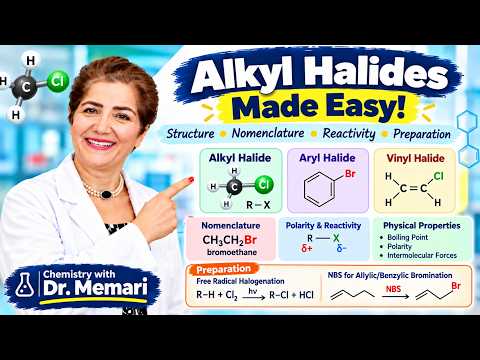
Alkyl halides are compounds with a halogen bonded to an sp3 carbon; their polar carbon-halogen bond makes the carbon electrophilic and enables reactions unavailable to relatively unreactive alkanes. The lesson covers halide classification and IUPAC naming, physical properties and uses, then explains radical halogenation, relative radical stability, and NBS-mediated allylic and benzylic bromination.
Key takeaways
- An alkyl halide is classified by the substitution level of the carbon bonded to the halogen, not by the total number of carbons in the molecule.
- For naming alkyl halides, prioritize the longest carbon chain and the lowest locant set; halogens are named as prefixes rather than treated as high-priority functional groups.
- Polar C-X bonds create a partially positive carbon that can be attacked by nucleophiles, explaining why alkyl halides are more reactive than alkanes.
- Radical halogenation favors formation of more stable radicals, generally making tertiary substitution faster than secondary and primary substitution.
- NBS enables allylic or benzylic bromination by providing bromine slowly, while resonance stabilization makes these radical positions especially favorable.
- Geminal dihalides have both halogens on the same carbon, whereas vicinal dihalides have them on neighboring carbons.
Chapters
- The general formula is RX, with R as an alkyl group and X as a halogen; alkyl halides have halogen attached to an sp3 carbon.
- Vinyl halides have halogen attached to an sp2 carbon in a C=C bond, while aryl halides have halogen attached to an aromatic ring.
- The polar C-X bond leaves carbon partially positive, making it a target for electron-rich nucleophiles such as hydroxide.
- Classify an alkyl halide as primary, secondary, or tertiary by counting the carbon groups attached to the carbon bearing the halogen.
- Choose the longest carbon chain, number it to give substituents the lowest locant set, and list prefixes such as chloro and methyl alphabetically.
- For cyclic compounds with a tie in locants, assign the lower number to the substituent that comes first alphabetically; add cis/trans descriptors when stereochemistry is specified.
- Geminal dihalides have both halogens on one carbon, while vicinal dihalides place them on adjacent carbons.
- Halothane, Freon refrigerants, and the now-banned pesticide DDT illustrate uses and environmental concerns; halogenated organic waste requires separate handling.
- Alkanes react with halogens under heat or light through a free-radical chain reaction to form alkyl halides.
- Tertiary radical formation is generally faster than secondary, which is faster than primary, because more substituted carbon radicals are more stable.
- When one molecule offers multiple substitution sites, the site producing the more stable radical tends to yield more product.
- An allylic carbon is next to a C=C bond; resonance delocalizes an allylic radical and stabilizes it, making allylic substitution favorable.
- Br2 and light can produce multiple allylic bromination products; a secondary allylic site can be favored over a primary allylic site.
- NBS, or N-bromosuccinimide, supplies bromine gradually and supports selective mono-bromination at allylic or benzylic positions while preserving the double bond.
- Alkyl halides can also be prepared from alkenes, alcohols, alkynes, or other alkyl halides; for example, adding HCl to an alkene can form an alkyl halide.
- Compared with alkanes, alkyl halides have dipole-dipole interactions in addition to dispersion forces, typically raising boiling points for comparable compounds.
- The key reactivity model is the polar C-X bond: carbon is electrophilic, and alkyl halides participate in nucleophilic substitution and elimination reactions.
Transcript excerpt
0:01 So when we have carbon attached to any halogen as part of the um organic compound this is is known as the alkalhalide. General formula for alkalhalide is RX. R is the abbreviation for alkal group and X is the abbreviation for H hallogen. Um if we have a molecule that has other functional groups like high priority functional group like O and also has hogen we classify this molecule as alcohol because O takes the priority. Um if the hybridization is sp3 then we have we're dealing with the alkalhelite because we have the alkal group here for vinyl helide like a vinyl chloride here the helite is attached to carbonarbon double bond. So one of the
0:48 group attached to the CC carbon with a double bond with the sp2 hybridization is um hogen. So we have the vinyl helite. Uh PBC we learned this in chapter 8 most likely like a polyvinyl chloride is a polymer of this molecule. If you polymerize this compound is a vinyl um ethylen chloride or vinyl chloride you get PVC as a vinyl chloride. And then a chloride ar it's aromatic um the chlorine or in general aerial helite is going to be aromatic carrying the one of the homogens the abbreviation for that for ar group is a r so a rx is the abbreviation for aerrol helite now we could have chloride bromide or or iodide but any of them what is unique
1:36 about alkenhelide compared to alkan we have alkan versus alkalhalide. The electro negativity of carbons of course are identical because it's the same element and it's also very close to hydrogen. So all bonds in alkane is non-polar. Each bond is non-polar and the molecule is non-polar. When it comes to alkalhalides, the bond between the carbon and hogen is polar bond with
This is the start of the transcript. Save this video free for the whole transcript, searchable and time-coded.
Related notes
Summary, takeaways, and chapters were generated by AI from the video's transcript and may contain errors. The video belongs to its creator, Chemistry with Dr. Memari.