BIO 105 CH3 (Part 1) - Introduction to Ecology Lecture
 Watch on YouTube →
Overview
Aquatic ecology explains how water's density, light attenuation, temperature, pressure, salinity, and circulation shape organism distributions from freshwater lakes to ocean trenches. The lecture connects these physical gradients to marine habitats and food webs, noting that the 2010 Census of Marine Life identified nearly 250,000 marine species while substantial diversity remained undocumented, and that submersibles, sonar, remote sensing, and remotely operated vehicles have expanded exploration.
Key takeaways
- Water's high density and viscosity make movement energetically costly, while buoyancy reduces support requirements; aquatic organisms are therefore filtered by a different physical environment than terrestrial species.
- Thermal stratification can restrict mixing between surface and deep water, causing temperature layers to develop distinct oxygen and nutrient conditions.
- The hydrologic cycle is also a transport network: runoff and river flow carry pollutants, sediments, nutrients, and organic matter between terrestrial and aquatic ecosystems.
- Ocean circulation redistributes heat and nutrients globally; cold, salty water formed near polar regions sinks and contributes to deep thermohaline circulation.
- Most ocean volume lies beyond the reach of sunlight, so deep-sea food webs depend on sinking organic matter or, around hydrothermal systems, chemosynthetic production.
- Intertidal species form vertical zones because tidal exposure combines physical stress, such as desiccation, with biological pressures, including competition and predation.
Chapters
- Water provides buoyancy but is denser and more viscous than air, making locomotion more energetically costly while reducing structural demands from gravity.
- Light fades with depth, and photosynthesis becomes constrained below the light compensation point; dissolved oxygen depends on temperature, mixing, photosynthesis, and decomposition.
- Thermal stratification forms a thermocline between warm surface water and colder deep water, limiting mixing and allowing oxygen and nutrient levels to diverge.
- The hydrologic cycle transports nutrients, sediments, pollutants, and organic matter; reservoir turnover ranges from about 9 days for atmospheric water to thousands of years for ocean water.
- Wind-driven currents redistribute heat, oxygen, nutrients, and organisms; upwelling brings nutrient-rich deep water into illuminated surface waters.
- The Pacific, Atlantic, and Indian oceans form an interconnected system, while seafloor features range from plains and seamounts to the Mariana Trench, deeper than 10,000 meters.
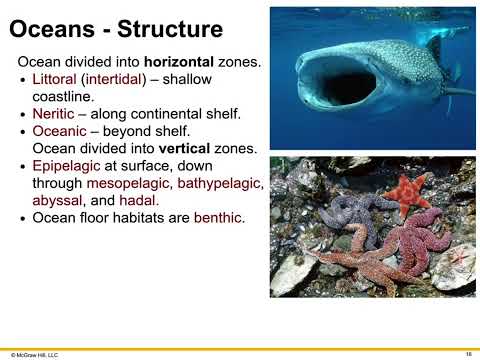
- Marine habitats are classified horizontally as intertidal, neritic, and oceanic, and vertically as epipelagic, mesopelagic, bathypelagic, abyssal, and hadal zones.
- In aphotic waters, organisms rely largely on organic material sinking from above or, near hydrothermal systems, on chemosynthesis; deep-sea species also use bioluminescence for communication, camouflage, and prey attraction.
- The lecture's comparison identifies 28 animal phyla in marine systems, including 13 endemic to marine environments, reflecting the evolutionary importance of oceans.
- Commercial harvesting, chemical contaminants in deep-sea sediments, and plastic debris show that ocean size does not shield marine ecosystems from human impacts.
- Kelp forests thrive along cooler rocky coasts, often where maximum temperatures stay below about 20°C; coral reefs are concentrated in warm tropical waters.
- Coral reefs include fringing reefs, barrier reefs, and atolls, and can develop as volcanic islands subside while coral continues growing upward.
- Kelp blades form a surface canopy, stipes extend downward, and holdfasts anchor kelp to rock; currents deliver nutrients and oxygen but storms can detach kelp.
- Coral animals rely on symbiotic photosynthetic algae called zooxanthellae, supporting high productivity in nutrient-poor tropical waters.
- Intertidal organisms face changing immersion, desiccation, temperature extremes, wave stress, and predators; adaptations include attachment, water conservation, refuge, and physiological tolerance.
- Semidiurnal tides produce roughly two high and two low tides each day; spring tides have the greatest tidal range, while neap tides have smaller ranges.
- Vertical shore bands reflect both exposure and biological interactions: upper-shore organisms face greater desiccation risk, while lower-shore organisms experience more competition and marine predators.
Transcript excerpt
0:00 Up to this point, we've approached ecology largely from a terrestrial perspective. That makes sense, where terrestrial organisms and most of the ecological patterns we encounter directly involve forests, grasslands, soils, and climate. But most of Earth's surface is aquatic. So the question for this chapter is straightforward. What changes when water becomes the physical environment in which life operates? Quite a lot. Light behaves differently. Oxygen availability changes. temperature becomes more stable but often stratified. Movement becomes more energetically expensive. And those physical properties ultimately shape the distribution of aquatic organisms. One of the interesting biases in ecology is that humans tend to view Earth from the land outward. Even though water dominates the planet's surface, that
0:49 bias also affects how much we know. Terrestrial environments are comparatively accessible. Deep marine environments are not. Our understanding of ocean biodiversity has expanded largely alongside improvements in submersibles, sonar, remote sensing, and remotely operated vehicles. The 2010 census of marine life identified nearly 250,000 marine species while also concluding that substantial diversity remained undocumented. So, aquatic ecology isn't simply the study of familiar oceans and lakes. In many respects, we're still describing the biological diversity of the planet. The first thing I want you to recognize is that water changes the selective environment. Water provides buoyancy which reduces the structural demands imposed by gravity. At the same time,
1:37 water is considerably denser and more viscous than air. So, locomotion becomes more energetically expensive. Temperature also fluctuates less rapidly in water than in air. Those properties help explain why aquatic biomes are often classified differently from terrestrial ones. Instead of relying primarily on vegetation, we pay particular attention to physical variables. Salinity is one. Water movement is another. Freshwater versus marine. And within freshwater systems, lentic environments contain relatively still water, while loadic systems
This is the start of the transcript. Save this video free for the whole transcript, searchable and time-coded.
Related notes
Summary, takeaways, and chapters were generated by AI from the video's transcript and may contain errors. The video belongs to its creator, Dakota Shade.