BIO 105 - CH2 (Part 2) - Introduction to Ecology Lecture
 Watch on YouTube →
Overview
Ecology explains biomes as dynamic relationships among climate, soil, geography, disturbance, and organisms, rather than fixed collections of species. The lecture compares nine terrestrial biomes, from tropical rainforest receiving roughly 2,000 to 4,000 mm of annual rainfall to tundra with short growing seasons, and shows how seasonal water, temperature, fire, soils, and human activity shape their vegetation and wildlife.
Key takeaways
- A biome is best understood as a relationship among climate, soil, geography, disturbance, and organisms, so changes in rainfall or temperature can shift vegetation and species distributions.
- Tropical rainforest vegetation can be highly productive despite nutrient-poor soil because heavy rainfall leaches nutrients and much of the remaining nutrient supply is held in living biomass.
- Rainfall timing matters as much as annual total: a wet season followed by drought shapes tropical dry forests and savannas differently from rainfall spread evenly across the year.
- Fire can harm individual plants while maintaining ecosystems such as savannas and chaparral by limiting woody growth or triggering recovery and germination.
- Temperate grassland soils became fertile through repeated growth and decomposition of extensive grass roots, and agriculture now relies on part of that ecological inheritance.
- Cold and short growing seasons impose distinct constraints: boreal forests favor needle-retaining conifers, while tundra supports low-growing plants and slow nutrient cycling.
Chapters
- Changing one factor, such as temperature, rainfall, or soil fertility, can shift which plants survive and whether a landscape supports forest, grassland, or sparse vegetation.
- Climate change can move species northward or uphill, while some species may have nowhere suitable to go; biome boundaries on maps simplify nature's gradual transitions.
- Compare each of the nine terrestrial biomes by location, climate, dominant flora, and fauna, then ask which environmental changes explain differences between them.
- Tropical rainforests, mostly within about 10 degrees of the equator, receive roughly 2,000 to 4,000 mm of rain annually and stay warm through the year.
- Heavy rain leaches nutrients from rainforest soils, so much of the ecosystem's nutrients circulate through living vegetation; mycorrhizal fungi help plants acquire nutrients.
- Canopy, understory, and forest-floor niches let many species use different parts of the same forest, while clearing vegetation can expose nutrient-poor soil and undermine the system's productivity.
- Tropical dry forests, often around 10 to 25 degrees latitude, have wet and dry seasons; seasonal water scarcity shapes plant growth, animal movement, and human land use.
- Savannas form where a pronounced dry season limits trees and grasses dominate; seasonal rainfall moves grasses, herbivores, and predators, while periodic fire can maintain grassland structure.
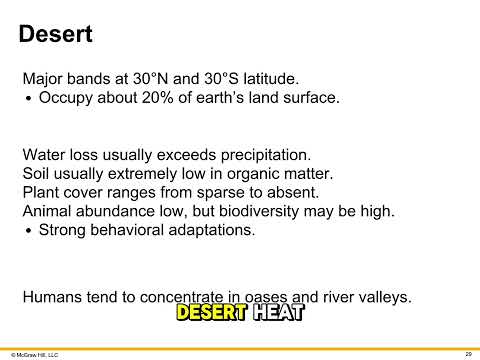
- Deserts are defined by water scarcity, not heat: many occur near 30 degrees north or south, and Mongolia shows that cold regions can also be deserts.
- Desert organisms conserve water through strategies such as nocturnal activity, burrowing, reduced leaf area, water storage, and extensive roots.
- Mediterranean woodland and shrubland, or chaparral, has cooler, wetter winters and hot, dry summers; fire-adapted plants and human settlement interact in regions such as California and the Mediterranean basin.
- Temperate grasslands are known as prairies in North America, steppes in parts of Eurasia, and pampas in South America; deep, fertile soils develop as grass roots die and decompose.
- Agriculture has converted much original temperate grassland, using soil fertility partly created by the former grassland ecosystem; historic prairie dynamics also involved bison, grazing, fire, and drought.
- More reliable precipitation allows trees to compete with grasses in temperate forests; deciduous trees drop leaves when winter makes maintaining them costly, while conifers retain needles.
- Missouri lies in the temperate forest biome, and broad biome categories encompass climate variation among places such as Oregon, Pennsylvania, and France.
- The boreal forest, or taiga, spans Canada, Alaska, Scandinavia, and Russia and covers about 11% of Earth's land area; long winters and short summers favor needle-retaining conifers.
- Boreal species must use a brief productive season, with migratory animals arriving to feed and reproduce; logging, mining, and resource extraction connect even remote forests to human economies.
- Tundra receives roughly 200 to 600 mm of precipitation annually, but cold temperatures, rather than high rainfall, distinguish it from desert environments.
- Cold slows decomposition and nutrient cycling in tundra, favoring low-growing vegetation; plant growth, insects, bird arrivals, and reproduction are compressed into a brief summer.
- Elevation can reproduce latitudinal biome shifts over a few miles, as temperature, moisture, soils, drainage, and wind change from mountain base to alpine habitat.
- North-south mountain ranges such as the Rockies and Andes may offer routes for species tracking climate, while east-west ranges can pose different barriers; isolated high-elevation habitats can act as ecological islands.
- Weather describes short-term conditions, while climate summarizes long-term patterns, typically over decades; a single hot or cold day cannot establish a climate trend.
- Climate averages conceal consequential variability: ecologists track drought and wet periods with tools such as the Palmer Drought Severity Index and consider ENSO, spatial differences, and year-to-year change.
Transcript excerpt
0:00 So, now we come to the point where all of those pieces we've been collecting finally have to answer for themselves. Sunlight, temperature, rainfall, mountains, soil. And you might reasonably ask, "What exactly have we been building toward?" Well, suppose I give you a landscape and I let you control the environmental conditions. You can change only one thing at a time. First, lower the temperature. What happens? The growing season becomes shorter. Some plants no longer have enough time to complete their life cycle. Others now have an advantage. Now leave the temperature alone and reduce the rainfall. What changes? A tree that once survived comfortably may now struggle. Grasses may begin replacing forest. Eventually even the
0:47 grasses begin to thin. Now change the soil. Make it less fertile, more acidic. Drain it faster. Hold more water. the organisms change again. So here's the question. When we look at a biome, are we really looking at a collection of plants and animals or are we looking at the biological consequences of a particular set of environmental conditions? That's the more useful way to think about it. A biome is in a sense an ecological answer to an environmental question. Early plant ecologists were already wrestling with this in the early 20th century. Why does one plant occur here but disappear 20 m away? Why does a forest stop and grassland begin? Why do
1:37 certain species consistently appear together? Climate and soil emerged very quickly as major parts of the explanation. But now let me complicate the question. Suppose the climate itself begins to change. Do the biomes stay where we drew them on the map? They can't, at least not necessarily. Some species expand, others retreat. Some move northward, some move uphill, and some reach the point where there is
This is the start of the transcript. Save this video free for the whole transcript, searchable and time-coded.
Related notes
Summary, takeaways, and chapters were generated by AI from the video's transcript and may contain errors. The video belongs to its creator, Dakota Shade.