BIO 105 - CH2 (Part 1) - Introduction to Ecology Lecture
 Watch on YouTube →
Overview
Ecology explains terrestrial biomes as outcomes of linked physical processes: sunlight and Earth's 23.5° axial tilt shape temperature, atmospheric circulation and precipitation, while mountains and elevation modify local climate. The lecture connects those conditions to plant strategies, food webs, climate diagrams, and soil development, including the O, A, E, B, C, and R horizons.
Key takeaways
- Biomes are defined by dominant vegetation and shared environmental challenges, so deserts on different continents can have similar plant and animal strategies without sharing the same species.
- In terrestrial food webs, sunlight captured by plants moves through consumers and ultimately returns to the ecosystem through decomposers, scavengers, and detritivores.
- Uneven solar heating and Earth's 23.5° tilt shape global climate; rising moist air near the equator supports rainforests, while dry descending air near 30° latitude favors deserts.
- Climate diagrams must be read month by month: equal annual precipitation totals can create different growing conditions when rainfall is distributed differently across the year.
- Mountain rain shadows can create wet windward slopes and dry leeward regions, while elevation lowers temperatures enough for vegetation to shift toward tundra-like conditions.
- Soil horizons record ongoing transfers of organic matter, minerals, and water: leaching removes material from the E horizon, and accumulation adds it to the B horizon.
Chapters
- Biomes are broad terrestrial ecosystem types identified mainly by dominant plant forms, not by identical species; African and Australian deserts share water scarcity despite different evolutionary histories.
- Natural history studies organisms in context, including climate, soil, predators, and competitors, while ecology asks why an organism can live in a particular place.
- In most terrestrial ecosystems, photosynthetic plants convert sunlight into chemical energy; primary, secondary, and tertiary consumers transfer that energy through food webs.
- Fungi and bacteria decompose dead material, while scavengers and detritivores consume animal remains and dead plant matter.
- Direct sunlight concentrates energy in the tropics, while sunlight arriving at a lower angle spreads over a larger area toward the poles.
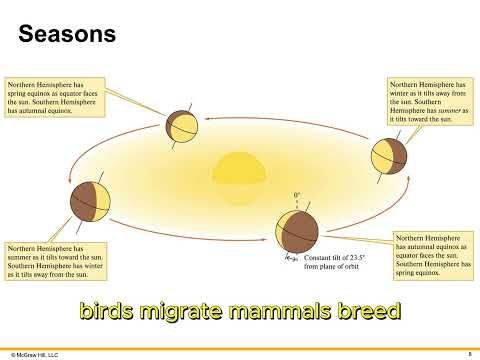
- Earth's 23.5° axial tilt causes seasons: a hemisphere tilted toward the Sun receives more direct light and longer daylight, not summer simply because Earth is closer to the Sun.
- Near the equator, warm moist air rises, cools, and produces frequent rain; dry descending air around 30° north and south helps explain major deserts such as the Sahara and Arabian Desert.
- Three major atmospheric circulation cells in each hemisphere, plus the Coriolis effect, generate global wind belts including trade winds, westerlies, and polar easterlies.
- Climate diagrams compare monthly temperature and precipitation; the example scale pairs 10°C with 20 mm of precipitation to show when water is available for plant growth.
- Annual totals can conceal seasonal differences: two locations receiving 40 inches of rain may support different vegetation if one has year-round rain and the other a three-month wet season.
- Higher elevations are generally colder, and mountains force moist air upward, causing it to cool and release precipitation on the windward side.
- The rain shadow effect leaves descending air warmer and drier on the leeward side; the Cascades and Sierra Nevada contribute to wetter western slopes and drier inland regions.
- Soil is a living system of mineral particles, organic matter, water, air, roots, fungi, bacteria, and small animals, shaped by climate, organisms, topography, parent material, and time.
- The O horizon contains accumulating organic material, while the A horizon is biologically active topsoil where minerals mix with organic matter and roots are common.
- Water leaches materials from the E horizon and can deposit clay and iron oxides in the B horizon; below these are weathered parent material in the C horizon and relatively unweathered bedrock in the R horizon.
- Soil forms gradually as rock weathers, organisms establish, plants add organic matter, and water transports compounds through the profile.
Transcript excerpt
0:00 Take a second and think about how strange the surface of Earth actually is. You can leave a place covered in thick forest, travel a few hundred miles, and suddenly there are almost no trees. Keep going and you might find yourself in grassland. Travel far enough south and the seasons begin to disappear. Go north and eventually even the trees disappear. And yet none of those places are random. There's a pattern underneath all of it. That's really what we're going to uncover in chapter 2. We use the word biome for these major divisions of the terrestrial environment. They're distinguished primarily by the kinds of plants that dominate them. So you can think of a biome as a broad ecosystem type. Now notice that I said kinds of plants, not necessarily the exact species. That's an
0:48 important distinction. Take two deserts on opposite sides of the planet. One might be in Africa and another in Australia. You're not going to find exactly the same organisms living in both places. Their evolutionary histories are completely different. But if you stood in either desert, you'd probably recognize the problem every organism there is trying to solve. Water is scarce. Vegetation is relatively sparse. Plants have to avoid drying out. Animals have to deal with heat and dehydration. Different species, same problem. And evolution has this wonderful habit of finding different ways to solve similar problems. That's one reason biomes are so fascinating. Geography may separate organisms by thousands of miles, but climate can force them into
1:36 remarkably similar lifestyles. There's another idea tied to this called natural history, which is essentially the study of organisms in the context of their environment, climate, soils, predators, competitors, and the other forces acting on them. And I want you to carry that mindset through this chapter.
This is the start of the transcript. Save this video free for the whole transcript, searchable and time-coded.
Related notes
Summary, takeaways, and chapters were generated by AI from the video's transcript and may contain errors. The video belongs to its creator, Dakota Shade.