September 10, 2026, Classroom Lecture
 Watch on YouTube →
Overview
Dr. Kush Jenkins teaches Chapter 2 accounting fundamentals: how to verify transactions with source documents, classify accounts, and record debits and credits using an eight-question analysis method. Examples include a $30,000 common-stock investment, cash and credit purchases, and consulting revenue; Jenkins then connects journal entries and T-accounts to trial balances and financial statements, while explaining exam logistics and academic-integrity expectations.
Key takeaways
- Debit and credit identify the left and right sides of a T-account, not positive and negative values; asset increases are debits, while liability increases are credits.
- Jenkins's eight-question transaction method proceeds from cash-versus-credit classification through account type and change direction, then determines the debit or credit for each side of the entry.
- A $30,000 shareholder contribution is recorded as a $30,000 debit to cash and a $30,000 credit to common stock; a $2,500 cash supplies purchase debits supplies and credits cash.
- A $7,100 supplies purchase on credit increases supplies and accounts payable, so it is recorded with a debit to supplies and a credit to accounts payable.
- Financial statements follow the trial balance: the single-step income statement calculates revenue minus expenses, and retained earnings equals beginning retained earnings plus net income minus dividends.
- The first exam covers Chapters 1–3, is open for three days with a one-hour continuous attempt, uses Proctorio, and permits one two-sided page of notes plus a calculator.
Chapters
0:00
Friends of Cascades Library Book Sale and Extra Credit
- Jenkins announces two volunteer dates for the Friends of Cascades Library book sale: September 20 at 10:00 a.m. and September 27 at 2:30 p.m.
- Students can help set up books on the first Sunday or put them away on the second; attending both may earn more extra-credit points.
- The book sale helps fund community library programs, including young-adult activities and Friday game nights.
7:47
Transaction Types, Source Documents, and Professional Skepticism
- External transactions involve parties outside a company, such as Disney hiring Chipotle to cater an event; internal transactions can occur between Disney-owned divisions, such as theme parks and Marvel licensing.
- Source documents—including checks, supplier bills, purchase orders, bank statements, and sales tickets—provide evidence for accounting entries.
- Jenkins connects documentation to professional skepticism: an asserted $3 billion contract should not be recorded until the contract is verified.
- Accountants' responsibility to tell the truth can conflict with a business owner's profit motive.
12:41
Account Categories and the Chart-of-Accounts Numbering System
- An account tracks increases and decreases in a specific asset, liability, equity, revenue, or expense; examples include cash, land, and buildings.
- The general ledger contains the company's accounts, while a trial balance collects their balances.
- Jenkins maps account-number ranges as 100s for assets, 200s for liabilities, 300s for equity, 400s for revenue, 500s for contra-revenue, and 600s for expenses.
- Contra-revenue accounts reduce reported revenue.
16:47
Debit and Credit Sides for Assets, Liabilities, Revenue, and Expenses
- A debit records the left side of a T-account and a credit records the right; neither term inherently means positive or negative.
- Asset increases are debits and asset decreases are credits; liability increases are credits and liability decreases are debits.
- Jenkins explains that expense increases are debits and expense decreases are credits, then works through revenue treatment in later examples.
- He asks students to focus on which side of the T-account receives an amount rather than interpreting debits and credits as signs.
21:12
Common Stock Contributions and Dividends as One-Way Flows
- Jenkins uses Ben's proposed investment in AT&T to illustrate that an investor transfers capital to a company when purchasing common stock.
- The common-stock increase is recorded as a credit; the related cash received by the company is a debit.
- A dividend is the opposite flow: the company transfers capital to investors, and the dividend account is recorded as a debit.
- Jenkins stresses that accurately recording investor contributions matters because misstating amounts can undermine confidence in the company's records.
26:05
Jenkins's Eight-Question Method for Analyzing Transactions
- Questions 1–4 identify whether the transaction is cash or credit, classify that first account, determine whether it increased or decreased, and select debit or credit.
- Question 5 asks what the cash or credit was exchanged for; question 6 classifies the second account as an asset, liability, common stock, dividend, revenue, or expense.
- Questions 7–8 determine whether the second account increased or decreased and whether that change is a debit or credit.
- The method breaks journal entries into a sequence of limited choices instead of requiring students to guess both accounts and sides at once.
32:19
Recording a $30,000 Investor Contribution
- For Fast Forward's December 1 transaction, shareholders invest $30,000; Jenkins treats the investment as a cash transaction even though the prompt does not explicitly say cash.
- Cash is an asset that increases, so the company debits cash $30,000.
- Common stock increases by $30,000 and is credited, keeping the accounting equation balanced.
- The entry demonstrates that both sides of the equation can increase even though one is a debit and the other a credit.
39:42
Recording Supplies Purchased for $2,500 Cash
- Fast Forward pays $2,500 cash for supplies: supplies, an asset, increase and are debited.
- Cash, also an asset, decreases and is credited for $2,500.
- Jenkins explains that parentheses indicate a negative amount in the displayed equation, so the asset increase and cash decrease offset.
- T-account balances accumulate entries; the $2,500 credit reduces the cash account's prior debit balance.
42:18
Equipment Purchase, Credit Supplies, and Consulting Revenue
- A $26,000 cash equipment purchase debits equipment and credits cash because equipment increases while cash decreases.
- A $7,100 supplies purchase on credit debits supplies and credits accounts payable, increasing both an asset and a liability.
- When Fast Forward immediately collects $4,200 for consulting services, it debits cash and credits consulting revenue.
- Jenkins recommends including transaction dates in T-accounts to trace entries over time.
46:01
From T-Accounts and Trial Balance to Financial Statements
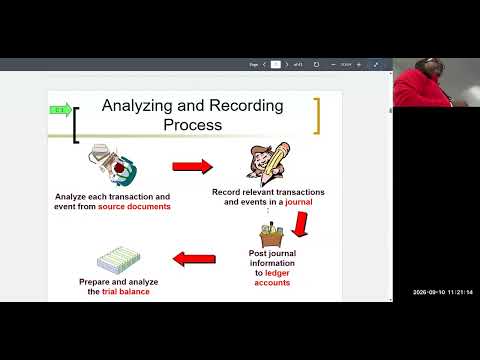
- After journalizing transactions, students post amounts to T-accounts, total the accounts, and prepare a trial balance.
- Trial-balance amounts are transferred to financial statements; Jenkins demonstrates a single-step income statement with revenue above expenses and net income calculated as revenue minus expenses.
- The statement of retained earnings uses beginning retained earnings plus net income minus dividends to calculate ending retained earnings.
- The balance sheet then reports assets, liabilities, and equity; Jenkins gives example balances including $4,350 cash, $26,000 equipment, and $6,200 accounts payable.
50:39
Exam Preparation, Debt Ratio, and the First Test
- Jenkins says Exam 1 covers Chapters 1–3 and is expected roughly two weekends after the lecture, depending on the class's pace.
- He describes the midterm as the course's most demanding, thinking-focused exam and notes students can drop one exam.
- The debt ratio is calculated as total liabilities divided by total assets.
- Jenkins advises using the study guide and says exam questions are generally drawn from challenging practice material.
53:53
Workbook Assignment Dates and Exam Window Planning
- Jenkins assigns workbook pages 58–66 and discusses whether the class prefers Sunday assignment deadlines.
- He warns that postponing assignments until December can leave students without practice before exams; students can complete work early instead.
- The first exam is planned as an online assessment open for three days, with one continuous hour to complete it.
- Students may take the online exam at home or in the testing center, but a paper makeup version does not provide the online 'check my work' opportunities.
58:39
Online Exam Setup, Proctoring, and Allowed Resources
- The online exam uses Proctorio and records students; Jenkins advises choosing a quiet, camera-ready space and avoiding interruptions or inappropriate on-camera behavior.
- Questions require students to enter numbers and select account names from dropdown menus; numerical answers allow a small tolerance.
- Students may use one page of notes—front and back—and a calculator, including a phone calculator.
- The testing center can be used for the online assessment, but students should clarify that they need computer access rather than a paper exam.
1:05:06
Exam Integrity, AI Use, and Institution-Level Consequences
- Jenkins warns that copying answers from classmates is unreliable because exam versions and numerical answers differ between students.
- He says AI-generated answer patterns can be conspicuous when students know advanced outputs but cannot supply basic related information, such as an employee's wages.
- He cautions students that institutional academic-integrity enforcement—not only an instructor's response—can have serious consequences.
- His advice is to learn the underlying accounting process rather than submit isolated answers that cannot be explained.
1:10:39
A Disputed Grade, Exam Review, and Institutional Authority
- Jenkins recounts a former student's claim that he had promised an A after a final exam; he asked for a specific date so he could verify the recorded class session.
- After the student escalated the matter, a dean reviewed a final-exam recording and identified five students she believed had cheated; Jenkins says the dean assigned zeros and removed students who then failed from Accounting II.
- He uses the story to warn that exam reviews or academic consequences may be initiated by administrators, not only by a student's instructor.
- Jenkins also notes that his classes and exams may receive heightened scrutiny and tells students to understand institutional policies and escalation procedures.
1:18:02
Attendance, Notes Clarification, and Class Wrap-Up
- Jenkins checks attendance near the end of class and confirms that the permitted exam notes may be used on both sides of one sheet.
- He reiterates that Chapter 1 homework can be submitted multiple times and reminds students to complete the worksheet.
- Students raise a question about the extra-credit dates, and Jenkins confirms the September 20 book-sale volunteer opportunity.
- He closes by reminding students to return for class the following week.
Summary, takeaways, and chapters were generated by AI from the video's transcript and may contain errors. The video belongs to its creator, Dr. Kush Jenkins.