August 27,2026 Classroom Lecture
 Watch on YouTube →
Overview
Dr. Kush Jenkins introduces financial accounting as the process of identifying material information, recording it, and communicating it to external users, then explains ethics, fraud risk, GAAP, and core accounting assumptions. The lecture connects those concepts to the expanded accounting equation, asset and liability accounts, and the idea that a company’s assets come from borrowing, investor contributions, or business operations.
Key takeaways
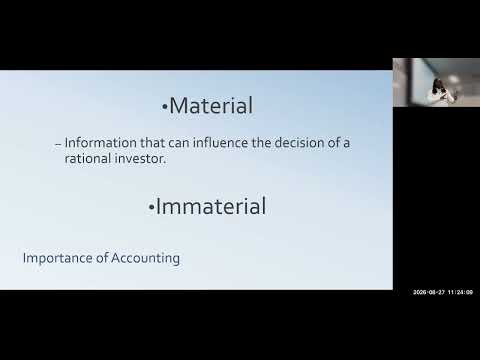
- Accounting begins by identifying material information: information is material when it can influence or change a rational investor’s decision.
- Useful external financial reporting depends on relevance, reliability, and comparability, and serves users such as lenders, shareholders, government officials, customers, and auditors.
- The fraud triangle consists of opportunity, rationalization, and financial pressure; Jenkins links overdue personal bills to increased pressure and access to assets to opportunity.
- The expanded accounting equation is assets = liabilities + capital − dividends + revenue − expenses, while assets = liabilities + equity is its abbreviated form.
- The cost principle records an asset at its transaction cost; in Jenkins’s example, land purchased for $1 is recorded at $1 even when its estimated market value is $10 million.
- The lecture classifies company assets as arising from borrowing, investor contributions, or day-to-day operations, providing a basic lens for interpreting financial statements.
Chapters
0:00
Chapter 1 Objectives: Accounting, Ethics, and GAAP
- Dr. Kush Jenkins opens with Chapter 1 goals: explain accounting’s purpose, identify users and uses, describe why ethics matters, and define generally accepted accounting principles.
- The class will focus on financial accounting and external users before studying managerial accounting and internal users next semester.
2:10
Materiality and the Rational Investor
- Jenkins defines accounting’s basic work as identifying, recording, and communicating information.
- Material information can influence or change a rational investor’s decision; immaterial information does not affect that decision.
- The lecture describes a rational decision-maker as having access to information, being able to make a decision, and not acting under duress.
14:00
Recording Relevant Information and Communicating It
- Accountants distinguish material from immaterial information before deciding what to record and communicate.
- Jenkins uses his mother’s dog medical bills as a tax-preparation example: he keeps the documents but does not treat nondeductible pet costs as relevant tax expenses.
- He stresses that communication requires judging what matters to the user rather than passing along every detail.
16:00
AI, Human Creativity, and Accounting Communication
- Jenkins argues that communication and creativity, alongside AI literacy, can help workers remain valuable as AI adoption grows.
- He says employers report that some people who use AI heavily may rely on its suggestions instead of developing original ideas.
- Using Einstein and relativity as an example, he emphasizes firsthand observation and lived experience as sources of insight that AI cannot reproduce in the same way.
24:20
Relevant, Reliable, Comparable Information and Its Users
- Jenkins identifies relevance, reliability, and comparability as qualities that make accounting information useful to external users.
- Comparability means financial information from companies such as Amazon and Alibaba should be presented in a form users can meaningfully compare, including consistent currency presentation.
- Financial accounting serves external users such as lenders, shareholders, government officials, customers, and external auditors; managerial accounting serves internal users such as managers and sales staff.
29:00
Ethics, Professional Appearance, and the Fraud Triangle
- Jenkins says accountants need to act ethically and appear credible, illustrating how circumstances can undermine the credibility of an otherwise truthful claim.
- He introduces three fraud-risk factors: opportunity, rationalization, and financial pressure.
- Examples include access to valuables at Fort Knox as opportunity, excusing misconduct because a boss did it as rationalization, and overdue mortgage or credit-card bills as financial pressure.
33:00
U.S. GAAP, the SEC, and Standard-Setting
- GAAP means generally accepted accounting principles and provides standards intended to make financial information relevant, reliable, and comparable.
- Jenkins identifies the Securities and Exchange Commission (SEC) as the U.S. oversight body and the Financial Accounting Standards Board (FASB) as the private standard-setter.
- He characterizes U.S. GAAP as rules-based, with specific guidance for topics such as depreciation and amortization.
35:00
U.S. GAAP and IFRS: Different Standard-Setting Approaches
- Jenkins contrasts U.S. GAAP with International Financial Reporting Standards (IFRS), set by the International Accounting Standards Board (IASB).
- He describes U.S. guidance as more detailed and rules-based, while presenting IFRS as more principles-oriented and focused on the spirit of the standard.
- The lecture highlights asset valuation as an area where the frameworks can differ and notes that international convergence efforts have faced resistance.
38:20
Measurement, Revenue, Expense Matching, and Full Disclosure
- The measurement or cost principle records assets at their transaction cost; Jenkins’s example is land bought from an uncle for $1, which remains recorded at $1 even if its estimated value is $10 million.
- Revenue recognition determines when revenue is recorded, while expense recognition or matching links expenses to the revenue they help generate.
- Full disclosure requires companies to report material information; Jenkins uses a hypothetical risk at a nuclear plant to illustrate why significant hazards belong in financial reporting.
43:00
Going Concern, Monetary Units, Periods, and Business Entities
- The going-concern assumption presumes that a company will continue operating and may continue its existing activities; Jenkins discusses Apple’s shift from computers toward products such as the iPhone.
- The monetary-unit assumption expresses financial statements in a currency, such as U.S. dollars or British pounds, and the time-period assumption allows reporting by week, month, or year.
- The business-entity assumption separates a business from its owners; Jenkins distinguishes sole proprietorships, partnerships, and corporations as common entity forms.
50:11
The Expanded Accounting Equation and Equity
- Jenkins presents the expanded equation as assets = liabilities + capital − dividends + revenue − expenses.
- He explains that assets = liabilities + equity is a shortened form, with equity expanded into owner investment, dividends, revenue, and expenses.
- The equation is introduced as the framework he will use to teach debits and credits.
52:00
Assets, Receivables, and Payable Accounts
- Examples of assets include cash, land, buildings, equipment, supplies, vehicles, and accounts receivable.
- Jenkins uses a one-year distinction as a classroom guide: amounts due within a year are treated as accounts receivable or accounts payable, while longer-term amounts are notes receivable or notes payable.
- For an 18-month customer balance, he separates the first 12 months from the remaining six; he also uses mortgage balances to illustrate current and longer-term portions.
56:30
Where Company Assets Come From and Chapter 1 Practice
- Jenkins groups the sources of company assets into three categories: borrowed funds, investor contributions, and day-to-day operations.
- He says financial statements tell a story about a company’s activity and encourages students to explain accounting concepts in accessible language.
- The next class will begin transaction analysis; assigned workbook practice includes questions 3–8, pages 28–33, and pages 36–41, with exercises reviewed in class.
Summary, takeaways, and chapters were generated by AI from the video's transcript and may contain errors. The video belongs to its creator, Dr. Kush Jenkins.