September 29,2026 Classroom Lecture
 Watch on YouTube →
Overview
Dr. Kush Jenkins reviews exam-one accounting problems, emphasizing accurate journal entries, careful reading of transaction details, and planning homework around exam deadlines. He then introduces the multi-step income statement for merchandisers, explaining net sales, cost of goods sold, gross profit, operating expenses, and subsequent earnings measures, before connecting full disclosure to Anthropic’s AI-risk disclosures.
Key takeaways
- Calculate supplies consumed as beginning supplies plus purchases minus ending supplies; the example produces $13,706 in Supplies Expense from $3,225, $13,319, and $2,838.
- For year-end adjustments, recognize costs incurred and revenue earned even when cash has not moved: the examples include $5,000 in Salaries Payable and $3,500 in Rent Receivable.
- When a transaction gives a total daily payroll cost of $2,500 for 15 employees, do not multiply by 15 again; the stated amount already represents the group total.
- A merchandiser’s multi-step income statement subtracts discounts and returns or allowances from Sales to get Net Sales, then subtracts Cost of Goods Sold to get Gross Profit.
- Gross Profit helps assess whether a company’s core products are profitable, while operating expenses may be reduced after an acquisition eliminates duplicate roles and departments.
- Jenkins uses Anthropic’s discussion of AI-related existential risk to illustrate why material risks may need to be disclosed to investors.
Chapters
0:00
Exam Feedback, Extensions, and Accounting-Class Deadlines
- Jenkins discusses exam grades and urges students not to interpret one low score as a disaster, since the lowest exam grade can be dropped.
- He criticizes an extension request based on the mistaken belief that Exam 1 was due December 14, stressing that students must follow class updates and agreed deadlines.
- Students who miss a Thursday class or another session should watch its recording rather than expect a classmate or instructor to reconstruct the lesson.
10:30
Adjusting Office Supplies from Beginning and Ending Balances
- The supplies adjustment uses a beginning balance of $3,225, purchases of $13,319, and ending supplies of $2,838.
- Supplies used are calculated as beginning supplies plus purchases minus ending supplies: $3,225 + $13,319 − $2,838 = $13,706.
- Record the adjustment by debiting Supplies Expense and crediting Office Supplies for $13,706.
13:19
Plan Homework Around the Exam, Not Just Its Due Date
- Jenkins notes that students chose a homework due date that fell after the exam, but the homework still contained material needed for the exam.
- His advice is to schedule work in the order that best prepares each student, rather than automatically doing assignments in due-date order.
- He relates this to students’ competing responsibilities, sharing that he became a parent at 18 and still made time for schoolwork.
17:16
Adjust Prepaid Insurance and Accrue Year-End Salaries
- Prepaid Insurance has a $31,848 debit balance before adjustment, with $22,911 of coverage still unexpired at year-end.
- The expired insurance cost is $8,937; debit Insurance Expense and credit Prepaid Insurance for that amount.
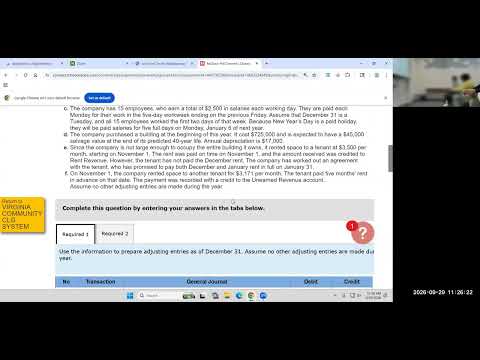
- Employees earn $2,500 in total per working day, and two days worked by December 31 create a $5,000 Salaries Payable accrual.
- Jenkins warns students not to multiply by the 15 employees: the stated $2,500 is already the combined daily salary cost.
23:21
Record Depreciation and Accrued and Unearned Rent
- A building costing $725,000 has a $45,000 salvage value and a 40-year life, but the problem directly supplies annual depreciation of $17,000.
- Record the stated depreciation by debiting Depreciation Expense and crediting Accumulated Depreciation; do not recalculate the amount from the building details.
- A tenant’s unpaid December rent of $3,500 is earned revenue at year-end, so debit Rent Receivable and credit Rent Revenue.
- For five months of rent received in advance at $3,171 per month, November and December earnings total $6,342; debit Unearned Revenue and credit Rent Revenue.
29:15
Post January Cash Payments and Rent Collections
- The January payroll covers five days at $2,500 per day, for total cash wages of $12,500.
- Debit Salaries Payable for the prior-year two-day accrual of $5,000 and Salaries Expense for the remaining three days, $7,500; credit Cash for $12,500.
- When $7,000 of rent for December and January arrives on January 31, debit Cash for $7,000.
- Credit Rent Receivable for December’s $3,500 accrual and Rent Revenue for January’s $3,500 earnings.
35:35
Review Financial Statements and Closing-Entry Confusion
- Jenkins says most students correctly prepared the income statement, statement of retained earnings, and balance sheet, while journalizing and closing entries caused more difficulty.
- Net income for the retained earnings statement is revenue minus expenses; the discussed problem gives net income of $17,100.
- He acknowledges that his study guide grouped expenses together while the exam required students to list them individually.
39:58
Transition from Exam Review to the Merchandising Chapter
- After telling the class its overall performance was solid, Jenkins takes attendance and shifts from exam corrections to the next accounting chapter.
- He frames the upcoming material as a move beyond the simpler income statements students have been preparing.
43:18
Build a Multi-Step Income Statement from Net Sales
- A single-step income statement lists revenues and expenses, which Jenkins says works well for service organizations such as accounting firms, law firms, and plumbing businesses.
- Merchandisers and manufacturers instead use a multi-step income statement, beginning with Sales.
- Subtract Sales Discounts and Sales Returns and Allowances from Sales to calculate Net Sales.
- A return means a customer gives goods back; an allowance reduces the price while the customer keeps the goods.
49:33
Calculate Gross Profit and Evaluate the Product Business
- Jenkins defines Cost of Goods Sold as the costs required to bring products to sale and subtracts it from Net Sales to find Gross Profit.
- Gross Profit indicates whether a company can earn money from its core product activity, such as McDonald’s selling hamburgers.
- In an acquisition, buyers may focus on Gross Profit because they can reduce or remove duplicated operating expenses after combining companies.
- He illustrates a takeover by explaining that the acquiring business may replace the target’s CEO, CFO, accounting team, and HR department with existing staff.
1:00:00
Operating Expenses, One-Time Items, and Earnings Measures
- The multi-step statement separates operating expenses into selling expenses and general and administrative expenses.
- Jenkins describes extraordinary gains and losses as one-time events outside normal operations, such as Five Guys selling property or a Maine business suffering flood damage.
- He outlines EBITDA as earnings before interest, taxes, depreciation, and amortization, then subtracts depreciation and amortization to reach EBIT.
- Subtracting interest produces EBT, and subtracting taxes produces net income.
1:03:18
Full Disclosure and Anthropic’s AI-Risk Discussion
- Jenkins asks which accounting principle requires material information to appear in financial statements and identifies full disclosure as the relevant idea.
- He defines IPO as an initial public offering and discusses reported upcoming offerings, including Anthropic, the company behind Claude.
- The class considers why a company’s financial disclosures would address the possibility that its AI technology poses an existential risk to humanity.
- Jenkins uses the example to connect disclosure requirements with risks that could matter to investors.
1:07:00
Close of Class and Preview of Thursday
- Jenkins says the class will finish Chapter 4 on Thursday.
- He closes by reassuring students and inviting them to visit his farm for fresh food if AI poses an existential threat.
Summary, takeaways, and chapters were generated by AI from the video's transcript and may contain errors. The video belongs to its creator, Dr. Kush Jenkins.