24b. Quiz 2 Review
 Watch on YouTube →
Overview
The review prepares students for a closed-book Wednesday quiz by revisiting orthogonality, least squares, determinants, and eigenvalues through worked exam problems. It connects projection matrices to eigenvalues and iterative systems, derives a determinant recurrence for a tridiagonal family, and examines projections and eigenvalues of a second symmetric matrix family.
Key takeaways
- A projection onto the span of a nonzero vector a is P = aa^T/(a^Ta); for a = (2, 1, 2), P has eigenvalues 1, 0, 0 and satisfies P^2 = P.
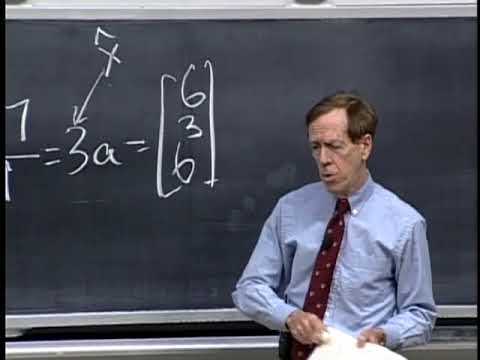
- For an iterative system u(k+1) = Pu(k) with this projection matrix, u0 = (9, 9, 0) reaches (6, 3, 6) after one step and stays there.
- Least squares finds the projection of b onto Col(A); fitting a through-origin line to (1, 4), (2, 5), and (3, 8) gives slope 19/7.
- For the tridiagonal determinant family with 1s on all three diagonals, Dn = Dn-1 - Dn-2, with D1 = 1 and D2 = 0.
- The recurrence matrix [[1, -1], [1, 0]] has eigenvalues e^(iπ/3) and e^(-iπ/3), so its sixth power is the identity and the determinant sequence repeats every six steps.
- For A3 = [[0, 1, 0], [1, 0, 2], [0, 2, 0]], the eigenvalues are 0 and ±√5; the related A4 has determinant 9, making its column-space projection I4.
Chapters
- The quiz is scheduled for Wednesday at 1:00 p.m. in the top floor of Walker, and is closed book.
- For orthonormal columns in Q, the defining matrix identity is Q^TQ = I.
- The review scope includes projections, least squares, Gram-Schmidt, determinant properties and cofactor expansion, plus eigenvalues, eigenvectors, and matrix powers.
- Differential equations are excluded because that material belongs to the third quiz.
- For a = (2, 1, 2), the projection matrix onto its span is P = aa^T/(a^Ta) = (1/9)aa^T.
- Since a^Ta = 9, P is one ninth of the matrix with rows (4, 2, 4), (2, 1, 2), and (4, 2, 4).
- P has rank 1, column space span(a), eigenvalue 1 along a, and eigenvalue 0 with multiplicity 2.
- The trace also gives the nonzero eigenvalue: tr(P) = 1.
- Starting from u0 = (9, 9, 0), one projection gives u1 = Pu0 = (6, 3, 6); because P^2 = P, every later iterate is the same.
- For a general matrix A, compute A^ku0 by expanding u0 in eigenvectors, then multiplying each eigenvector component by its eigenvalue raised to k.
- To fit y = Dt through (1, 4), (2, 5), and (3, 8), set up AD ≈ b with A = (1, 2, 3)^T and b = (4, 5, 8)^T.
- The normal equation gives D-hat = (A^TA)^-1 A^Tb = 38/14 = 19/7.
- The least-squares solution projects b = (4, 5, 8)^T onto the column space of A, the line spanned by (1, 2, 3)^T.
- The fitted line y = (19/7)t is a graph of the data fit; the geometric projection occurs in the vector space containing b and the columns of A.
- For a1 = (1, 2, 3) and a2 = (1, 1, 1), Gram-Schmidt forms b = a2 - [(a1^Ta2)/(a1^Ta1)]a1.
- Here a1^Ta2 = 6 and a1^Ta1 = 14, so subtracting (6/14)a1 from a2 produces a vector orthogonal to a1.
- A 4 by 4 matrix is invertible exactly when none of its eigenvalues λ1, λ2, λ3, λ4 is zero.
- The eigenvalues of A^-1 are 1/λ1 through 1/λ4, so det(A^-1) = 1/(λ1λ2λ3λ4).
- Adding the identity shifts each eigenvalue by 1, giving tr(A + I) = λ1 + λ2 + λ3 + λ4 + 4.
- The trace equals the sum of eigenvalues, while the determinant equals their product.
- For the tridiagonal family with 1s on the main, upper, and lower diagonals, let Dn denote the determinant of its n by n member.
- Expanding by cofactors along the first row yields Dn = Dn-1 - Dn-2; the negative term comes from the sign of the second cofactor.
- The initial values are D1 = 1 and D2 = 0.
- Writing the recurrence as a first-order system gives (Dn, Dn-1)^T = [[1, -1], [1, 0]](Dn-1, Dn-2)^T.
- The second family is symmetric, has zeros on the diagonal, and has successive off-diagonal weights 1, 2, 3, and so on.
- Its 3 by 3 member is A3 = [[0, 1, 0], [1, 0, 2], [0, 2, 0]].
- A3 is singular because its third column is twice its first; its column space is a plane in R^3.
- The projection onto that column space is a 3 by 3 matrix; because A3 is rank deficient, a basis for its column space is needed for the usual full-column-rank projection formula.
- The characteristic equation from det(A3 - λI) is -λ^3 + 5λ = 0.
- Factoring gives λ(-λ^2 + 5) = 0, so A3 has eigenvalues 0, √5, and -√5.
- The eigenvalues sum to zero, matching the zero trace of A3 and providing a quick consistency check.
- The determinant is also zero, consistent with A3's singularity.
- For the 4 by 4 member A4 of the weighted symmetric family, cofactor expansion gives det(A4) = 9.
- Since det(A4) is nonzero, its column space is all of R^4.
- The projection matrix onto the column space of A4 is therefore the 4 by 4 identity matrix.
- The review closes by noting the recurring pattern: odd-sized family members can be singular while the even-sized members are invertible.
Transcript excerpt
0:09 OK, this is quiz review day. The quiz coming up on Wednesday will before this lecture the quiz will be this hour one o'clock Wednesday in Walker, top floor of Walker, closed book, all normal. I wrote down what we've covered in this second part of the course, and actually I'm impressed as I write it. so that's chapter four on orthogonality and you're remembering these -- what this is suggesting, these are those columns are orthonormal vectors, and then we call that matrix Q and the -- what's the key -- how do we state the fact that those v-
1:01 those columns are orthonormal in terms of Q, it means that Q transpose Q is the identity. So that's the matrix statement of the -- of the property that the columns are orthonormal, the dot products are either one or zero, and then we computed the projections onto lines and onto subspaces, and we used that to solve problems Ax=b in -- in the least square sense, when there was no solution, we found the best solution. And then finally this Graham-Schmidt idea, which takes independent vectors and lines them up, takes -- subtracts off the projections of the part
1:54 you've already done, so that the new part is orthogonal and so it takes a basis to an orthonormal basis. And you -- those calculations involve square roots a lot because you're making things unit vectors, but you should know that step. OK, for determinants, the three big -- the big picture is the properties of the determinant, one to three d- properties one, two and three, d- that define the determinant, and then four, five, six through ten were consequences. Then the big formula that has n factorial terms, half of them have plus signs and half minus signs, and then
This is the start of the transcript. Save this video free for the whole transcript, searchable and time-coded.
Related notes
Summary, takeaways, and chapters were generated by AI from the video's transcript and may contain errors. The video belongs to its creator, MIT OpenCourseWare.