11/10/2026 Food Choices
Overview
Food choices connect personal nourishment and family traditions to energy use, food access, waste, animal agriculture, and community. The class compares homegrown potatoes with processed products, cites food waste as 8% of global greenhouse gas emissions and about one-third of all food produced, and examines meat’s resource costs before outlining practical options such as farmers markets, composting, gardening, and reducing meat consumption.
Key takeaways
- Food choices make up about one-third of an ecological footprint, so the foods people buy and eat can be a meaningful point of environmental action.
- Homegrown potatoes can produce roughly 20 calories of energy for each calorie invested, while commercial machinery, processing, and transportation add substantial energy costs.
- Food access is also an equity issue: more than 40 million people in the United States lack access to varied, affordable healthy food options.
- Food waste has a major climate impact: about one-third of global food production is wasted, and food waste generates roughly 8% of global greenhouse gas emissions.
- Meat production consumes substantial resources and involves demanding labor; the class estimates 284 gallons of oil to raise one cow and describes slaughterhouse work occurring at a pace of one cow every 12 seconds.
- Practical responses include reducing food waste, composting scraps, trying meatless meals, growing food, and shopping at farmers markets or through community-supported agriculture.
Chapters
- The course moves into part three, focused on what individuals, families, and groups can do after learning about environmental challenges.
- Earlier units covered chemicals, climate change, oceans, and species decline; this section turns toward everyday decisions.
- The instructor asks students to relabel journal pages for food, shelter, transportation, slowing down, and good news.
- The class challenges the feeling that one person is powerless, emphasizing that small actions can accumulate and group efforts can amplify them.
- Student Affairs’ Flourish Fest is offered as a campus resource for well-being during a difficult point in the semester.
- Students can explore becoming a BISC 3 teaching assistant through an informational conversation, without committing to the role.
- Seeking positive stories and connections can counter doomscrolling and help restore a sense of possibility.
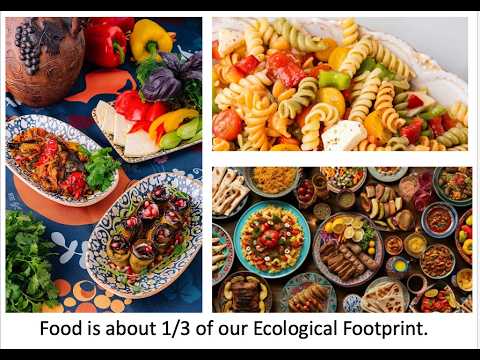
- Food accounts for about one-third of an ecological footprint, making food selection a consequential environmental choice.
- The reflection “May we be nourished that we may nourish life” links self-care with having energy to support other people.
- Students consider what they have eaten that day and how their choices relate to nourishment.
- A family ritual of coffee and cookies honors the instructor’s grandfather, who lived to 99 and took breaks at 10 a.m. and 2 p.m.
- A molasses cookie raises questions about ingredient origins, including Madagascar-grown vanilla, cinnamon, rice-based gluten-free flour, and eggs.
- The accompanying coffee connects Honduran beans to the instructor’s brother, a coffee roaster, while hemp milk and Pennsylvania maple syrup have different regional origins.
- Food choices reflect family traditions, current household needs, budget, food sensitivities, and opportunities to grow food.
- Potatoes are described as the world’s fourth most cultivated crop after rice, wheat, and corn, and as a versatile, nutrient-dense staple.
- A homegrown potato can return roughly 20 calories of energy for each calorie invested, because planting and watering require relatively little energy.
- Commercial growing, machinery, pesticides or herbicides, processing, and transportation add energy inputs and can reverse the favorable balance.
- The examples range from nearly free garden potatoes to store-bought potatoes at about 40 cents per pound and Pringles at roughly $4.50 per pound.
- U.S. grocery stores now carry roughly 30,000 to 40,000 products, compared with about 7,000 in the late 1990s, including more highly processed food-like products.
- Food deserts can leave people without a car or a supermarket within a mile; more than 40 million people in the United States lack access to varied, affordable healthy food.
- About one-third of food produced worldwide is wasted, and nearly 40 million tons of the U.S. food supply are discarded each year.
- Food waste generates about 8% of global greenhouse gas emissions; composting campus food scraps returns nutrients to soil and avoids landfill methane.
- The class uses a film to prompt consideration of how meat reaches consumers and why its production raises environmental concerns.
- Raising one cow is estimated to require about 284 gallons of oil across production, processing, packaging, shipping, refrigeration, and preparation.
- The annual fossil-fuel use associated with an American meat consumer is compared to driving 16,720 miles; the class also cites 75 billion chickens consumed worldwide each year.
- A cattle slaughterhouse worker may kill or incapacitate a cow every 12 seconds, in work associated with serious injuries, infection risks, and psychological strain.
- The instructor presents food decisions as personal rather than prescribing vegetarianism or veganism, and describes eating chicken and sometimes beef because of dietary restrictions.
- Meatless Mondays are offered as one way to reduce consumption; local sourcing is suggested when it is affordable and available.
- The class traces the shift toward large-scale farming to Secretary of Agriculture Earl Butz and policies beginning in 1971.
- Gardens, organic production, farmers markets, and community-supported agriculture provide alternatives that can shorten supply chains and strengthen local ties.
- Penn State’s campus composting system turns food scraps into soil used for campus trees and flowers, reducing methane emissions.
- The student farm and its club offer ways to participate in growing food; the class also notes that soil microbes such as Mycobacterium vaccae may support mood and resilience.
- Farmers markets can create more person-to-person connections than traditional grocery stores, while shared meals build community.
- Students are asked to examine a favorite food, beverage, or clothing item and consider the processes that brought it to them.
Transcript excerpt
0:14 Hi everyone, welcome. It's good to see you all. Thanks for finding your new seats. Um if there are TAs and LCs in the back there that can help with folks who come in late, I would be grateful. Thank you. If they need help finding spots. Uh and so we are I've made a shift in our the order of our classes um in order to I think better serve you and that it makes sense to me as well. And so I need you to have your journals out because I'm going to have you fix fix some stuff, rearrange some things. Um and I want to make sure that we're all staying on the same page. And I do
1:03 think that this is worthwhile so that we can yeah, there's just I see the need for something a little different this semester. So so we're rolling with it. So you're going to be on page 116 right now. And 116 at the top, I'm going to come down and look. Um 116 at the top says unexam number two. And you're going to change that to food. Okay? We're going to skip unexam two because I think we have more exciting things to move move on to. Um so page 116 is food. Page 117 is shelter.
1:59 And then moving page 125 next week, we're going to do transportation on page 125. Page 126 is slowing down. And then page 136 we're going to call good news. And then we'll be back on track. I appreciate you trusting me that this
2:50 is going to work. And so thanks for rolling along along with the shift. So with this being uh the food class, that means that we are leaving what we uh have been calling part two of By Side
This is the start of the transcript. Save this video free for the whole transcript, searchable and time-coded.
Related notes
Summary, takeaways, and chapters were generated by AI from the video's transcript and may contain errors. The video belongs to its creator, BiSc3 Penn State University.