10/30/2026 First-Person Ecology
Overview
Autumn Graham presents first-person ecology as a practice of noticing relationships with the self, other people, and the natural world, arguing that this awareness can counter the illusion of separation behind environmental problems. Through a body scan, a self-portrait exercise, campus species observation, seasonal food examples, and paired eye contact, she shows how attention can grow into appreciation, relationship, responsibility, and action.
Key takeaways
- First-person ecology treats relationships with the body, people, food, water, technology, campus, and other species as interconnected parts of everyday life.
- The practice follows a practical sequence: attention becomes appreciation, appreciation becomes relationship, relationship becomes responsibility, and responsibility becomes action.
- Environmental problems can arise when people forget their dependence on other people and ecological systems; noticing those dependencies is a starting point for responding.
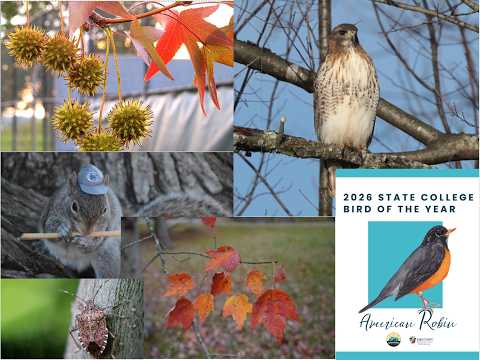
- Learning local species can begin with observation rather than memorizing names: Graham highlights a red-tailed hawk, eastern gray squirrel, sweetgum tree, and seasonal stink bugs around Penn State.
- Eating seasonally and tracing a meal back to its growers, transport, cooking, water, and soil can make food systems and local ecological support more visible.
- Eye contact can create an opportunity for deeper connection, but students' differing comfort levels and cultural expectations show that attention practices should account for individual experience.
Chapters
- Autumn Graham welcomes the BISCI3 class and promotes Logan's extra-credit screening of three short films about hope.
- The screening is scheduled for the following Wednesday at 7 p.m. in Willard 271.
- Graham asks students to prepare a journal and something to write with for the opening activities.
- Graham guides students through slow breaths, with feet grounded and eyes closed if comfortable.
- The modified body scan directs attention to the heartbeat, lungs, feet, legs, and mind.
- Students consider how their bodies sustain them and how their choices affect their own well-being and others.
- Students privately draw who they are, with no expectation of artistic skill or sharing their page.
- Examples include a cartoon avatar, words inside a heart, and drawings of the sun, plants, and animals.
- Graham asks students to imagine removing everything in the drawing that supports their life but is not technically them.
- A colleague's exercise, learned through work with Indigenous elders, highlighted how people often include environmental support in their self-portraits.
- Students describe first-person ecology as their perspective, their place in the environment, and how their actions affect it.
- Graham defines the practice as learning to notice relationships, including connections to food, sleep, family, roommates, water, campus, and technology.
- She connects forgotten relationships with environmental problems and names greed, convenience, distraction, consumerism, indifference, and hopelessness as signs of separation.
- Graham challenges students to name five people on their floor and five species they encountered on their walk to class.
- A student identifies an eastern gray squirrel, a praying mantis, an oak, a ginkgo, and robins.
- Graham points out a red-tailed hawk and a sweetgum tree, recognizable by its distinctive seed pods, as well as seasonal stink bugs.
- She encourages learning through attentive observation and love for place, not using species knowledge to prove dominance.
- Graham explains that autumn leaf color changes as light shifts, chlorophyll and sugars decline, and yellow, orange, and red pigments become visible before leaves fall.
- Pennsylvania is described as 58% forested and home to an estimated 25,000 species across plants, trees, invertebrates, mammals, and birds.
- Autumn foods include winter squash, sweet potatoes, and turnips; eating with the seasons can strengthen awareness of the land.
- Penn State's student farm offers cooking demonstrations and volunteer opportunities, while the sustainability leadership minor applies care for people and nature across career fields.
- Graham says students have described nurturing a relationship with the environment as quenching a deep thirst.
- She suggests that connection with nature can fade from childhood into adulthood and that deliberate attention can help restore it.
- Students discuss what the idea brings up for them before Graham leads another grounding exercise.
- Students reflect on where they have been that day, what they ate, and the people and natural systems that made the meal possible.
- Graham prompts them to consider who grew and transported their food, who cooked it, and how water and soil supported it.
- She contrasts hours spent looking at screens with seconds spent fully looking at other people, then organizes a paired attention exercise.
- Pairs spend two minutes looking into each other's eyes in a quiet exercise Graham frames as a chance to take a social risk.
- Students report discomfort, difficulty sustaining eye contact, increased confidence, and different cultural expectations around looking at others.
- One student experiences the exercise as a competition to avoid looking away; Graham redirects attention toward the possibility of deeper connection.
- Graham links connection with self, other people, and the planet to addressing environmental and social problems.
- An inner development guide draws on 25 research teams, 194 countries, and more than 20,000 voices to identify capacities for a sustainable future.
- Its goals include cultivating inner life, understanding complexity, caring for others and the world, building trust, and enabling change.
- Graham summarizes first-person ecology as a progression from attention to appreciation, relationship, responsibility, and action, then asks students what they will add to their self-portrait.
Transcript excerpt
1:11 All right, welcome everybody. Byite three, right? By side three. I'm back here for another lecture. Um, and yeah, I'm really excited to spend this time with all of you. Before we get started, I wanted to reiterate the extra credit movie that is happening with Logan up here. Everybody give a hand for Logan. >> He's been doing such a great job with the extra credit movies. If you haven't gone to one, you really should. Um, this one is going to be three short films uh that all have to do with the reality of
2:00 hope. Um, so that's next Wednesday, 7 p.m. in Willard 271. That's great. All right, so we're going to start with a mindfulness practice. Um, if you don't have your journal out, get it out. See you, brother. It's awesome. Um, and make sure you have you have your journal out. If you forgot it today, that's okay. It's okay. Just get out something to write on, something to write with. I hope that you have those things in your bag. Um, and I want you to just place your feet on the ground,
2:51 sitting in the pro posture of awareness. So, I'll do it with you. Sitting in the posture of awareness. And if you feel comfortable, I want you to just close your eyes. Taking some deep breaths together. We're just going to wait for the room to settle. Breathing in through the nose, out through the mouth. In through the nose,
3:42 out through the mouth. In doubt. Tune into your body and breath. Think of all those pieces that are working together in this moment to sustain you. So, keeping your eyes closed, just think of those things. Your heartbeat beating to all your extremities,
4:32 right? Your lungs expanding, contracting.
This is the start of the transcript. Save this video free for the whole transcript, searchable and time-coded.
Related notes
Summary, takeaways, and chapters were generated by AI from the video's transcript and may contain errors. The video belongs to its creator, BiSc3 Penn State University.