10/27/2026 Separation Hypothesis
Overview
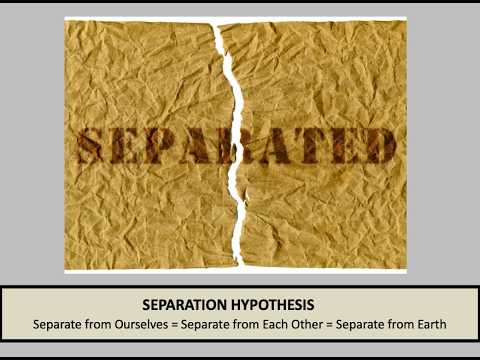
The lecture proposes the “separation hypothesis”: ecological crises such as climate change and species loss may reflect disconnection from ourselves, other people, and nature. It links that idea to population and consumption trends, René Descartes’s mind-body split, social conformity and technology, then invites students to explore how restoring personal and social connections could change their relationship with Earth.
Key takeaways
- The separation hypothesis treats ecological crises as possible symptoms of disconnection from oneself, other people, and nature, rather than as unrelated problems.
- Global population doubled from about 4 billion in 1970 to 8 billion in 2022, while energy use, fertilizer consumption, water use, and greenhouse-gas emissions rose during the Great Acceleration.
- The lecture links René Descartes’s 1637 mind-centered philosophy to a broader cultural split between thought, emotion, bodily intuition, and the natural world.
- Conformity can weaken self-knowledge: repeatedly suppressing preferences to fit in may leave people unsure what they want and make connection with others more difficult.
- Technology intended to connect people can contribute to isolation when in-person interaction is replaced by texting, social media, or solitary device use.
- Consumer choices are also environmental choices because clothing and other goods originate in nature; examining why a purchase feels necessary can reveal whether it reflects personal values or pressure to belong.
Chapters
- The Tibetan Plateau, nicknamed the Roof of the World, averages nearly 15,000 feet in elevation and covers roughly four times the area of Texas.
- Satellite imagery from the Earth Resources Observation and Science Center introduces the idea of viewing changing landscapes as Earth art.
- Students are asked to ground themselves with deep breaths before discussing challenging environmental topics.
- The Reality of Hope event offers three short films, a discussion panel, and a conversation about third places such as coffee shops, libraries, and parks.
- The class Canvas resources page collects campus organizations, podcasts, email lists, and student-recommended accounts related to people, nature, and environmental challenges.
- Students are invited to suggest additional resources, reinforcing connection as a shared course goal.
- Plastics, chemical pollution, climate change, and species loss are framed as symptoms of an underlying problem rather than isolated root causes.
- The flu analogy distinguishes visible symptoms, such as coughing, from the underlying cause.
- Students journal about possible root causes; responses include profit-seeking that discounts future generations, inattention to waste choices, and avoidance of difficult conversations.
- The lecture notes that the global population rose from about 4 billion in 1970 to 8 billion in 2022, with 9 billion projected around 2037.
- The Great Acceleration graph pairs population and economic growth with rising energy use, fertilizer consumption, water use, greenhouse gases, and ocean acidification.
- The lecture identifies post-1950 growth in consumption as a major pressure on natural systems and cites extinction risks for 33% of bird species, 41% of amphibians, and 44% of reef-building corals.
- The IUCN Red List is described as listing about one million species at risk of extinction.
- The central hypothesis is that the ecological “world of wounds” may reflect a disconnection within human inner lives.
- Emotional numbness, focusing only on one’s own story, and ignoring other people’s experiences are presented as forms of disconnection from Earth.
- The class is asked to treat the hypothesis as open to discussion and to examine what might be happening internally.
- René Descartes’s 1637 formulation, “I think, therefore I am,” is used to examine the cultural priority given to the mind over other parts of the self.
- The lecture contrasts that split with the vagus nerve’s connections among the head, heart, and gut.
- Students are told they have spent about 16,000 hours in educational settings, practicing mind-centered learning before being asked to reconnect different parts of themselves.
- A classroom discussion considers how choosing between reason and emotion can prevent people from integrating their thoughts, feelings, and gut reactions.
- A short film asks people what they would change about their bodies, showing how criticism of traits such as forehead size, ears, and acne can shape self-image.
- The lecture argues that fitting in can involve silencing parts of oneself and creating a false sense of belonging.
- Everyday conformity is illustrated through going out with friends despite wanting solitude, or choosing jobs and majors to meet others’ expectations.
- The lecture cites a figure of 12% of people having no trusted friend and describes humans as radically social animals.
- Phones, computers, texting, and social media are presented as technologies designed to connect people that can also encourage isolation and addictive use.
- Gated homes and large lots are used as examples of built environments that can increase separation from neighbors.
- A photograph of a crowded older mall prompts a comparison with present-day shopping, online retail, and phone use in public spaces.
- Students are asked to notice whether purchases meet needs, wants, or a perceived need to fit in, and to consider why they shop.
- The lecture cites approximately $430 billion spent on U.S. advertising and about $1,256 per person in the prior year.
- Clothing examples, including an upcycled cotton vest and pants likely made from fossil-fuel-based materials, show how consumer goods connect back to nature.
- A student compares disconnection to cutting strands in a web: the more connections removed, the less connected the whole becomes.
- Students describe how understanding oneself and forming relationships with trusted people can reinforce each other.
- A Guatemalan cultural example treats illness collectively: if a child is sick, the family and village are sick, and the same connection extends to the land and forest.
- The closing discussion prompt asks students to reflect on the courage required to grow up and become who they really are.
Transcript excerpt
1:18 Great. Take me a second. Hey everyone, welcome.
2:49 I'm happy to see you all today. Delighted that you're here. Thank you for coming. I was just saying to my lab group that it's a tricky day to come inside. It's so lovely out there and as the seasons change, it's um we I feel so compelled to soak in the sunshine. So, I'm glad that you came in. I'd like to draw your attention to the image up here. It's titled Roof of the World. This is an image taken of the Tibetan Plateau. Um it's on a website called Earth as art. Um it's part of the the GIS systems that are off that are run um by the
3:37 Earth Resources Observation and Science Center. And so this is Central Asian's Tibetan Plateau nicknamed the the roof of the world. Average elevation is more than 14,000 almost 15,000 ft. It's the world's highest and largest plateau covering an area roughly four times the size of Texas. So, it's this huge space. The idea the scene featuring some of the area's deep glacierfled lakes. thinking about how our our topography is changing as our world is changing and yet appreciating how we can look at the earth from these ways from this this creative angle of earth as art even as
4:27 spotted by the satellites. So I'm going to we're going to focus on some challenging stuff today. So, let's take a moment and just take a good uh feet on the floor, hand on your heart and your gut. If you so choose, take a couple of good deep breaths. As we approach some of these topics, it's important to remember we're on page 99 of the journal today. Um, you'll notice that I it appears as though I
This is the start of the transcript. Save this video free for the whole transcript, searchable and time-coded.
Related notes
Summary, takeaways, and chapters were generated by AI from the video's transcript and may contain errors. The video belongs to its creator, BiSc3 Penn State University.