1. Introduction to the Human Brain
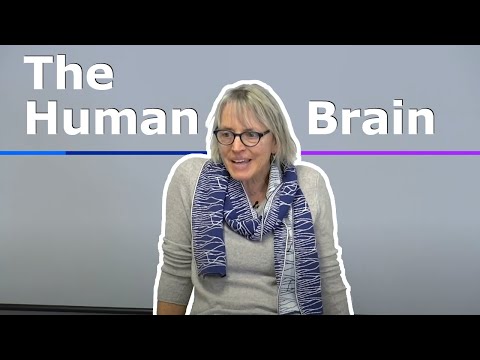 Watch on YouTube →
Overview
Nancy Kanwisher uses the case of Bob, whose slowly growing meningioma damaged navigation while leaving many other abilities intact, to introduce the brain’s specialized organization and the methods used to study it. She frames the course around how brain systems give rise to mental functions, contrasting human cognition with deep nets such as AlexNet, and previews research methods, course topics, and a practical strategy for reading scientific papers.
Key takeaways
- Bob’s meningioma damaged navigation while sparing driving, left-right discrimination, distance estimation, and recognition of familiar places, showing that apparently related spatial abilities can depend on separable brain systems.
- A lab scan showed Bob’s tumor had grown from grape-sized to lime-sized over several years; its position near the PPA and retrosplenial cortex connected a clinical symptom to research on scene perception and navigation.
- AlexNet’s 2012 ImageNet result helped make deep nets useful computational models for neuroscience, but ResNet accuracy dropping from 71% to about 25% on more varied images exposes a substantial robustness gap.
- Recognizing objects in an image is not the same as understanding the scene: interpreting satire requires knowledge of intentions, beliefs, social expectations, and what different people can see.
- Kanwisher’s course treats cognitive neuroscience as a combination of mental-function analysis and brain measurement, using methods such as psychophysics, patient studies, fMRI, EEG, MEG, and neurophysiology.
- A productive way to read a research paper is to identify its question, finding, interpretation, and design, using figures and sections selectively instead of trying to decode every technical detail in order.
Chapters
- Nancy Kanwisher introduces the MIT course 9.13, The Human Brain, and previews a personal case story followed by the course rationale, methods, topics, and logistics.
- The opening story is intended to foreshadow brain organization, specialized abilities, and recovery after brain injury.
- Kanwisher finds her friend Bob unconscious after hearing a crash, calls 911, and takes him to Mount Auburn Hospital when EMTs find no obvious problem.
- Bob had repeatedly become lost, including giving the wrong directions from his own driveway and failing to find familiar places in his hometown.
- His strong writing, high-powered job, and social wit had made the navigation difficulties seem inconsistent with a brain problem.
- Kanwisher urges the ER doctor to check Bob’s brain, recalling years of navigation symptoms and her lab’s research on navigation-related regions.
- An MRI reveals a lime-sized mass beside the parahippocampal place area, or PPA, and retrosplenial cortex, regions associated with scenes and navigation.
- An older research scan shows the mass had been grape-sized years earlier, suggesting slow growth; doctors later identify it as a meningioma rather than cancer.
- Before surgery, Kanwisher asks Bob to draw the floor plan of his own house and then her house; both attempts are disorganized.
- Bob draws recognizable bicycles and lobsters with their parts in roughly correct relationships, suggesting the deficit is more specific to spatial layouts than to complex objects generally.
- Kanwisher connects this kind of patient testing to neuropsychology, which infers mental components by comparing preserved and impaired abilities.
- Bob undergoes an 11-hour operation to remove the mass, which was intertwined with the large vein of Galen.
- With expert surgical care, Bob is coherent soon after surgery, goes home two days later, and returns to work within days.
- His navigation ability does not recover, so he relies on iPhone GPS; Kanwisher notes that adults often recover less readily than children after damage to specialized circuits.
- Bob can drive, distinguish left from right, recognize familiar places, and estimate distances, but cannot reliably determine a route from one place to another.
- He manages some familiar routes as memorized sequences of turns, yet cannot devise an alternate route when a road or campus path is blocked.
- New hotels and indoor layouts are difficult because GPS cannot readily guide him inside buildings; his own reports describe familiar scenes that fade when he tries to imagine what lies behind him.
- Bob’s case illustrates that brain damage can remove a specific ability without making a person globally less intelligent or changing their overall identity.
- Some brain regions perform highly specific functions, while others contribute to multiple mental processes.
- Kanwisher argues that mapping brain organization matters because it can reveal the component structure of the mind, not merely where a function is located.
- Kanwisher argues that the brain is closely tied to personal identity: replacing a heart preserves the person, but replacing a brain would not.
- Studying the mind can serve as empirical epistemology, helping researchers examine the capacities and limits of the human knower.
- She presents understanding the brain as a way to investigate what humans can know and whether some ideas may fall beyond human cognitive capacity.
- Kanwisher describes AlexNet, trained on more than one million ImageNet images, as a major 2012 advance in visual object recognition.
- AlexNet often classifies difficult images plausibly, including identifying a partly cropped mite and recognizing a barely visible motor scooter.
- Research by Boris Katz and Andrei Barbu tests deep nets on more varied, crowdsourced images; ResNet accuracy falls from 71% on ImageNet to about 25% on their harder examples.
- Deep nets therefore provide computationally precise models useful to neuroscience, while their failures on unusual images show that human object recognition remains different.
- Captioning systems can describe straightforward scenes, such as a ship on water or people playing football, but also produce errors such as a building with a cake or a necklace made of bananas.
- Kanwisher draws on Josh Tenenbaum’s distinction between pattern classification and building models that explain how a scene works.
- Understanding a satirical image of Barack Obama and a man on a scale requires knowledge of embarrassment, visibility, and the joke’s point of view, not just recognizing people and objects.
- AI progress is substantial, but current systems still struggle with flexible navigation, inferring beliefs, and other forms of human reasoning.
- The course focuses on how the brain gives rise to the mind, beginning with mental functions such as vision, hearing, language, and social cognition.
- For each function, students will ask what is computed, whether specialized machinery exists, and what information brain regions represent.
- Methods include psychophysics, perceptual illusions, neuropsychological studies, fMRI, single-neuron recordings, EEG, MEG, and diffusion tractography.
- Kanwisher says brain biology is most informative when connected to the mental functions it implements, much as a book’s physical properties matter alongside its text.
- Around 1990, well-established maps included primary sensory and motor areas, language regions associated with Broca and Wernicke, and limited evidence about face recognition and attention.
- Functional MRI has since helped identify dozens of brain regions and their likely functions in typical individuals.
- The course emphasizes domains with strong evidence, including color, shape, motion, faces, places, bodies, scenes, words, number, speech, music, language, and understanding other minds.
- The course asks how specialized systems develop, whether they have counterparts in other species, how experience changes the brain, and whether thought can occur without language or awareness.
- Motor control, much subcortical function, decision-making, memory, reinforcement learning, and attention receive limited coverage.
- Kanwisher cautions that researchers generally lack neuron-by-neuron wiring explanations for complex human abilities such as understanding a sentence, although circuits for simpler tasks such as fear conditioning in mice are better characterized.
- The course is designed as an advanced follow-up to MIT courses 9.00 or 9.01, with optional background material for students who have not taken them.
- Kanwisher prioritizes understanding major theoretical questions, evaluating neuroscience methods, learning selected cognitive domains, and reading current research papers.
- Students will read about two papers per week, usually complete a short response on one, take a midterm worth 25% and a cumulative final worth 25%, and complete brief in-class quizzes.
- A longer three-to-five-page assignment asks students to propose a specific experiment with a clear hypothesis and design.
- Assignments are submitted through Stellar, generally by 6:00 PM the night before the related lecture; the course favors original research papers over a textbook.
- The early schedule includes basic neuroanatomy, a human-brain dissection with Ann Graybiel, and lectures on color, motion, shape, faces, scenes, bodies, and debates about visual-cortex specialization.
- Later topics include navigation, brain development, blindness, number cognition, reward and pleasure, speech, music, brain-machine interfaces, language, and theory of mind.
- The course concludes with brain networks, student experiment design, a guest lecture on deep nets and cognition, and attention and awareness.
- The navigation unit draws on Bob’s case and combines patient studies, fMRI, animal physiology, and cognitive science.
- Kanwisher recommends identifying a paper’s research question, main finding, interpretation, and experimental design before getting lost in technical details.
- For an example on face inversion and the fusiform face area, readers should determine what responses changed between upright and inverted faces and what that implies about face-specific processing.
- Readers can move between the abstract, introduction, methods, results, and figures rather than reading every section linearly.
- MRI scanner specifications and advanced statistical details can often be set aside for this course, while basic ideas such as p-values, t-tests, ANOVA, and correlation remain useful.
Transcript excerpt
0:00 [SQUEAKING] [RUSTLING] [CLICKING] NANCY KANWISHER: All right. It's 11:05. I'm going to try to start promptly at 11:05 each time. So welcome. Is everybody psyched? I'm psyched. This is 913, the Human Brain. I'm Nancy Kanwisher. I'm the prof for this class. And lest, you were wondering, I have a brain, and there it is. That's me, with some bits colored in that you will learn about in this class. OK. What I'm going to do today is I'm going to tell you a brief story for around 10 minutes. And then I'm going to talk about the why, how, and what studying the human brain, why it's a cool thing to do, how you do it, and what in particular
0:48 we're going to learn about in here, and then we'll do some mechanics and details of the course, and allocation of grades, and all that. It's on the syllabus anyway. Cool? That's the agenda. All right. So let's start with that story. And for this, I'm going to sit up here. The story isn't that long, but it has a lot of interesting little weird bits. So I have cue cards to remind myself of all the bits I want to remember to say. So you can put away your phones and your computers. And you don't need to take notes. This is just a story. It's going to foreshadow a lot of the themes in the course, but it's not stuff you're going to be tested on. OK. So this is a true story, and I've changed only a few tiny little bits
1:38 to protect the identity of the people involved. But otherwise, it's an absolutely true story. It's a story about a scary medical situation that happened to a friend of mine a few years ago. But at the same time, it's a story
This is the start of the transcript. Save this video free for the whole transcript, searchable and time-coded.
Related notes
Summary, takeaways, and chapters were generated by AI from the video's transcript and may contain errors. The video belongs to its creator, MIT OpenCourseWare.