University of Utah ECE/CS 3700
Professor Fayazi · University of Utah · 7 lectures with notes
Every lecture with its full transcript and chapters, and one search across all 7 lectures.
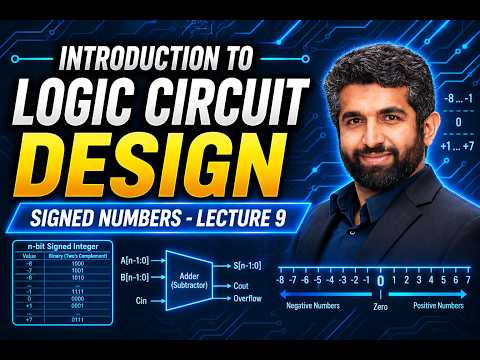
Introduction to Logic Circuit Design (University of Utah) - Signed Numbers (Lecture 9)
Signed integer formats differ in how they encode negatives and handle arithmetic, with two's complement avoiding one's complement's end-around-carry adjustment.
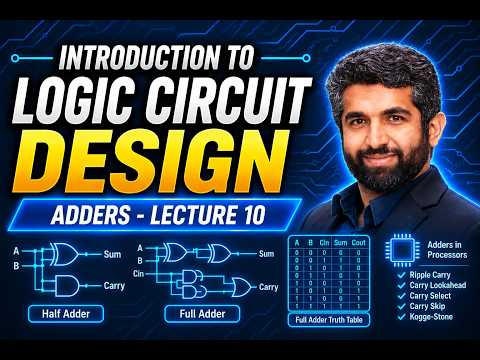
Introduction to Logic Circuit Design (University of Utah) - Adders (Lecture 10)
Carry lookahead and carry select reduce ripple-carry delay, while BCD addition requires detecting sums above 9 and correcting them.
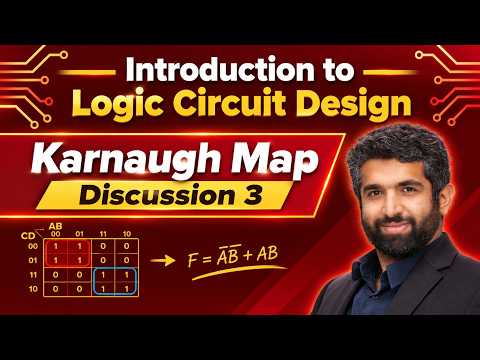
Intro to Logic Circuit Design (University of Utah) - Karnaugh Map (Discussion 3)
Karnaugh-map minimization uses essential implicants first, then systematic cover comparisons to prove minimum-cost SOP and POS solutions.
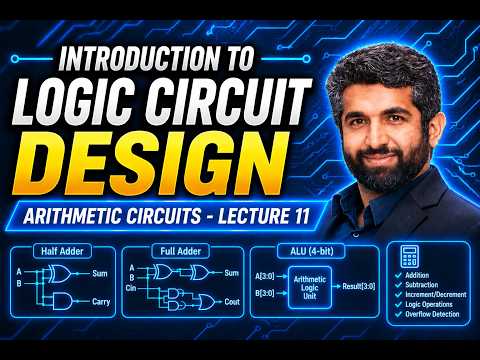
Introduction to Logic Circuit Design (University of Utah) - Arithmetic Circuits (Lecture 11)
BCD addition corrects invalid digit sums with six; binary multiplication combines shifted partial products using adders.
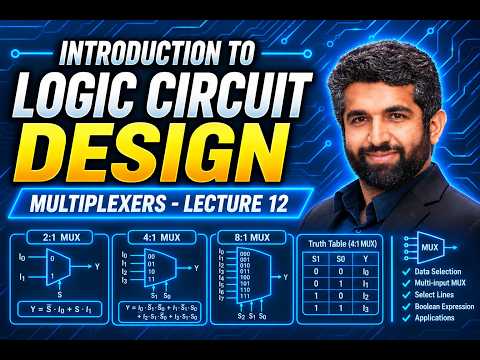
Introduction to Logic Circuit Design (University of Utah) - Multiplexers (Lecture 12)
Multiplexers select among data inputs and can implement Boolean functions such as two-variable XOR.
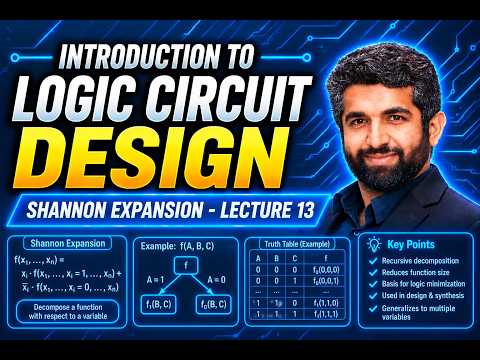
Introduction to Logic Circuit Design (University of Utah) - Shannon Expansion (Lecture 13)
Shannon expansion turns truth-table cofactors into multiplexer inputs, enabling systematic implementation of Boolean functions.
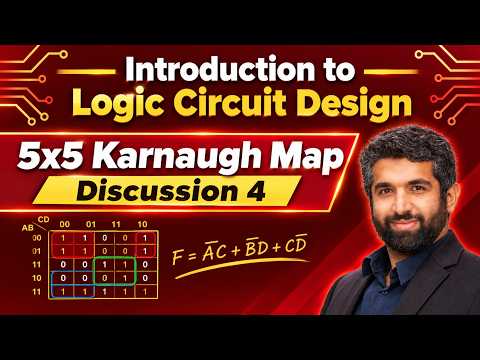
Intro to Logic Circuit Design (University of Utah) - 5x5 Karnaugh Map (Discussion 4)
Karnaugh-map don't-cares help simplify SOP expressions, while case analysis can establish that a cover is truly minimum.