Introduction to Logic Circuit Design (University of Utah) - Signed Numbers (Lecture 9)
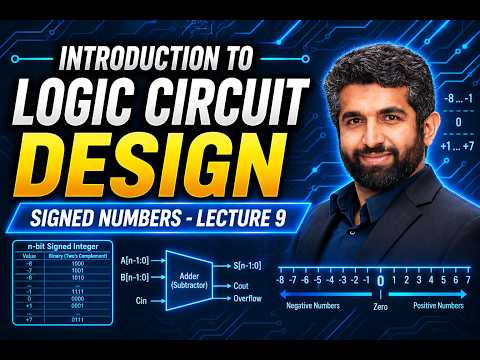 Watch on YouTube →
Overview
The University of Utah logic design lecture introduces positional number representation, conversions among decimal, binary, octal, and hexadecimal, then turns to signed integers and arithmetic. It compares sign-magnitude, one's-complement, and two's-complement representations, emphasizing fixed bit width, overflow, and the extra end-around-carry step that makes one's-complement addition inconvenient.
Key takeaways
- In base r, each digit contributes its value multiplied by a positional power of r, and valid digits range from 0 to r−1.
- Because 8 and 16 are powers of 2, binary converts directly to octal in 3-bit groups and to hexadecimal in 4-bit groups.
- Sign-magnitude assigns the leftmost bit as a sign indicator, with 0 for positive and 1 for negative, while the remaining bits encode magnitude.
- One's complement negates a bit pattern by inverting all bits; two's complement negates it by inverting all bits and adding 1.
- One's-complement addition requires wrapping a carry out of the most significant bit around to the least significant end, an extra step avoided by two's-complement arithmetic.
- A signed number's range and the possibility of overflow depend on its fixed bit width.
Chapters
- The course begins Chapter 3 on number representation and arithmetic circuits, with multipliers cited as a future circuit-design topic.
- Class announcements cover a feedback survey for extra credit, the next quiz, and homework grading and solution dates.
- A number in base r uses digits from 0 through r−1, and each digit's contribution depends on its position's power of r.
- The same positional-value calculation applies across bases, including decimal base 10 and binary base 2.
- Hexadecimal uses letters for digit values above 9, such as A for 10 and F for 15.
- Octal and hexadecimal are useful because their bases, 8 and 16, are powers of 2 and represent binary values with fewer written digits.
- Group binary digits into sets of 3 to convert to octal, or sets of 4 to convert to hexadecimal, then map each group to one digit.
- For the reverse conversion, replace each octal digit with 3 binary bits and each hexadecimal digit with 4 bits; general base conversion can use successive division.
- Unsigned positional notation represents nonnegative magnitudes, but subtraction motivates a representation that can encode negative values.
- The most significant bit (MSB) is on the left and the least significant bit (LSB) is on the right; signed formats assign special meaning to the MSB.
- The number of bits matters because it limits the values representable and can cause overflow, a concern illustrated with 64-bit computing.
- In sign-magnitude representation, the leftmost bit indicates sign: 0 means positive and 1 means negative.
- The remaining bits encode the magnitude, separating sign information from the ordinary binary value.
- Signed representations depend on a specified bit width, so the same bit pattern's interpretation depends on how many bits are assigned.
- One's complement forms a negative value by inverting every bit of the corresponding positive bit pattern.
- Two's complement uses the inverted bit pattern plus 1, making its negative-value equation differ from one's complement by one.
- The lecture compares these as distinct fixed-width signed-number conventions rather than treating a bit pattern as having one universal meaning.
- Worked binary additions demonstrate how signed values are combined using complement representations.
- In one's-complement addition, a carry out of the most significant position must be wrapped around and added back to the low-order bits.
- That end-around-carry adjustment makes one's complement less convenient; the lecture also flags overflow as a consequence of finite bit width.
Transcript excerpt
0:07 So we start chapter 3 which is number representation and arithmetic circuits. So by the end of this chapter will learn how to design hopefully some armatic circus like other multiplier and other cool circ for announcements I didn't have it at the beginning of the class but yeah so we have extra credit week 1 to3 feedback surve please that out is very helpful for goes and doesn't go and you get some extra credit basic bonus point the upcoming
0:58 this is wrong 920 basic upcing we have our quiz second quiz next thsday basic in a try to grade quiz one by m So you can see the results of that as well and the homework one and two would be graded Monday Tuesday that time frame so the material of two would be again it happens in the class we gna start 34 sharply would be mostly homework two and homework 3 material homework solution has been uploaded on canvas homework 3 upload the solution on Tuesday basically so our Sunday is a normal
1:45 deadline we have we give one grace day if someone is late but it is 25% deduction so don't plan for that but if anything happens and we upload the solution after that so it is mainly lecture 1 to seven material but with the more emphasis on carap so it would be basically car maps material mainly but for that you need any question so please be pr forve take the slides seriously and sim talked about the beginning of this class
2:40 that number can be represented binary 10 number any follows equ value any bases if base is r if base is r that means digits allow to use 10 for
3:46 [گلویش را صاف میکند] ز show 15 and okay this might be written
This is the start of the transcript. Save this video free for the whole transcript, searchable and time-coded.
Related notes
Summary, takeaways, and chapters were generated by AI from the video's transcript and may contain errors. The video belongs to its creator, MEDAL-Research.