MidMidtermSupport jjPHY203 FA26
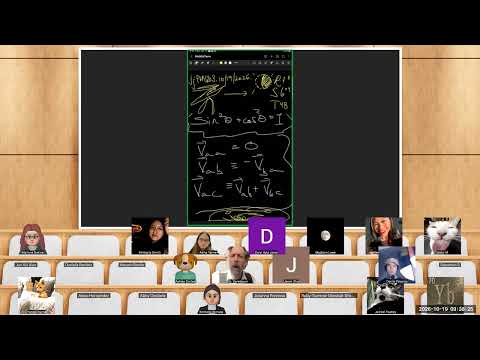 Watch on YouTube →
Overview
Dr. Yaverbaum explains how to produce a polished, individualized PHY203 take-home midterm that demonstrates physics reasoning, not just final answers. He clarifies the five-step method, responsible use of AI, and the boat-current problem: part D is a visual estimate, part E uses vector components and Galileo’s principle of relativity, and parts F and G organize and complete vectors across three reference frames.
Key takeaways
- Treat the take-home midterm as a scientific report: draft the reasoning first, then submit a polished final document by Wednesday at 9:24.
- Step 3 should introduce general principles that apply beyond one problem; step 4 should show their detailed application, with equations, English explanations, and diagrams.
- AI use is allowed, but students should question AI outputs and produce an individualized explanation grounded in PHY203 lectures and labs.
- For question 4 part E, resolve the selected relative-velocity vectors into components, sum them in an X-Y chart, and reconstruct the result with a Pythagorean triangle.
- Part D’s scaled, non-right vector diagram provides an approximate prediction that should agree with part E’s calculated boat velocity relative to shore.
- Parts F and G organize boat, water, and shore velocities across three reference frames; same-frame vectors are tail-to-tail, and the missing sides follow vector relations such as AB + BC = AC.
Chapters
0:00
PHY203 Midterm Support and the Final-Document Approach
- Dr. Yaverbaum frames the session as support during an unusual midterm period, with several nights still available to improve the work.
- He recommends treating the take-home exam like a report or presentation: work through a rough draft, then submit a neat, proofread final document.
- The submitted version should read as finished work rather than scratch calculations or thinking in progress.
7:36
Correcting Two Midterm Typos Before Continuing
- Dr. Yaverbaum says two exam errors were corrected in the Google Stream and in a re-uploaded document.
- One typo gave 0.04 meters where the intended value was 0.4 meters.
- He also says outdated wording in question 4 part D was removed because it incorrectly altered the question.
9:36
Why Steps 3 and 4 Should Over-Explain the Physics
- Dr. Yaverbaum advises students to over-explain, especially in steps 3 and 4, instead of shortening their reasoning.
- Include seemingly small algebra moves, such as dividing both sides by 2, when they form part of the solution process.
- Present equations alongside English explanations, diagrams, arrows, or color-coded notes so the reader can follow how the reasoning develops.
13:08
Separate General Principles in Step 3 from Problem-Specific Work
- Step 3 should state principles, definitions, or equations that are generally true and then apply them to the problem, rather than list facts true only in that particular setup.
- Most step 3 sections use one or two conceptual tools, with about three as a practical maximum.
- When first introducing a principle, explain its equation in English; later references can rely on that earlier explanation.
18:12
Choose Handwriting or Typesetting for Readability and Authenticity
- Dr. Yaverbaum accepts handwritten, tablet-written, or typed submissions if the final work is clear, thorough, inviting, and easy to read.
- Neat handwriting can support diagrams, color, and explanatory notes; Overleaf is a suitable option for students already comfortable typesetting mathematics.
- Poorly formatted typed work can be hard to follow and may appear copied, so students should not adopt unfamiliar software just to make the document look formal.
23:16
Use AI as a Tutor, but Keep the Midterm Your Own
- Dr. Yaverbaum does not ban AI; he asks students to use it, if helpful, as a tutor or colleague and to question its answers in the specific context of PHY203.
- A strong submission should reflect the student’s own understanding of class material, rather than look like text generated by Gemini or another chatbot.
- He describes the exam as open-world: students may use resources such as classmates, videos, and lab material, but must still explain and connect the ideas themselves.
- The final document is due Wednesday morning at 9:24 and should look like a revised final draft; students do not submit a rough draft for grading first.
26:15
Responsible Open-World Work and Learning from AI Dialogue
- Dr. Yaverbaum says an open-world exam does not require students to promise they will never use AI; the goal is to show that AI supported their work without replacing their thinking.
- He recommends dialoguing with AI about confusing physics ideas, then testing its answers against the course’s specific framing and asking follow-up questions.
- The exam is intended to practice scientific responsibility, where employers, graduate schools, and research funders assess the quality and individuality of the work.
- Students may use lab knowledge, but should explain it and connect it to lecture concepts rather than treating “we learned it in lab” as proof.
37:00
Connect Lab Knowledge to Lecture Physics
- Dr. Yaverbaum confirms that at least one midterm question checks whether students paid attention in lab.
- Lab observations and concepts can reinforce lecture material, but must be explained as part of the solution.
- A self-contained submission teaches the reader why a lab-based claim applies, rather than merely naming the lab as its source.
39:16
Clarifying Question 4: Boat Velocity Relative to Shore
- Parts D and E ask for the same quantity: the boat’s velocity relative to shore, expressed as both a speed and a direction.
- “From the perspective of the shore” means treating the shore as at rest and finding the boat’s velocity in that reference frame.
- The final direction should be given as an angle with a compass orientation, such as degrees southeast or northwest.
- Dr. Yaverbaum notes that question 4 has no part C; parts A and B are brief five-step exercises before the main D and E work.
45:22
Part E: Resolve Velocity Vectors into Components
- Part E finds the boat’s velocity relative to shore by adding the appropriate velocity vectors, selected using Galileo’s principle of relativity.
- Break each chosen vector into horizontal and vertical components, producing two right-triangle diagrams.
- Use an X-Y or VX-VY chart to sum components, then combine the resulting components in a third, Pythagorean triangle.
- The first time a student invokes Galileo’s principle, step 3 should explain its meaning and identify which objects and relative velocities correspond to the equation.
50:20
Part D: Draw a Scaled Vector Estimate to Check Part E
- Part D is a visual estimate, not a numerical component calculation: draw two relevant velocity vectors tip-to-tail and add the vector that completes the triangle.
- The completed non-right triangle should show the physical relationship among the velocities and, if drawn to scale, suggest the answer’s approximate magnitude and direction.
- Report a reasonable visual estimate, such as about 40 or 45 degrees, rather than false precision like 42.3 degrees.
- Compare the estimate from D with the computed result in E to check whether the direction and magnitude are consistent.
54:20
Partial Credit and Consistent Five-Step Solutions
- The five-step method earns credit for presenting and analyzing a problem even when a later calculation is wrong.
- Dr. Yaverbaum says he generally avoids punishing the same early mistake repeatedly if the student applies it consistently afterward.
- Step 5 can receive its highest score only when the final answer is correct, though a consistent solution with an earlier error can still earn substantial credit.
- He recommends using the five-step method for each subpart, including D, unless a clearly signposted shared setup makes a combined treatment easier to read.
59:20
Choosing Question 2 or 3: Computation Versus Relativity
- Students complete question 1 and question 4, then choose question 2 or question 3.
- Question 2, “Big Old Duck,” uses two-dimensional motion and more computation, including quadratic equations, but builds on material covered in class.
- Question 3 is a classic one-dimensional test of Galileo’s principle of relativity, with fewer computations if solved from the bottle’s reference frame.
- Students choosing question 3 should explain the physics behind claims about the boat’s travel time, especially any comparison between its upstream and downstream trips.
1:07:00
Parts F and G: Compare Three Frames and Complete the Vector Triangles
- Part F asks for three incomplete, tail-to-tail vector diagrams, one each from the water, boat, and shore reference frames.
- For the water frame, label boat relative to water and shore relative to water; the other frames use water relative to boat with shore relative to boat, and water relative to shore with boat relative to shore.
- Vectors observed in the same frame should be shown tail-to-tail, not tip-to-tail, because tip-to-tail represents vector addition between compatible relative velocities.
- Part G completes each triangle using relations such as AB + BC = AC and identifies the missing vector’s magnitude and direction, largely by arranging results already found in earlier parts.
Summary, takeaways, and chapters were generated by AI from the video's transcript and may contain errors. The video belongs to its creator, Dr. Yaverbaum.