UNC COMP 301 - F26/Lec 15 - Observer (part 2); Lambda exp. and Anonymous classes; JavaFX Intro.
 Watch on YouTube →
Overview
Muhammad Sayeed Ghani develops the Observer pattern through three Java basketball-game versions: first one subject per observer, then multiple subjects, and finally event-specific notifications. He connects the pattern to single-method lambda expressions and anonymous classes, then introduces JavaFX by comparing it with AWT and Swing and demonstrating the Maven run workflow.
Key takeaways
- Passing the subject reference into update supports observers that follow multiple subjects without keeping a list of subjects or a single-subject field.
- A push-style Observer design sends notifications from the subject to registered observers; including an event object lets observers distinguish score changes, lead changes, and other event categories.
- Use lambdas for concise, one-off implementations of single-method interfaces, but prefer named classes when behavior must be reused or needs fields and inheritance.
- Anonymous classes provide inline implementations with state, multiple methods, and inheritance, making them a middle ground between lambdas and named classes.
- Java GUI libraries trade off platform behavior differently: AWT delegates rendering to native systems, Swing supplies Java-based components, and JavaFX adds CSS styling and responsive layouts.
- JavaFX requires a Maven dependency and plugin workflow; after updating pom.xml, reload Maven projects and run the application through the JavaFX plugin.
Chapters
- The lecture reviews the Observer pattern and lambda expressions before introducing JavaFX.
- The upcoming user-interface sequence will include JavaFX and the Model-View-Controller architecture.
- JavaFX will be used in an upcoming assignment, with setup issues worth resolving before it is released.
- A basketball game acts as the subject, while UNC and Duke fans act as observers.
- Observers register with the subject; when a team scores, the subject calls each observer's update method.
- The subject interface combines registration methods such as addObserver and notifyObservers with game-specific operations such as tracking scores.
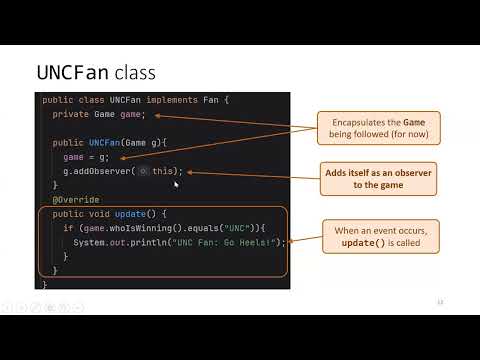
- In the first design, each fan stores a reference to a Game passed through its constructor and registers itself with that game.
- The fan's update method reads the game state to decide whether to cheer for its team.
- The UML diagram shows an association between the observer and subject interface because the fan holds a game field; aggregation could also be reasonable for this one-to-one relationship.
- A fan may follow multiple games, so storing just one Game field in the observer limits the design.
- Because the pattern uses a push model, each subject can pass itself to the observer when it calls update, using this as the subject reference.
- Passing the subject into update removes the need for an observer-side list of games or a constructor dedicated to storing and registering a single game.
- The revised main method creates a list of games, including Duke versus UNC, UNC versus NC State, and Duke versus Georgetown.
- It creates fan observers separately, then explicitly registers each observer with selected games.
- The observer no longer stores a Game field, so its UML relationship to the game is a dependency rather than an association.
- Version three extends the multiple-subject design to distinguish events such as ordinary score changes, lead changes, and substantial leads.
- The update method gains an event parameter in addition to the subject reference, allowing observers to identify both the game and the event.
- A GameEvent interface can expose event details through getters, including the event type and the team that scored.
- The Game implementation creates an event inside scorePoints after updating the teams' scores, then includes it in observer notifications.
- Example event categories are a score change, a lead change, and a big lead.
- The example lead-change logic is incomplete if it only checks whether the game was tied: a team can also take the lead by overtaking an existing one-point lead.
- Version three retains multiple games and registered fans while adding GameEvent and its implementation.
- Observers receive both the Game reference and event information, enabling responses tailored to the event.
- UML diagrams help track how the design changes across versions, including the event object created by the Game implementation.
- The Fan observer interface has one method, update, and the revised observer has no fields, making it suitable for a lambda expression.
- A lambda consists of parameters, an arrow, and a method body; its parameters must match the interface method's parameters.
- The variable should use the Fan interface type, following programming-to-the-interface practice, while the lambda body replaces a named fan implementation.
- A lambda still implements the interface method, so code invokes it with the object name and method name, such as tarHeel.update(...).
- Lambdas fit one-method interfaces and one-off implementations, but repeated lambda bodies for many fan instances create duplicated code.
- Use a named class when instances need shared reusable behavior, fields, or inheritance; lambdas cannot hold fields or support inheritance.
- An anonymous class provides inline implementation without a separately named class, while supporting fields, multiple methods, and inheritance.
- Its syntax uses new followed by the interface name and a body containing the implementation, even though ordinary instantiation uses a concrete class.
- Anonymous classes and lambdas are most useful for one-off cases; a named class is preferable when the implementation needs reuse.
- Human-computer interaction covers interfaces for computers embedded in phones, cars, medical equipment, and home sensors.
- Interaction methods include command-line input, graphical controls, speech, gestures, robotics, and haptic devices.
- The course focuses on GUIs, where components such as buttons and sliders collect human input and prompt computer responses.
- AWT uses abstract components implemented natively by each operating system, producing platform-dependent rendering and a limited lowest-common-denominator feature set.
- Swing implements its concrete components in Java, so its look and feel is more consistent across operating systems.
- JavaFX is presented as the modern successor, with CSS-based styling and responsive layouts, but it must be added separately rather than coming bundled with the JDK.
- JavaFX requires a Maven dependency in pom.xml; after editing the file, reload the Maven projects.
- Rather than relying on the usual IDE run button, launch the application through the JavaFX plugin's JavaFX run task.
- The demonstrated Hello, World application opens a separate window with a clickable button; the next lecture will build a JavaFX application from scratch.
Transcript excerpt
0:00 So, we've had a couple of slow weeks, the last recently, so I'm going to spend some time today just reviewing some of the things that we've talked about in the last 2 weeks. Besides, of course, covering a bunch of new material. So, we'll spend a little bit of time taking a look at the observer design pattern, which we introduced in the last lecture, which was a week ago. And also take a look at how lambda expressions are going to be utilized in the observer design pattern, and that again was discussed 2 weeks ago. That might need a bit of a revision. And then, depending on how much time we have left, we might do just a little bit of an introduction to our next major topic, which is graphical user
0:47 interfaces using JavaFX. It's a library available from Java, and that's going to be used in your next assignment, which should be coming out in about a week's time. All right. So, let's go ahead and do a quick take a quick look at where we are in the semester. So, we are, as I said, moving actually ahead of schedule, in fact, substantially ahead of schedule. Today, we should be finished with the observer design pattern, and we should be starting JavaFX most likely in a proper way in the next two lectures. And that will move us into the user interface discussions, which includes
1:34 the model-view-controller. And the model-view-controller is sort of an overall architecture, which we're going to be using in the last two homework assignments. Which is actually the last assignment, but it comprises of two parts. And then, subsequent to that um for most of November, we should be probably taking a look at some of the topics which we might have missed uh in
This is the start of the transcript. Save this video free for the whole transcript, searchable and time-coded.
Related notes
Summary, takeaways, and chapters were generated by AI from the video's transcript and may contain errors. The video belongs to its creator, Muhammad Sayeed Ghani.