Fischer Projections Explained: Convert Structures & Determine R/S Configuration
 Watch on YouTube →
Overview
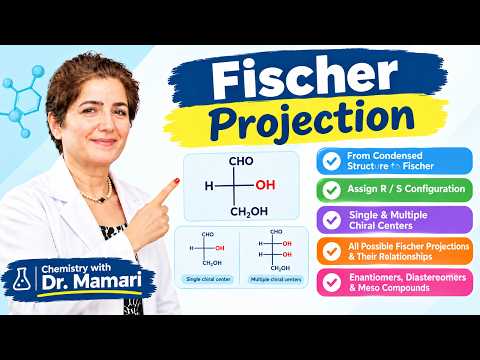
Fischer projections encode the carbon chain on vertical bonds pointing away and substituents on horizontal bonds pointing toward the viewer. The lesson shows how to convert condensed structures, assign R/S configurations using CIP priorities and the horizontal-bond inversion rule, enumerate up to 2^n stereoisomers, and distinguish identical compounds, enantiomers, diastereomers, and meso forms.
Key takeaways
- Fischer projection vertical bonds point away from the viewer, while horizontal bonds point toward the viewer.
- After assigning CIP priorities, use the usual clockwise-R and counterclockwise-S rule only when priority 4 points away; when priority 4 lies on a horizontal bond, invert the result.
- A molecule with n independent chiral centers can have up to 2^n stereoisomers; two centers therefore allow up to four configurations.
- Enantiomers have opposite configurations at every stereocenter, while diastereomers differ at one or more but not all stereocenters.
- Identical R/S designations at all corresponding centers indicate the same compound when the molecular connectivity is also the same.
- A plane of symmetry can make a stereoisomer meso and reduce the number of distinct compounds below the 2^n maximum.
Chapters
- Draw the carbon skeleton vertically and place the substituents on horizontal bonds; each horizontal level represents one chiral center.
- The example with O, ethyl, methyl, and H assigns priorities by atomic number and then compares the carbon groups.
- In a Fischer projection, vertical bonds point away and horizontal bonds point toward the viewer; if priority 4 is horizontal, reverse the usual clockwise-R and counterclockwise-S result.
- Place the more oxidized aldehyde end at the top of the vertical chain and draw one horizontal line for each of the molecule's two chiral centers.
- Swapping H and OH at a center changes that center's configuration; with two independent centers, the maximum is 2^2 = 4 configurations.
- A symmetry plane can reduce the number of distinct compounds: identical ends may permit a meso form, while different ends prevent that symmetry in the example.
- Assign CIP priorities separately at each stereocenter, including comparing carbon groups by the atoms attached to them; a carbonyl carbon outranks a carbon attached to oxygen and carbon in the illustrated comparison.
- The lesson identifies structures with configurations 2S,3S and 2R,3R as enantiomers because both centers are inverted.
- Structures that differ at some but not all stereocenters are diastereomers; matching R/S labels at every center indicate the same compound.
- For n stereocenters, 2^n is the maximum configuration count, but symmetry can make some configurations identical.
Transcript excerpt
0:00 Fishial projection from condensed structure. Uh when you're drawing fishial projection, you're going to draw a vertical line first a vertical line and then count how many chyro centers you have. How many chyro centers for this molecule? >> One. >> One. So you're going to use only one horizontal line. Number of horizontal line aligns with how many kyro centers you have. If uh the carbon chain that you so vertical line is carbon chain the horizontal line are the groups attached to the carbon chain are the branching branching. Okay. So in this case we have CH3 we have H
0:47 O CH2 CH3. How do we know if H is on the right side or left side? We don't know. But this is one acceptable fisher projection. How many facial projection we have for this? It's going to be at least for this one is two. What would be the mirror image? See drawing mirror image is much easier with the facial projection. What group goes here? >> H >> H and here >> O. This one is going to be CH2CH3 and CH3. So we have two structures. One is going to be R. The other one because it's a mirror image is going to be S. some similarity. Assigning priority is the same. Which one is the highest priority?
1:35 I'm going to start with the structure one first. What's the highest priority? >> Oxygen. >> Oxygen. So that's this group. Lowest priority. >> Hydrogen. >> Between two and three. >> Eth would be two and metal would be three. And this is structure one because it's identical. two three and four. If I go from priority one to two to three, is it clockwise or counterclockw counterclockwise for structure one? >> Structure one is counterclockwise. Structure two.
This is the start of the transcript. Save this video free for the whole transcript, searchable and time-coded.
Related notes
Summary, takeaways, and chapters were generated by AI from the video's transcript and may contain errors. The video belongs to its creator, Chemistry with Dr. Memari.