Hydration of Alkenes Made Easy! | Markovnikov vs. Anti-Markovnikov | Organic Chemistry
 Watch on YouTube →
Overview
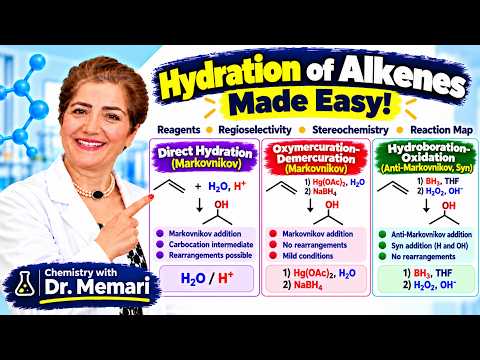
Alkene hydration adds H and OH across a double bond to form an alcohol, and the product’s regiochemistry and stereochemistry depend on the reaction pathway. Dr. Memari compares acid-catalyzed direct hydration, oxymercuration-demercuration with Hg(OAc)2/H2O then NaBH4, and hydroboration-oxidation with BH3·THF then H2O2/NaOH.
Key takeaways
- Acid-catalyzed direct hydration is Markovnikov because water attacks the more substituted, more stable carbocation, but that carbocation can rearrange.
- Oxymercuration-demercuration uses Hg(OAc)2/H2O followed by NaBH4 to produce a Markovnikov alcohol through a bridged intermediate, with anti addition and reduced rearrangement risk.
- Hydroboration-oxidation uses BH3·THF followed by H2O2/NaOH and places OH on the less substituted alkene carbon, giving an anti-Markovnikov alcohol.
- Hydroboration adds H and BH2 syn through a bridge; oxidation replaces BH2 with OH at the same carbon, preserving the net syn relationship.
- Reagents written as sequential numbered steps indicate that the first-stage product is formed before the second reagent is added.
Chapters
- Hydration adds H and OH across an alkene, producing an alcohol.
- Direct hydration uses H+ to form a carbocation; the more stable carbocation determines Markovnikov placement, and rearrangements may occur.
- Oxymercuration-demercuration uses Hg(OAc)2 and H2O first, followed by NaBH4 as a separate second step.
- The alkene attacks electrophilic HgOAc+ to form a bridged mercurinium intermediate, rather than a free carbocation.
- Water attacks the more substituted carbon, opens the mercury bridge, and deprotonation gives the oxymercuration product.
- NaBH4 replaces the carbon-bound mercury group with H, yielding a Markovnikov alcohol with anti addition.
- The bridged intermediate restricts rearrangement compared with direct acid hydration.
- Hydroboration uses BH3·THF; THF stabilizes electron-deficient BH3, and H2O2/NaOH carries out the oxidation step.
- In the concerted bridge-forming addition, BH2 bonds to the less substituted carbon while H bonds to the more substituted carbon.
- Oxidation replaces the carbon-bound BH2 with OH without changing its position, producing an anti-Markovnikov alcohol.
- Because H and BH2 add from the same face and OH replaces BH2, the net addition is syn.
Transcript excerpt
0:00 For hydration of alkene, we have three different reactions. When you say hydration, that means you're adding water. Just like hydrating, adding water. Dehydrated means lack of water. Hydration, addition of water. So, basically is adding H2O, right? H2O. What does that mean? It means you're you're adding H and OH. H to one carbon, OH to another carbon. That means hydration. The first reaction we had the mechanism already is known as direct hydration. So, H+ comes in first, forms a carbocation. The more stable carbocation will give you the product. And the more stable carbocation is the secondary carbocation. So, OH is added
0:49 to the second carbon in this case. There is always chance for rearrangement whenever you have carbocation intermediate. Not restricted carbocation. Not like bromination that you have a triangle. So, if it's not restricted carbocation, there is chance for rearrangement. A second reaction for hydration. So, all three of them are for hydration. That means at the end of the last product is going to be alcohol. When you add water to alkene, you end up with alcohol because you're adding H and OH. The third one is known as hydroboration oxidation. Now, what's the reagent for oxymercuration-demercuration? Oxymercuration-demercuration is mercury(II) acetate and water.
1:37 You add these two. And the next step number two, when you separate by comma or separate the reagents by backslash, that means you're adding together at the same time. If you separate by number, means you isolate the product. Then you do the second step of the reaction. You basically get a compound as a product, and then you add the second reagent. It's not that like you're just getting intermediates and the nucleophile attacks. You add the reagent later after the first step is done. And the next step,
This is the start of the transcript. Save this video free for the whole transcript, searchable and time-coded.
Related notes
Summary, takeaways, and chapters were generated by AI from the video's transcript and may contain errors. The video belongs to its creator, Chemistry with Dr. Memari.