SOC 220 - October 27
 Watch on YouTube →
Overview
Jeff Brassard explains ethnographic research as participant observation shaped by access, trust, researcher roles, and careful documentation. He distinguishes overt and covert approaches, outlines four participation roles and their risks, and shows why timely field notes and separate analytic memos matter; the class also reviews midterm results, including a 77 average.
Key takeaways
- Overt ethnography is generally easier to justify ethically because researchers disclose their role and participants can choose whether to take part; covert research risks consent violations and is rarely approved.
- A sponsor can unlock access even in an open setting: community-center organizers helped Randall Contreras gain trust among aging Latino gang members after his initial visits drew suspicion.
- Confidentiality requires refusing to confirm who has participated, especially in small research communities where names and referrals can expose participants.
- Ethnographer roles trade access against bias and context: complete participation risks overidentification, while complete observation limits understanding of why people act as they do.
- Researchers must decline requests to carry items, pass messages, commit crimes, or form romantic relationships, since even a seemingly minor favor can create legal, ethical, or safety risks.
- Field notes should be written promptly and kept distinct from analytic memos; the notes preserve observations, while memos connect those observations to theories such as Foucault's concept of power.
Chapters
- The class midterm average was 77, with especially uneven results on short-answer questions.
- Common errors involved nominal versus operational definitions, inductive versus deductive approaches, and nomothetic versus idiographic research.
- Jeff Brassard invited students to book appointments or review exams after class; the first quantitative assignment was still being marked.
- Ethnography uses participant observation in real-world settings, ranging from a weekend at San Diego Comic-Con to years of visits to community centers.
- Interviews and content analysis often supplement participant observation.
- Open settings are easier to enter than closed settings, while covert studies face substantial ethical barriers and are rarely approved under modern standards.
- Researchers entering closed settings often need a gatekeeper who grants access or a sponsor who vouches for them.
- Access negotiations should specify research aims, methods, intrusiveness, and time commitments.
- One researcher negotiated to complete much of RCMP training in Regina, including tear-gas training, while agreeing not to report private conversations without permission.
- Even open settings such as Alcoholics Anonymous meetings may require trusted introductions and consent before participants will speak freely.
- Randall Contreras studied aging Latino gang members by visiting community centers where they played basketball.
- Contreras initially met suspicion; community-center organizers introduced him, and their pronunciation of his name helped him appear more culturally familiar to participants.
- Introductions also enabled criminologists to build research contacts with Hells Angels members in Edmonton.
- Initial enthusiasm from sponsors or participants can fade as people question a researcher's motives, worry about information leaks, or try to obstruct the study.
- A graduate student lost a planned hour-long interview with a producer after repeatedly insisting that the color yellow in the miniseries Roots had hidden significance.
- Researchers should avoid acting like know-it-alls, stop pressing questions that irritate participants, and preserve relationships through tact.
- Researchers may adopt a suitable social role, but flirtation can create confusion, compromise consent, and endanger research relationships.
- A researcher named Kelly created the World of Warcraft character Survey Lady to conduct surveys and join raids while studying gender dynamics.
- Participants may test confidentiality by asking whether a researcher has interviewed particular people; researchers should not disclose who has participated.
- In prison research, participants may test whether minor disclosures reach correctional officers, so researchers need a clear confidentiality practice.
- A Hollywood executive spent the first 30 minutes of an interview testing Jeff Brassard's knowledge of television projects in Russia before agreeing to a longer conversation.
- Snowball sampling lets participants choose whether to refer others, avoiding a researcher's direct disclosure of who has already taken part.
- Researchers may need to renegotiate access when managers change or circumstances shift, and should adapt rather than treat access as permanent.
- Key informants are especially knowledgeable and cooperative participants who can clarify a setting and introduce the researcher to others.
- Relying on a few key informants can exclude other group members or alienate people who dislike those informants.
- Because key informants may not represent the whole group, their accounts should be treated as one perspective rather than a complete picture.
- Complete participation means secretly adopting a group's role and participating as though the researcher were an ordinary member.
- The covert approach can produce close access, but it is uncommon because of ethical, access, and safety concerns.
- Researchers risk overidentifying with participants and softening criticism, or disliking them and portraying them too negatively.
- A covert study of a white nationalist group illustrates how immersion can produce strong reactions toward participants.
- A participant as observer takes part openly, as Survey Lady did in World of Warcraft raids, but participants may change their behavior because they know they are observed.
- An observer as participant stays at the edge of a group, such as attending an AA meeting without joining the discussion, which can make interpretation harder.
- A complete observer does not interact with participants and can document public behavior, but gains little context or depth.
- These roles form a continuum rather than rigid categories, and the SOC 220 mini-assignment will use complete observation.
- Taking part in activities, such as playing basketball or joining a World of Warcraft raid, can establish credibility with participants.
- Researchers should not commit crimes, carry packages, pass messages, give rides, or begin romantic relationships with participants.
- In prison settings, even bringing a participant a pen can violate rules and create leverage that threatens the researcher's access or safety.
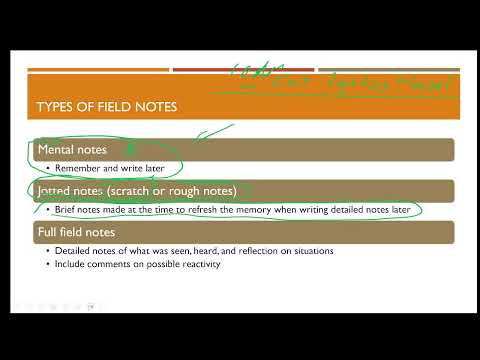
- Field notes record events, conversations, behavior, setting details, and initial reflections from participant observation.
- Researchers should write notes as soon as possible, ideally during observation, after an interaction, or by the end of the day, because memory can distort events.
- Focus-group note-takers can record context missing from audio, such as a participant tuning out, looking at a phone, or showing confusion.
- Audio and video recordings can supplement notes, but long recordings create substantial review and transcription work.
- Mental reminders and brief scratch notes, once written in pocket notebooks and now often captured on phones or iPads, should be expanded into detailed field notes.
- Full notes document what the researcher saw and heard, contextual details, reflections, and ways the researcher's actions may have affected events.
- Analytic memos connect field-note observations to concepts such as Michel Foucault's power or biopolitics, while remaining separate from the descriptive data.
- Jeff Brassard postponed visual ethnography and interviewing until the next class; he also noted that Otter AI and Gemini raise data-security and funding questions for transcription.
Transcript excerpt
0:45 really Alrighty. I think somewhere is my PowerPoint. Okay. Um, welcome to the room of multiplying tables and chairs. Um, I don't know how they do it. It's a arcane art.
1:34 Conjure tables from nowhere and chairs apparently. Nope. Still the one with the gross stain on it. Okay, good. Um, I'm like, did the stain go away? Is this a new chair? It is not. Um, okay. So, uh, midterms are marked. Um, class average was 77. So, not too too bad. Um, you know, some real highs and lows. Um, especially when it came to the the short answer. Um, so, um, if you're wanting to have a look at it, um, you can book an appointment with me. I have quite a few spots left, especially on Friday this week. Um, so do go ahead, but then next week, you
2:20 know, stuff starts to ease off as well because my 377 class is having its second midterm. So then there's going to be a bit of a gap um where they're not looking for office hours as much. Um marking of the first the quantitative assignment is underway. Uh but you know it's going to probably take a while because they're fairly involved. So yeah, patience. But oh sorry that wasn't a hand up for me. That was a hand up for the person. They were like this like what what the No, I'm kidding. Like why aren't our assignments marked? They've been in for like one whole week. It's underway. Sorry, I I I misread your body language. So, >> what does it even matter what I got
3:12 wrong? No, that's fair. That's fair. That's uh And honestly, if your if your grade is kind of like okay, then maybe not. I don't know. You could just come and see it if you want.
This is the start of the transcript. Save this video free for the whole transcript, searchable and time-coded.
Related notes
Summary, takeaways, and chapters were generated by AI from the video's transcript and may contain errors. The video belongs to its creator, Jeff Brassard.