SOC 220 - Sept 3
 Watch on YouTube →
Overview
Jeff Brassard introduces social research methods by showing how theories, research questions, and assumptions about knowledge shape study design. He contrasts deductive theory-to-data research—often quantitative—with inductive data-to-theory research—often qualitative, then explains positivism, interpretivism, ontology, and the role of values, politics, funding, and gatekeepers in research. Examples include social-media use and mental health, the National Study of Youth and Religion's 3,000 surveys and 300 interviews, and prison research in Alberta.
Key takeaways
- Deductive research moves from theory to data: researchers formulate hypotheses such as H1–H3 and test them, commonly with quantitative surveys.
- Inductive research reverses that sequence, building theory from collected data; grounded theory is a common qualitative example.
- Positivism treats social phenomena as measurable and often value-free, while interpretivism focuses on subjective meaning and how people understand their own lives.
- Ontology and epistemology guide method choices: objectivist and positivist assumptions often lead to quantitative measurement, while constructionist and interpretivist assumptions often favor interviews or ethnography.
- Mixed methods can pair broad statistical patterns with detailed participant accounts; the National Study of Youth and Religion combined 3,000 surveys with 300 interviews.
- Research feasibility depends on more than a good idea: funding priorities, political influence, gatekeepers, access conditions, and project timelines can shape what researchers can study and publish.
Chapters
0:00
Course Opening, Student Q&A, and Room-Change Request
- Jeff Brassard opens the SOC 220 social research methods class and introduces a semester-long Slido Q&A code and QR option.
- Brassard has requested a room change because the current classroom is hot and may be difficult to use for exams.
- He plans to share room updates when the university responds, with a replacement ideally nearby in Tory, Humanities, or Business.
5:26
Theories Define Concepts and Propose Relationships
- A theory explains observed patterns in the social world, such as a proposed link between social-media use and mental-health outcomes.
- Researchers must define key terms: social-media use could mean hours on designated apps, while mental health could be measured with a depression index.
- Relational statements describe how variables connect; deterministic claims assert near-certain causation, while probabilistic claims express less-than-certain evidence.
10:39
Theory Guides Research; Middle-Range Theory Dominates Sociology
- Research can begin with a theory and test it, or findings can be used to assess and revise the theory.
- Middle-range theories address limited, testable phenomena, such as social-media use and undergraduate mental health; Brassard estimates they account for nearly all sociological work.
- Grand theories by thinkers such as Karl Marx, Émile Durkheim, Max Weber, and Michel Foucault aim to explain broad features of society and are uncommon in routine research.
17:34
Deductive Research Moves from Theory to Data
- Deductive research typically begins with a theory, reviews existing scholarship, formulates hypotheses, and then tests them with data.
- Quantitative journal articles commonly state hypotheses such as H1, H2, and H3 before presenting survey or questionnaire results.
- Researchers use results to assess each hypothesis and revise the theory if the evidence does not support it.
23:38
Inductive Research Builds Theory from Data
- Inductive research starts by collecting and examining data, then develops an explanation grounded in observed patterns.
- Qualitative researchers may analyze Chinese television to identify recurring ideological messages, revisiting the material as interpretations develop.
- Grounded theory names this data-led approach; Brassard illustrates iterative observation with his own PhD research on Russian sitcoms.
27:55
Epistemology and Positivism: Measuring the Social World
- Epistemology concerns how people can gain knowledge, while ontology concerns what they believe reality is like.
- Positivism applies the natural-science model to society, emphasizing empiricism, measurement, and numerical evidence.
- Positivist research commonly uses quantitative methods and hypotheses; its value-free ideal assumes data can speak independently of researchers' beliefs.
33:36
Interpretivism and Critical Research Prioritize Meaning and Change
- Interpretivism challenges the possibility of fully objective knowledge and seeks to understand how people interpret their social worlds.
- Ethnography and interviews help researchers pursue empathic understanding; Peter Berger and Thomas Luckmann's The Social Construction of Reality is a foundational reference.
- Critical approaches, often associated with Marxism, conflict theory, feminism, and anti-racism, reject value-free research and emphasize practice and social change.
41:17
Ontology: Objectivism, Constructionism, and Critical Realism
- Objectivism holds that social phenomena exist independently of individual perceptions and can be measured, an assumption common in quantitative research.
- Hard constructionism treats reality as entirely dependent on mental and linguistic constructions; Brassard connects this position with Nietzsche and Jacques Derrida.
- A softer constructionist or critical-realist position accepts a real social world while recognizing that human interpretation limits how fully researchers can know it.
47:04
Worldview Shapes Method: Quantitative and Qualitative Research
- Objectivist ontology often aligns with positivist epistemology and quantitative methods aimed at measuring social phenomena.
- Constructionist assumptions more often align with interpretivism and qualitative methods that capture people's perspectives in their own words.
- Brassard presents these as common tendencies rather than fixed rules, noting that mixed methods can cross the apparent divide.
50:23
Mixed Methods Combine Statistical Patterns and Participant Accounts
- Quantitative research analyzes numerical data and statistics; qualitative research primarily analyzes words and other non-numeric material.
- Brassard argues that combining methods can produce richer findings by pairing survey patterns with interview explanations.
- The National Study of Youth and Religion collected 3,000 surveys and 300 interviews; Christian Smith's writing combines participant anecdotes, statistical results, and quotations.
55:27
Values Shape Topics, Methods, Analysis, and Conclusions
- Researchers' values influence which topics they choose, how they frame questions, which theoretical frameworks they use, and whether they select surveys, interviews, or ethnography.
- Brassard warns that researchers may be tempted to bury results that conflict with their commitments or a discipline's prevailing assumptions.
- He recommends reflexivity: explain relevant background and biases, such as studying Ireland as a Canadian or Russia as someone raised there, so readers can assess interpretations.
1:02:02
Three Positions on Values in Research
- One position says researchers should leave their values at the door and follow the data, though Brassard notes this is difficult in practice.
- A second position holds that research cannot be value-free, so researchers should disclose how their commitments shape the work.
- A third position treats values as a guide for investigation; Brassard is more comfortable with the middle position than with explicitly activist research.
1:04:14
Politics Influences Research Funding and Priorities
- Political commitments can affect research topics, presentation, and access to funding.
- Brassard recalls a directive under the Harper government encouraging Canada's Social Sciences and Humanities Research Council (SSHRC) to prioritize projects with business applications.
- He contrasts this with Alberta investment in carbon capture, which can support the government's political case for further oil-sands extraction.
1:07:06
Gatekeepers Control Access to Research Settings
- Closed settings such as prisons require permission from gatekeepers before researchers can recruit participants or collect data.
- For an Alberta prison study, Brassard's former supervisor sought approval from the provincial Justice Minister and negotiated access with correctional centres, including Edmonton Remand Centre.
- Access can come with conditions, from reviewing a final report or editing quotations to expectations about the study's framing and future access.
1:12:08
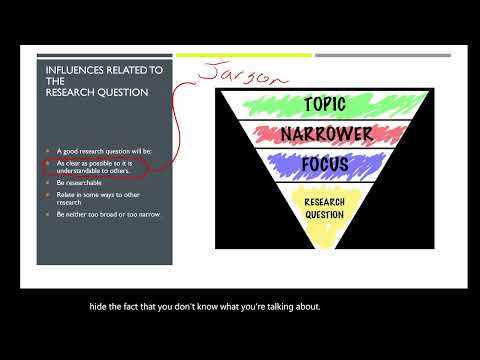
Good Research Questions Must Be Clear and Feasible
- A strong research question should be clear, understandable to non-specialists, and relatively free of specialized jargon.
- Questions must be researchable within available time and resources; Brassard recounts a master's student whose overly broad project could not be completed within a two-year funding period.
- A viable question should connect to existing research and avoid being either so broad it cannot be answered or so narrow that it yields too little to study.
Summary, takeaways, and chapters were generated by AI from the video's transcript and may contain errors. The video belongs to its creator, Jeff Brassard.