SOC 220- October 20
 Watch on YouTube →
Overview
Jeff Brassard introduces qualitative research as the study of people’s experiences, meanings, and perspectives, typically using inductive and interpretivist approaches. He explains common methods, the iterative grounded theory process, flexible concept definitions, and criteria for evaluating research, including credibility, transferability, dependability, and confirmability. The lecture emphasizes thick description and empathic understanding while showing why qualitative samples are usually non-probability samples: interviewing 400 people for two hours each would require 800 interview hours before analysis.
Key takeaways
- Qualitative research questions should foreground experience, perception, or meaning; Brassard recommends avoiding how-does-X-affect-Y formulations in the course’s assignments.
- Grounded theory is iterative: researchers collect and interpret data, revise theory and sometimes the research question, then collect more data until theoretical saturation.
- Definitive concepts specify nominal and operational definitions, while sensitizing concepts provide flexible guidance that can be sharpened as findings emerge.
- A probability sample of 400 two-hour interviews would require 800 interviewing hours, plus substantial transcription and analysis, explaining why qualitative studies usually rely on non-probability samples.
- Transferability is not population-level generalization; thick description lets readers compare a study’s detailed findings with research in similar contexts.
- Credibility, dependability, and confirmability require different checks: participant feedback, audits of procedures and evidence, and scrutiny of researcher bias.
Chapters
- The course shifts from quantitative methods to qualitative research, with mixed methods planned for later in the term.
- Qualitative research focuses on the quality of people’s experiences and how they interpret the social world.
- It is typically inductive, interpretivist, constructionist, and naturalist, although Jeff Brassard notes that exceptions exist.
- Qualitative interviews are commonly semi-structured or unstructured; focus groups interview several participants together.
- Ethnography includes participant observation and often interviews, while participant observation alone does not require interviews.
- Content analysis interprets texts and documents, such as online material supplementing observations at a furry convention.
- Discourse and conversation analysis are more common in linguistics; participatory action research combines methods to pursue social change.
- Quantitative questions often ask how an independent variable affects a dependent variable, such as screen time affecting anxiety.
- For this introductory course, Brassard recommends avoiding the how-does-X-affect-Y formulation for qualitative questions.
- Useful templates include What is the experience of a group in a circumstance? and How does a group understand an experience?
- Examples include studying single mothers in the workplace or how undergraduate students experience a math class.
- A site is the place where research takes place, especially important for ethnography and participant observation.
- Comic-Con could serve as a site for studying cosplayers, while a sports pub could be a site for observing hockey fans.
- Subjects are the people a researcher intends to interview or observe, such as Edmonton Oilers fans.
- The idealized approach begins theory agnostic, without assuming in advance what the findings will mean.
- Researchers choose methods such as interviews, focus groups, ethnography, or content analysis based on the question.
- Qualitative projects often combine methods; an ethnography may use both interviews and content analysis alongside observation.
- Researchers collect material through interviews or observation, interpret participants’ activities and meanings, and develop an initial theory.
- Grounded theory builds theory from data, then checks and revises it through additional collection and interpretation.
- Researchers may revise the research question as findings clarify what needs to be investigated next.
- The iterative process continues until theoretical saturation, when further research no longer reveals new or useful findings.
- Researchers may not actually enter the field without expectations; reading prior studies can give them an initial theory.
- A common practical pattern is theory to data to theory, rather than a perfectly theory-free progression from data to theory.
- Further interviews may involve new participants, returning participants, or follow-up conversations.
- After saturation, researchers write up findings in an article, book, or conference presentation and explain the study’s credibility and value.
- A definitive concept provides nominal and operational definitions, similar to concept work in quantitative research.
- For example, despair could be defined as hopelessness and explored through interviews about fans’ feelings toward a struggling team.
- A sensitizing concept offers broader guidance when the researcher cannot yet specify exactly what will be observed or measured.
- Brassard’s example of power began as a broad concept and was refined toward the Foucauldian idea of the imposition of subjectivity.
- Qualitative research is harder to evaluate by rerunning calculations because it relies on interpersonal data and interpretation in words.
- Trustworthiness includes four criteria: credibility, transferability, dependability, and confirmability.
- Authenticity concerns whether research is transformative or emancipatory and whether participants feel their views are represented accurately.
- Credibility asks whether the people studied agree with the researcher’s interpretation of their thoughts and actions.
- Respondent member validation can include presenting findings to participants in a focus group or sending them a final report.
- Feedback may be affected by pressure to please the researcher, limited participant expertise, or attempts to censor uncomfortable findings.
- Brassard describes sharing research with interviewees, including one recipient who replied that a 300-plus-page dissertation was too long to read.
- Qualitative studies commonly use convenience or snowball samples rather than probability samples because interviews demand extensive researcher time.
- Interviewing 400 people for two hours each takes 800 hours; allowing two analysis hours per interview adds 1,600 hours of analysis.
- A solo doctoral researcher may manage around 30 interviews, making population-level generalization inappropriate.
- Thick descriptions provide detailed context so readers can compare findings with studies of similar people or settings.
- Dependability asks whether proper procedures were followed and whether the study’s conclusions are supported by its data.
- Auditing may involve peer reviewers checking interview transcripts or ethnographic field notes against published claims.
- Making transcripts publicly available can support scrutiny but may expose sensitive participant details or enable searches using AI.
- Confirmability asks whether researcher choices, such as participant selection, introduced bias or steered findings toward a preferred conclusion.
- Qualitative research seeks empathic understanding: interpreting social life from participants’ perspectives without needing to share their feelings.
- Thick description places behavior in context, helping explain actions that might otherwise seem irrational or unusual.
- Naturalism aims to minimize researcher disruption and reactivity, or changes in behavior caused by being observed.
- Participatory action research can move beyond empathy toward sympathy by involving participants in efforts to create social change.
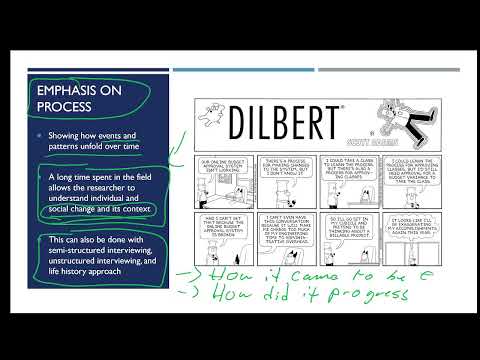
- Qualitative research examines process by tracing how events develop and how a situation came to exist.
- Interviews with people who met a spouse through a dating app could reconstruct relationship stages from first contact to marriage.
- Ethnography can follow change directly over time, while interviews or content analysis can reconstruct a process from accounts or records.
- Letters, text messages, or dating-app chats can provide a historical record of how relationships and interactions progressed.
Transcript excerpt
0:21 [sighs] [snorts]
1:18 [clears throat] >> Already, I guess uh I guess it's that time. Okay. Um So, obviously, we are now done the first half of the
2:06 course. Right? So, we finished talking about quantitative methods. Um and for the most part, you kind of put that to one side um till the end of the course. And like I said, the only thing that I think will will really come back is is right at the end. We're going to talk about mixed methods. Um where basically we take quant and qual and kind of put them together um in terms of what, you know, we can do with both of them at the same time. But that's like very end of the course. Um and then, you know, on your which I know you're probably not thinking about this yet because we just, you know, are are finishing up our um first of those major assignments, right? But when you get to sampling for your second major assignment that's due, I
2:53 think, on the last day of of class, we're very close to the end of the term. Um you know, our convenience samples that we talked about when we talked about probability sampling or non-probability samples, rather, um are things that you're going to want to keep in mind. But we'll come back to those again and and discuss them a little bit later. Okay. So, midterm was last week. Um I am I'm working my way through them as we speak. Um I hope I to have them done by Thursday or Friday. Um and as soon as they are, I will post the grades for you. Um and we'll, you know, hopefully we can work our way I can work my way. You're not doing anything. I
This is the start of the transcript. Save this video free for the whole transcript, searchable and time-coded.
Related notes
Summary, takeaways, and chapters were generated by AI from the video's transcript and may contain errors. The video belongs to its creator, Jeff Brassard.