Nov 10th - The central dogma of biology
Overview
The lecture explains gene expression through the central dogma: DNA is transcribed into RNA, and mRNA is translated into a polypeptide. It connects chromosome and allele terminology to gene regulation, bacterial transcription, eukaryotic mRNA processing, codon decoding, tRNA function, and the enzyme that loads amino acids onto tRNA.
Key takeaways
- Gene expression allows cells with the same chromosome complement to perform different jobs by turning different genes on or off.
- The central dogma links DNA to protein through two processes: transcription produces RNA, and translation reads mRNA to build a polypeptide.
- Bacterial transcription uses a sigma factor to target the promoter and RNA polymerase to read the template strand and synthesize RNA 5′ to 3′.
- Eukaryotic mRNA must be spliced, capped at its 5′ end, and given a poly-A tail at its 3′ end before it can leave the nucleus as mature mRNA.
- mRNA codons are three-base units; tRNA anticodons pair with them and deliver amino acids to the ribosome.
- Aminoacyl-tRNA synthetases use ATP to charge tRNAs with the correct amino acids, making their function essential for protein synthesis.
Chapters
- The history of DNA assignment is due by midnight, and the exam is scheduled for one week after this lecture.
- Thursday is planned as a review day, following the last new exam content in this class.
- Advising Day includes campus sessions on nursing, PNB, and research, plus opportunities to ask biology-specific questions.
- Aneuploidy affects one or a handful of chromosome sets, such as a sex chromosome pair missing one chromosome.
- Polyploidy changes the chromosome-set count across the genome, rather than affecting only a few chromosomes.
- The class identifies two karyotypes as aneuploid and one as polyploid, assuming each organism should be diploid.
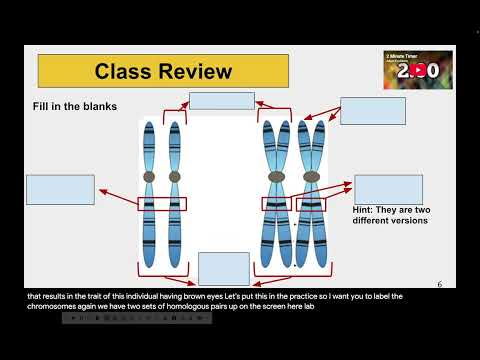
- A blue chromosome inherited from one parent and a black chromosome inherited from the other form a homologous pair.
- DNA replication during S phase produces sister chromatids, but each replicated structure is still counted as one chromosome.
- A chromosome contains many genes, each represented by a particular DNA sequence.
- A gene refers to a DNA sequence for a feature, while an allele is a version of that gene, such as a brown-eye or blue-eye allele.
- An individual inherits one allele from each parent, and the example uses B for dominant brown eyes and b for recessive blue eyes.
- The example genotype Bb produces brown eyes under the dominant-recessive model introduced for later Mendelian genetics.
- Most body cells contain the same complement of 23 chromosome pairs but express different sets of genes.
- A red blood cell can carry the eye-color gene without using it, because eye-color pigment production is not part of its function.
- Gene expression describes which genes are turned on and used to produce functional products in a particular cell.
- A gene can produce a protein, and that protein's molecular function can contribute to an observable trait.
- In the flower-color example, a gene produces a protein that makes pigment, resulting in purple flowers.
- The lecture focuses on how DNA produces a functional protein; later units connect traits to processes such as natural selection.
- Transcription copies information from DNA into RNA, while translation reads RNA to synthesize a protein.
- Together, these processes describe how a gene's nucleotide sequence can lead to a protein product.
- The lecture first examines transcription, the conversion of DNA sequence information into RNA.
- A regulatory region controls when and how much a gene is expressed; its promoter marks where transcription begins.
- A terminator signals where transcription ends, and the gene region lies between the promoter and terminator.
- Exons are retained in the final RNA product, while introns are transcribed initially but later removed.
- Introns can enable different combinations of exons to form different proteins, an area of ongoing research.
- Transcription creates an RNA copy using one DNA strand as a template.
- RNA uses uracil instead of thymine, so an A in the DNA template pairs with U in RNA; G pairs with C.
- The new RNA strand is antiparallel to its DNA template and is synthesized in the 5′ to 3′ direction.
- In bacteria, a sigma factor binds the promoter and helps RNA polymerase locate the transcription start site.
- RNA polymerase binds with the sigma factor and locally unwinds DNA to form a temporary open complex.
- Eukaryotes use multiple transcription factors and RNA polymerases, making the process more complex than the bacterial model.
- RNA polymerase reads the template strand, not the coding strand; the resulting RNA resembles the coding strand except that U replaces T.
- During elongation, RNA polymerase adds complementary RNA nucleotides and extends the transcript 5′ to 3′.
- The DNA briefly unwinds at the polymerase and rewinds after it passes, allowing RNA synthesis to proceed continuously.
- When RNA polymerase reaches the terminator sequence, transcription stops and the polymerase releases from the DNA.
- The newly made RNA also separates from its DNA template, leaving an RNA transcript.
- In the bacterial model, the transcript can be used without the additional RNA-processing steps required in eukaryotes.
- Eukaryotic pre-mRNA is spliced to remove introns and retain exons, producing a mature mRNA.
- A modified guanine cap is added to the 5′ end to help the mRNA leave the nucleus.
- A poly-A tail of roughly 100 to 200 adenines is added to the 3′ end, helping stabilize the mRNA in the cytosol.
- These processing steps distinguish eukaryotic mRNA maturation from the simpler bacterial process.
- Mature eukaryotic mRNA leaves the nucleus and meets a ribosome in the cytosol.
- Translation reads mRNA information to synthesize a polypeptide, a chain of amino-acid monomers that folds into a protein.
- The ribosome's role in protein synthesis connects the central dogma to the previously introduced function of this organelle.
- The genetic code is read in codons, groups of three mRNA nucleotides that specify amino acids or start and stop signals.
- To decode an mRNA sequence, begin at its 5′ end, divide it into triplets, and use a codon chart.
- AUG specifies methionine and commonly serves as a start codon; a stop codon such as UAA ends translation without adding an amino acid.
- The genetic code is redundant because most amino acids are specified by multiple codons, but a given codon specifies only one amino acid.
- Codons are nonoverlapping: each nucleotide is read once in its position within a three-base group.
- Several codons for the same amino acid differ only at the third position, so some sequence changes do not alter the amino acid.
- Each tRNA has an anticodon that base-pairs with a complementary mRNA codon and carries the corresponding amino acid.
- For example, the mRNA codon AAA pairs with the tRNA anticodon UUU, whose tRNA carries lysine.
- After delivering an amino acid to the growing polypeptide, a tRNA can be recharged and used again.
- A tRNA is often drawn as a cloverleaf, with an anticodon loop and an acceptor stem that carries its amino acid.
- An aminoacyl-tRNA synthetase uses ATP to attach the correct amino acid to its matching tRNA, producing a charged tRNA.
- If this enzyme fails, tRNAs cannot be loaded with amino acids, disrupting protein synthesis and the cell's ability to make needed proteins.
- The lecture closes with a review prompt on tRNA structure and the consequences of defective aminoacyl-tRNA synthetase.
Transcript excerpt
0:24 All right. Let's go ahead and get started. Uh first of all, we did content check on Thursday and we kind of ran out of time, so I said if you needed extra time, you could turn it in today. If that's the case, I have a pile up front. You can add it to it at some point today. Um let's see. Otherwise, I'm passing back content checks and test corrections. I will continue doing that throughout the lecture. We had an assignment Tuesday. I think it's still due. It's not due until midnight and I probably won't grade it until tomorrow. Uh but the history of DNA assignment, so if you haven't done that, uh go ahead and get that in by tonight. And then we have our exam one week from today. So today's content is the last content that will be on the exam. And I think
1:13 we'll get through all of it and then Thursday will be a review day. Um tomorrow is advising day. Uh so I just want to let you all know uh that there are many different sessions happening across campus. You can look up the schedule on the website here. Um but if you're interested in nursing or PNB or research on campus, there's sessions for all of those. I'd encourage you to attend since classes are cancelled. Um I know all of you have an advisor uh and many of you your advisor is your FTS advisor, um which may or may not be a bio person. If you have any bio-specific questions, I think there's a majors fair at some point that there'll a biology
2:00 table. Or if you see my office door open, feel free to pop in and ask me any question about the bio major. I'd be
This is the start of the transcript. Save this video free for the whole transcript, searchable and time-coded.
Related notes
Summary, takeaways, and chapters were generated by AI from the video's transcript and may contain errors. The video belongs to its creator, Reina's Bio Lectures.