MIME 4450 Lec 18 11 12 26
Overview
The lecture connects PLC programming to practical industrial automation: reliable data exchange, simulation, and motion control. It explains OPC UA handshaking and circular buffers, introduces Arena and robot simulation, and shows when coordinated axes are necessary, from glass cutting to fiberglass winding; Siemens S7-1200 PLCs can now perform motion-control tasks that once required specialized systems costing $250,000 in 1975.
Key takeaways
- In a one-way PLC production chain, the downstream device should generally request the data it needs; if the required data is absent, it should stop rather than proceed without confirmation.
- A circular buffer's separate read and write pointers preserve incoming data when a consumer falls behind, but its capacity must cover the expected outage because older data is overwritten after the pointers wrap.
- Arena can model production-line timing variation with statistical arrivals and help identify bottlenecks before a line is built, while robot simulators such as Fanuc ROBOGUIDE can check reach and interference.
- Coordinated motion is required when one axis must track another, such as a glass scribe matching line speed within about one or two milliseconds or a fiberglass carriage synchronizing with shell rotation.
- Modern Siemens S7-1200 PLCs can perform coordinated motion tasks that once required a dedicated system costing about $250,000 in 1975, though customer acceptance still depends on proving the application works.
- Relative motion does not require a fixed home position; for the hat-and-box task, a fast approach followed by a slow placement is a valid strategy, while overlapping axis movements can reduce cycle time.
Chapters
- Because the course has 14 scoring weeks rather than 15, every student receives a 50-point score for week 15, reducing the number of full scores needed for a perfect grade.
- The final project is worth 50% of the course grade and requires a working system, code review, and a typed English report.
- The formal final-project deadline is noon Wednesday of finals week, with a stated early-Thursday 8:30 a.m. cutoff for limited leniency.
- Week 10 assignments are returned, and the instructor says late week 10 work will be accepted only through that day.
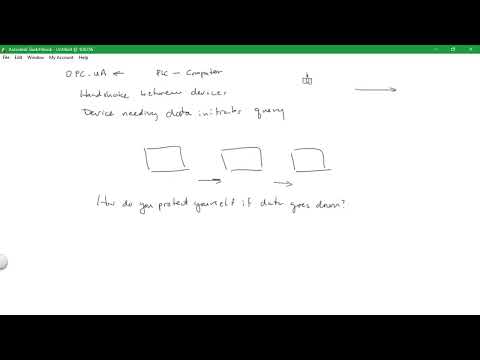
- OPC UA, or OPC Unified Architecture, can transfer data between a PLC and a computer, directly or through software such as Ignition.
- For a one-way production chain, the device that needs information should generally initiate the query.
- In a PLC1-to-PLC2-to-PLC3 sequence, PLC2 should request the data it needs from PLC1; without the data, PLC2 should stop rather than run on assumptions.
- The downstream-query rule helps make communication failures visible at the point where missing data affects the process.
- A factory dataset used in the instructor's PhD research contained 160 variables recorded in 20-minute intervals, but extensive gaps left only a few usable contiguous sequences.
- For an isolated missing interval, the instructor estimated a value by averaging the data points immediately before and after it; longer gaps were unusable.
- A circular table buffers incoming data in an array while separate write and read pointers track where data is stored and retrieved.
- When the reader falls behind, the buffer preserves data temporarily; at the end of the array, pointers wrap to the beginning and older entries are overwritten.
- Siemens PLCs provide circular-table functionality in their instructions, while Allen-Bradley users may need to implement the mechanism themselves.
- Arena is a statistical, graphical simulation package used to model production lines and identify bottlenecks before building a system.
- Arena simulations can introduce parts with normally distributed arrival times, exposing how timing variation affects line performance.
- A digital twin is a digital representation of a physical process, useful for testing control ideas, though it is not a perfect substitute for the real system.
- Fanuc's ROBOGUIDE simulates robot reach, timing, and possible arm interference; Hiwin robots also have a simulation package.
- The upcoming assignment asks students to program a multi-axis system, requiring them to decide whether the axes need coordinated motion or can operate independently.
- The examples extend PLC work toward robotic-arm applications, even when the equipment is not conventionally called a robot.
- A coordinated system links axis movement so that one axis responds to another's position or speed.
- The instructor introduces glass cutting as a case where motion must stay synchronized to produce a straight, consistent cut.
- In the glass-cutting example, a diamond scribe moves diagonally while tracking the glass line speed; speed changes must be matched within roughly one or two milliseconds.
- Slow correction can leave a visible notch or other imperfection in the cut.
- A drive means a motor paired with its controller, and coordinated drives synchronize motion across axes.
- A specialized system for this work cost about $250,000 in 1975, equivalent to roughly $2 to 3 million today; modern Siemens S7-1200 PLCs can perform coordinated motion control.
- The PLC's capability still needs to be demonstrated to customer requirements before the system can be accepted.
- Coordinated motion can use stepper motors or servos; the lecture describes servos as typically brushless DC motors.
- A servo can hold torque at zero speed, allowing it to keep a load suspended without moving.
- For a straight cut across moving glass, a robot arm is not the appropriate tool; a fixed bed frame and a motorized carriage can make the required straight pass.
- The instructor recounts a late-1990s grinder-control failure that damaged a machine, emphasizing the consequences of unsafe or incorrect motion control.
- Fiberglass tank production coordinates a rotating shell with a carriage that moves tape across the shell.
- The tape consists of many fiberglass strands bound with resin or styrene, and its angle affects the tank's strength.
- Coordinating rotation and carriage travel maintains consistent overlap, avoids gaps, and uses the tape efficiently.
- The instructor warns that styrene exposure can be hazardous, citing a plant worker whose sense of smell had been dulled by exposure.
- The lecture opens the PLC configuration software and navigates to Technology and Motion Control instructions.
- Synchronous-motion instructions provide capabilities needed for coordinated-axis applications.
- The instructor identifies the newer G2 hardware as having capabilities absent from the lab's current equipment.
- The assignment's motion-control problem is introduced as a practical application rather than a requirement to use specialized robot-simulation software.
- Absolute motion uses a home or fixed reference position; relative motion specifies movement without returning to a home position.
- The hat-and-box assignment has no homing position and allows several valid programming approaches.
- One acceptable sequence moves a box into position, then brings the hat close quickly and lowers its speed for the final placement.
- Students are encouraged to consider overlapping axis movements to reduce cycle time, while recognizing that simultaneous motion makes programming more complex.
- The instructor says the week 12 assignment is due before Thanksgiving and that week 13 should be lighter.
Transcript excerpt
0:08 Okay. We're live. Okay. Um so uh for Jillian, your group, I do have I can swap you back your robot or not, but I do have the part if you guys want to put it back on. If you want it just you want me to put it back on, keep yours. I do need that I I need one of those a little plug. I need one I need either the one that was in the box or the one that was on your it doesn't really matter, but I need I need one. We're going to swap if you if you want that robot back then if you give me my robot back, it's got the plug on it. Okay? How you want to do it? I do have the part though. I can put it on or you can put it on. If you guys want to put it on, it's up to you. I do have the part. If anybody else does have a problem with the robots uh
0:57 physically, I do have I ordered five of those um ser- servos, so at least I I'm covered up to a point. Um the question's going to come up very quickly. There's a bunch of questions going to come up about scoring and all that kind of stuff. And uh we don't have 15 weeks. We we have 14 scoring weeks if you count the the the uh the final week as a scoring week. So there would be 14 scores instead of 15. So my thought is I will give you a 15th one I I'll give you number 15 50 points. Okay? So you you get one gifted. Does that make sense?
1:44 Everybody will get a gift of of week number 15 you'll be everybody will be
This is the start of the transcript. Save this video free for the whole transcript, searchable and time-coded.
In this course
Related notes
Summary, takeaways, and chapters were generated by AI from the video's transcript and may contain errors. The video belongs to its creator, Wm_T Evans.