EET 4450 Lec 13 10 22 26
Overview
The class reviews an EET 4450 exam, working through linear calibration, block-diagram reduction, and Laplace-transform problems while correcting sign and partial-fraction errors. It also previews the next test, which will include two Laplace problems and Bode plots but no block diagrams, and outlines upcoming labs, instrumentation, P&ID interpretation, and PID-algorithm calculations.
Key takeaways
- A linear calibration from -250 to 325 input units and 3 to 15 output units has slope 12/575 ≈ 0.02087 and intercept 8.217; an input of 144.3 therefore maps to about 11.228.
- Block-diagram signs must be determined from the signed arrows at each summing junction; numerical checks can expose an incorrect interpretation before applying feedback formulas.
- For (4s² + 5s + 2)/(s(s² + 4)), partial fractions lead to the time-domain result 1/2 + (7/2)cos(2t) + (5/2)sin(2t).
- Completing the square in s² + 2s + 13 gives (s + 1)² + 12, yielding an exponentially decaying response with frequency 2√3.
- The next exam is planned to include two Laplace problems and Bode plots, but no block-diagram reduction problems.
- Point-by-point PID-algorithm calculations and tracing instrument signals on P&IDs are intended to support practical troubleshooting and controller interpretation.
Chapters
- The input range is -250 to 325, so ΔX = 575; the output range is 3 to 15, so ΔY = 12.
- The calibration slope is m = 12/575 ≈ 0.02087, and using the point (325, 15) gives intercept b ≈ 8.217.
- For an input of 144.3, y = 0.02087(144.3) + 8.217 ≈ 11.228.
- Students can bring scoring concerns forward after comparing their work with the corrected solutions.
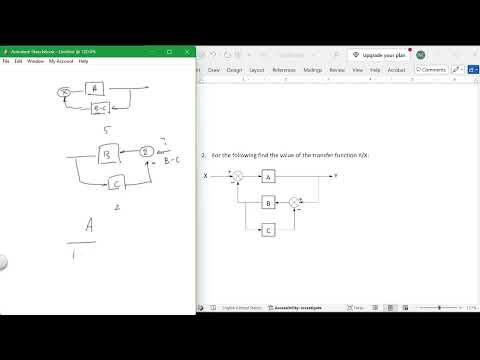
- The review focuses on reading the B and C signal directions at a summing junction before reducing the block diagram.
- Numerical examples, such as a signal of 5 combined with a signal of 3, are used to check whether the junction adds or subtracts.
- The instructor revises an earlier sign explanation and says students should receive credit if the correction affected their answer.
- The key method is to identify the actual signed signal entering each junction, then apply the appropriate feedback-loop reduction.
- A partial-fraction problem is solved using poles associated with factors including s - 3, s + 2, and s + 9.
- The corrected coefficients are A = -1/30, B = -13/35, and C = 59/42.
- The inverse transform is -e^(3t)/30 - (13/35)e^(-2t) + (59/42)e^(-9t).
- The instructor confirms a student's correction that the coefficient of e^(3t) must be negative.
- For (4s² + 5s + 2)/(s(s² + 4)), coefficient matching gives A = 1/2, a cosine numerator coefficient of 7/2, and a remaining constant numerator of 5.
- The denominator s² + 4 corresponds to frequency 2, so the cosine contribution is (7/2)cos(2t).
- Rewriting the remaining term to match 2/(s² + 4) gives a sine coefficient of 5/2.
- The complete inverse transform is 1/2 + (7/2)cos(2t) + (5/2)sin(2t).
- The transformed expression is Y(s) = (4s + 7)/(s² + 2s + 13), with the denominator rewritten as (s + 1)² + 12.
- Splitting the numerator gives 4(s + 1) + 3, matching the shifted cosine and sine transform forms.
- The inverse transform is 4e^(-t)cos(2√3t) + (√3/2)e^(-t)sin(2√3t).
- The solution demonstrates how to adjust the numerator to match the required 2√3 factor in the sine transform.
- The inner loop is reduced first to BC/(1 + CD), after which the result is combined with A using the summing-junction sign.
- That combined forward-path expression is then placed inside the outer feedback-loop reduction involving E.
- The instructor emphasizes reducing the diagram in stages rather than treating all blocks as one operation.
- A student identifies a sign error in the written expression, and the instructor confirms the correction.
- The final calibration item uses 4 = 0.02087C + 8.217, producing C ≈ -202.06.
- The next test is expected to include two Laplace-transform problems and Bode plots, with no block-diagram questions.
- The Laplace problems should resemble the more straightforward exam problems rather than the hardest problems from this test.
- The instructor says the second test should be easier overall and that upcoming topic questions will generally involve one problem per area.
- Students are asked to revisit Lab 4; updated equipment includes new pumps, computers, and PLCs after multiple earlier lab setups failed.
- Upcoming course work includes Lab 5, Lab 6, water-related exercises, and a revised approach to vision-system activities.
- P&ID questions will involve locating instrument tags such as IC or RC, counting instances, and tracing their inputs and outputs.
- Students will calculate a PID algorithm point by point across a graph to understand controller behavior and make better troubleshooting decisions in a factory.
- The remaining course shifts toward instrumentation, motors, videos, and more direct equation-based calculations.
Transcript excerpt
0:00 start, and uh we'll keep on here, and uh This is just Yeah. Okay, so uh it was not an easy test. I understand. It was not an easy test. Uh But, I thought you were prepared, and I feel bad. But, too Anyway, here it is. And I may have missed something, and if I missed something, uh and you want to get some extra points, and you see that I missed something on your on yours, uh I'll um see after we get through the this part of it.
0:47 In other words, we'll get the right answer up there, and if there's a if there's a problem still with you with my scoring of yours, uh I'll be glad to discuss it. I'm liberal with giving points. I don't you know, I Whatever. If you know me at all, you know that I don't get too upset about it. If you have a valid point, I'll give you points. Okay, so um Number one, um little box. Everybody have their test back?
1:40 Okay, and the the homework is being passed around. Hopefully, everybody that can get that and taken take that Got it. So, here's the box. And uh minus 250 to 325 is the X. That's the input. The output was 3 to 15. Okay? So, the delta X was 575. The delta Y was 12. So, delta Y over delta X, which is the M, is 12 / 575 4.02087
2:32 in that range. All right, then you go and you try to find B. So, that you take the 15 is equal to M, which is .020 87 * the 325 + B. B is equal to 8.217. Now, you go back and you find your output CM is equal to .02087 * 144.3 + 8.2
This is the start of the transcript. Save this video free for the whole transcript, searchable and time-coded.
In this course
Related notes
Summary, takeaways, and chapters were generated by AI from the video's transcript and may contain errors. The video belongs to its creator, Wm_T Evans.