MIME 4450 Lec 1 9 1 26
 Watch on YouTube →
Overview
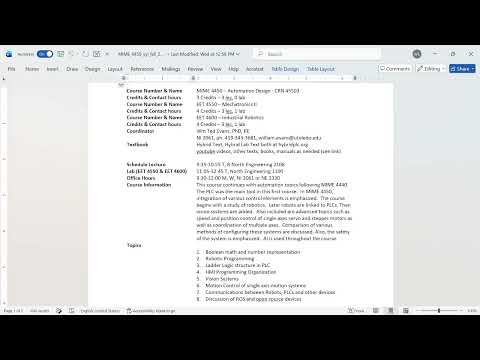
Ted Evans introduces MIME 4450 and related sections as a hands-on robotics and automation course where a required final project, worth 50% of the grade, connects a robot, a PLC, and another system such as Cognex vision. He explains the lab and software constraints, recommends combining manufacturer manuals, YouTube tutorials, and AI for troubleshooting, and uses his industrial experience to emphasize flexible system design, production constraints, and learning through iteration.
Key takeaways
- The MIME 4450 final project requires students to integrate three components, typically a robot, PLC, and vision system, and counts for half the course grade.
- Automation must accommodate real production conditions: Evans expanded an operator interface from six screens to 66 so staff could handle broken equipment and missing production plans.
- Unbounded flexibility can damage throughput and profitability: Evans cites a Libbey-Owens-Ford line that reportedly lost $7 million per year after operators could overfeed downstream equipment.
- A Windows 10 or 11 laptop with administrative rights is necessary for Siemens TIA Portal installation because lab computers restrict software installation.
- AI can speed up automation troubleshooting, but students should validate its incomplete or incorrect guidance using manufacturer manuals, YouTube tutorials, and hardware tests.
- Employers value evidence of hands-on programming: students should build, test, and revise PLC programs rather than wait until they feel fully prepared.
Chapters
- Ted Evans distinguishes MIME 4450 and 5450 students from EET 4600 and EE 4550 students sharing the course.
- MIME students do not have a scheduled lab period, but Evans says lab access is essential for learning the course material.
- The required final project is worth 50% of the grade; weekly assignments or short in-class quizzes make up the other 50%.
- Evans expects roughly 10 graded assignments across a 14- or 15-week term, with low scores dropped.
- Students may work alone or in groups of two or three to build an integrated project connecting three components.
- A project can combine a robot, PLC, and another device such as a vision system; using a safety PLC can count as two components.
- Evans describes AI, including ChatGPT, as a key troubleshooting resource, while warning that its answers can be incomplete or incorrect.
- Students should expect to use the lab for hands-on work, even when their section does not formally require lab attendance.
- Students need a Windows 10 or 11 laptop with administrative rights for installing and downloading automation software; MacBooks are not suitable.
- Evans has Siemens TIA Portal version 20 and enough site-license access for students to use the software for a year.
- The computers in the lab cannot be used for these installations because students lack administrative permissions.
- Evans has only a few spare Dell laptops, so the class needs to identify who requires a loaner.
- Evans took the robotics courses previously taught by Chris, but passed only the first and cannot award the associated certification.
- His course goal is to introduce FANUC and Universal Robots and help students learn how to use the equipment, rather than certify them as robotics specialists.
- He recommends asking AI targeted questions when stuck, then checking answers against manuals and practical results.
- Evans acknowledges that he is also learning some of the current equipment and describes troubleshooting a poorly tuned PID loop.
- Evans graduated in electrical engineering from the University of Illinois in 1971 and initially found himself working at a drafting board in Toledo.
- He moved into programming a real-time factory computer in assembly language, before PLC systems were commonplace.
- After his mentor left and another team member was reassigned, Evans had to develop automation for a factory line that had already started in manual mode.
- When a soda ash shortage stopped production for two days, he used the downtime to test and bring critical transfer logic online.
- The original system assumed operators would follow an automated production sheet, but actual conditions included misplaced boxes and broken cutter heads.
- Evans revised the system so operators could modify production plans and create a pattern from scratch when no usable sheet existed.
- The interface expanded from six operator-console screens to 66 as he built the flexibility the factory required.
- The system took from May to November to complete, illustrating how real production constraints can invalidate a clean initial specification.
- Evans describes a second Libbey-Owens-Ford line in Laurinburg, North Carolina, where operators could request more glass than downstream equipment could process.
- Excess flow created a production bottleneck: pressure fell, glass was crushed, productivity dropped, and the line reportedly lost about $7 million annually instead of earning that amount.
- Industrial engineer Marlon Barrett, formerly of PPG, worked with colleagues for three months to correct the line's operating problems.
- Evans uses the case to show that flexibility needs safeguards and that automation decisions can affect a company's financial performance.
- Evans says engineers must sometimes think like industrial engineers, considering the entire production line rather than only their assigned control task.
- He introduces CODESYS as a PLC and HMI software platform that runs on Unix-based systems and is used for a significant share of PLC work in Europe.
- CODESYS can be downloaded free, with its business model relying on royalties paid by hardware vendors using the software.
- Evans presents CODESYS as a possible project component and notes that Siemens views it as a competitor.
- Evans recounts recommending Cognex when asked about vision systems, then discovering that 10 boxes of Cognex equipment had arrived at the university.
- A student later integrated a Siemens PLC, Cognex camera, and a homemade conveyor to inspect parts and divert defective ones.
- That successful student project helped inspire the course's central goal: connecting separate technologies into a functioning system.
- Evans says the lab has 14 Cognex systems, alongside vision-equipped FANUC robots.
- The lab includes FANUC and Universal Robots, while 12 tabletop robots were ordered for the newly cleared North Engineering 1100 room.
- Evans estimates there are 29 available vision systems when Cognex units and robot-mounted vision are counted together.
- Multiple groups may share a robot, but must coordinate downloads and changes to avoid overwriting another group's program.
- Universal Robots run ROS, and Evans contrasts their approach with the widely used industrial FANUC robots.
- A capstone group combined a white FANUC robot, a PLC, and Cognex vision to play Connect Four.
- Evans proposes a Yahtzee project in which a robot retrieves selected dice and rerolls the rest based on a screen input.
- For a tabletop robot with built-in example programs, students must still integrate an external component such as a Siemens PLC.
- The PLC can provide an HMI, the human-machine interface operators use to control the system.
- Evans recommends combining manufacturer manuals, YouTube tutorials, and AI to get started, while treating AI responses as partial guidance rather than final answers.
- Students may use Allen-Bradley software if they already have access, but Siemens is the course's default because Evans can provide student software licenses.
- Evans says employers value candidates who have written and tested programs, even if they are not yet expert programmers in both Siemens and Allen-Bradley systems.
- His practical advice is to start with a working example, make a change when it fails, and keep iterating instead of fearing a blank page.
Transcript excerpt
0:20 Okay. Um, let's get started. So, my name is uh Ted Evans Evans. Uh it's William Theodore, but I go by my middle name. So if you get confused, it's kind of confusing, but on the other hand, that's who I am. Um two or three things today to go through. Uh one is to make sure that uh you understand the right course that you're in and also there's three different courses here and I want to explain that to you. Uh I'm also going to pass out this syllabus. Now, there's a little bit of confusion here because some of them are printed front and back and some of them are printed two sheets, the front and then the second sheet. So, you get two sheets. Uh you get a front and a back and this is the front and the back starting over here as well. And then, uh I'll start in the
1:09 upper corner. These are the two sheet ones. And there's going to be that um 458. Um we have been merging into the various group that we've been a part of all along the engine folded engineering department is folded not officially yet but it's just going to be a matter of time. So, I
1:58 I definitely want you to understand that this is uh not the way it's always going to be, but you're going to get the information that you need to uh to survive. MIME 4450. You're sitting here and you're wondering what on earth are these other people doing and what are we doing all together? And I'll explain the course in a few minutes. So, you get an overview of what you're going to be learning in the course. So, uh that's that's coming. So anyway, um the there's three groups. There's four
This is the start of the transcript. Save this video free for the whole transcript, searchable and time-coded.
Related notes
Summary, takeaways, and chapters were generated by AI from the video's transcript and may contain errors. The video belongs to its creator, Wm_T Evans.