Math 28 - Rational Exponents
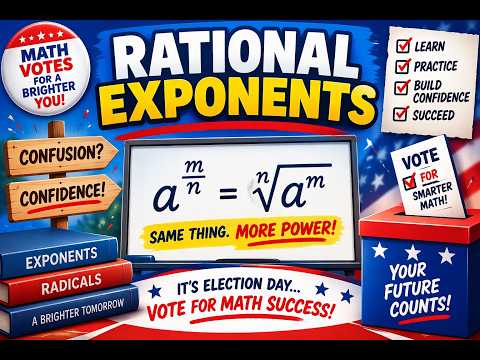 Watch on YouTube →
Overview
Christopher Lee develops rational exponents from familiar exponent rules, showing that a^(1/n) equals the nth root of a and a^(m/n) can be evaluated by taking the root before applying the numerator power. He demonstrates conversions between radical and exponent notation, handling negative exponents and signs, combining rational exponents, and simplifying compound expressions, including rationalizing a denominator.
Key takeaways
- A^(1/n) equals the nth root of a, so a rational exponent's denominator identifies the radical index.
- For a^(m/n), taking the nth root before applying the mth power often reduces the size of intermediate numbers, as 125^(2/3) becomes 5^2 = 25.
- An even root of a negative radicand is not real, but a negative sign outside the root is valid: ⁴√(-16) is nonreal while -⁴√16 = -2.
- Negative exponents indicate reciprocals, not negative values: 16^(-3/2) = 1/64.
- When multiplying powers with the same base, add exponents; when dividing, subtract them; when raising a power to a power, multiply exponents.
- Simplify inside a compound expression before applying its outside exponent, then rationalize a radical denominator when a fully simplified form requires it.
Chapters
- Christopher Lee reviews adding 7/15 + 5/12 by finding the common denominator 60 and obtaining 53/60.
- For (4x^2y^5)^3, apply the outside power to each factor to get 64x^6y^15.
- A negative exponent moves a factor to the denominator: 5^-3 = 1/125.
- Lee connects rational exponents to roots as a new way to write expressions already studied with radicals.
- Using (8^p)^3 = 8, the power rule gives 8^(3p) = 8^1, so p = 1/3.
- Since 8^(1/3) cubed equals 8, 8^(1/3) is the cube root of 8.
- For a real nth root and integer n at least 2, a^(1/n) = ⁿ√a.
- The denominator of the exponent becomes the radical's index, while the base remains the radicand.
- Lee emphasizes this root-exponent equivalence as the foundation for simplifying rational exponents.
- Convert x^(1/2) to √x, using an implied index of 2 for square roots.
- Convert y^(1/3) to ∛y and z^(1/4) to ⁴√z.
- The numerator 1 indicates the radicand's power, and the denominator supplies the radical index.
- Reverse the conversion by writing √(5y) as (5y)^(1/2).
- Write ∛(4x) as (4x)^(1/3), preserving the entire radicand as the base.
- For a radical with an outside multiplier, keep that multiplier separate while converting the radical's index into the denominator.
- Evaluate 25^(1/2) as √25 = 5.
- Evaluate 64^(1/3) as ∛64 = 4.
- Evaluate 256^(1/4) as ⁴√256 = 4.
- The fourth root of -16 is not a real number because an even root of a negative radicand has no real value.
- A negative sign outside the radical changes the result: -⁴√16 = -2.
- A negative exponent instead creates a reciprocal, so 16^(-1/4) = 1/⁴√16 = 1/2.
- Lee works through sign-placement practice, distinguishing a negative radicand from a negative sign in front of a root.
- The examples contrast a nonreal square root of a negative value with an outside negative such as -√64 = -8.
- A negative fractional exponent on a positive base gives a reciprocal, as in 64^(-1/2) = 1/8.
- The power rule gives a^(m/n) = (a^(1/n))^m = (a^m)^(1/n).
- In radical notation, these forms are (ⁿ√a)^m and ⁿ√(a^m).
- Lee recommends taking the root first to keep intermediate numbers smaller.
- Rewrite (√(y^3)) as y^(3/2), using the radicand's power as the numerator and the root index as the denominator.
- Rewrite (∛(2x))^4 as (2x)^(4/3).
- Rewrite a square root of 3a/(4b), raised to the third power, as (3a/(4b))^(3/2).
- Evaluate 125^(2/3) by finding ∛125 = 5 first, then squaring to get 25.
- For 16^(-3/2), move the factor to the denominator, take √16 = 4, and cube to get 1/64.
- For 32^(-2/5), use ⁵√32 = 2 before squaring, giving 1/4.
- For -25^(3/2), the negative sign is outside the power, so the result is -125.
- For 25^(-3/2), the negative exponent creates a reciprocal, giving 1/125.
- With a negative base inside an even root, as in (-25)^(3/2), the expression is not real.
- The product rule adds exponents: a^m · a^n = a^(m+n), and the quotient rule subtracts them: a^m/a^n = a^(m-n).
- The power rule multiplies exponents, while a power on a product or quotient applies to every factor.
- Lee also reviews zero exponents and negative exponents, including a^0 = 1 and a^(-n) = 1/a^n for nonzero a.
- For x^(1/2) · x^(5/6), add the exponents using denominator 6 to get x^(8/6) = x^(4/3).
- Simplify (z^9)^(2/3) by multiplying exponents: 9 · 2/3 = 6, so the result is z^6.
- For x^(1/3)/x^(5/3), subtract to get x^(-4/3), then rewrite it as 1/x^(4/3).
- Lee simplifies products and powers by applying the product-to-a-power rule before multiplying rational exponents.
- For (27u^(1/2))^(2/3), take ∛27 = 3 and simplify the exponent on u to obtain 9u^(1/3).
- For (m^(2/3)n^(1/2))^(3/2), multiply the exponents to get mn^(3/4).
- When 1/x^(4/3) is written with a cube-root denominator, multiplying numerator and denominator by ∛(x^2) yields an equivalent form with denominator x^2.
- Simplify x^(3/4) · x^(-1/4) divided by x^(-6/4) by adding numerator exponents, subtracting the denominator exponent, and reducing to x^2.
- In the final expression, simplify the inner quotient first to obtain a form equivalent to (16x^2/y)^(1/2).
- Taking the square root gives 4x/√y; rationalizing the denominator gives 4x√y/y.
- Lee notes that rational exponents are for the third exam, while the upcoming Thursday exam requires separate study.
Transcript excerpt
0:00 All right. So, I'm going to record this lecture in case anybody misses it. Um, I do know that some people might not have access to the internet or you might not have a device that that's working at correctly at the moment. So, I am sympathetic to that. So, I'm going to send out this to everybody. Um before get into the um lecture for today, just want to know if anybody has any questions. Anything you guys want to go over? Anything that's not making sense? Well, just to recap, we go ahead. >> I know. I was just saying like no, there's nothing. >> No questions. All right. Now, just to just to recap, we have our um exam on Thursday.
0:47 All right. um do your best to prepare for that. The homework that has been that that is um uploaded for today like you don't have to worry about that so much tonight because I know you guys have the upcoming exam but you know maybe on the weekend or so you know knock it out. All right. All right. So here's today's lesson. All right, we're going to do a little blast from the past first. Something simple. Nothing crazy. By the way, I know I owe you an email
1:38 response. I will get back to you. I promise. >> Okay. So let's see how do we do this again? >> Um the denominators have to be equal, right? >> Right. They have to have the same denominator. All right. So I have 7 over 15 + 5 over 12. What would you say is the LCD? What do you think? Um 60 >> three. >> Hey, how are you? >> Good, man. >> Good. Good.
2:25 >> How you doing? >> I'm well. I'm well. You're welcome.
This is the start of the transcript. Save this video free for the whole transcript, searchable and time-coded.
In this course
Related notes
Summary, takeaways, and chapters were generated by AI from the video's transcript and may contain errors. The video belongs to its creator, Christopher Lee.