Math 30 - Day 5 - Composition of Functions
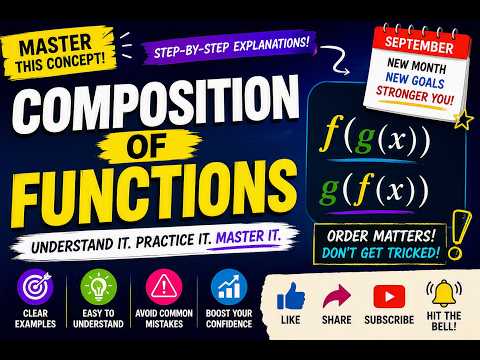 Watch on YouTube →
Overview
Christopher Lee reviews graph behavior and operations on functions before teaching composition as a process of feeding one function’s output into another. He demonstrates how to evaluate compositions from formulas, tables, and graphs, then derives their domains, including restrictions from both the inner function and the outer function.
Key takeaways
- To evaluate f(g(x)), calculate g(x) first and then use its output as the input to f; reversing the order generally creates a different function.
- Function composition is distinct from multiplication: f(g(x)) is generally not equal to f(x)g(x).
- For f(x) = x² and g(x) = x + 2, the compositions are f(g(x)) = (x + 2)² and g(f(x)) = x² + 2, making the order difference explicit.
- The same inside-out process works with formulas, tables, and graphs: find the inner output, then use that value to evaluate the outer function.
- The domain of f(g(x)) requires both x to be in the domain of g and g(x) to be in the domain of f.
- For f(x) = 5/(x - 1) and g(x) = 4/(3x - 2), the composite domain excludes x = 2/3, where g is undefined, and x = 2, where g(x) = 1 makes f undefined.
Chapters
0:00
Course Questions, WebWork Access, and Homework Submissions
- Christopher Lee explains that WebWork submissions can be retried without a grade penalty until the correct answer is entered.
- A WebWork cheat sheet covers answer-entry shortcuts, and assignments can be downloaded as PDFs for working on paper.
- Students can log in with their lowercase first and last names joined together, and WebWork also works on phones.
7:06
Reading Local Maximum and Minimum Points from a Graph
- The class identifies a local maximum at the coordinate (1, 2).
- The graph’s local minimum occurs at (-1, -2), with coordinates read as (x, y).
- Lee connects the review exercise to the WebWork section on rates of change and graph behavior.
9:33
Increasing and Decreasing Intervals for Constant, Linear, and Quadratic Functions
- A constant function such as y = 5 is neither increasing nor decreasing.
- The identity function y = x increases across its domain when the graph is read from left to right.
- For y = x², the function decreases on (-∞, 0) and increases on (0, ∞), with its minimum at (0, 0).
15:39
Monotonicity of Cubic, Reciprocal, and Root Functions
- The cubic function y = x³ increases across the real numbers.
- The reciprocal function y = 1/x decreases on each separate interval (-∞, 0) and (0, ∞).
- The reciprocal-square function y = 1/x² increases on (-∞, 0) and decreases on (0, ∞).
- The cube-root function increases on the real numbers, while √x increases on [0, ∞).
18:08
Absolute-Value Behavior and the Heating-Cost Composition Example
- For y = |x|, the graph decreases on (-∞, 0) and increases on (0, ∞).
- A heating-cost example defines C(T) as the cost at temperature T and T(D) as the average temperature on day D.
- The cost for day D is written C(T(D)): temperature depends on the day, and cost depends on temperature.
20:33
Adding, Subtracting, Multiplying, and Dividing Functions
- For functions f and g, the pointwise operations are (f + g)(x) = f(x) + g(x), (f - g)(x) = f(x) - g(x), and similarly for products and quotients.
- Lee illustrates function addition with household income: total income T(y) = H(y) + W(y) for each year y.
- Adding or subtracting function outputs requires compatible units; division also requires a nonzero denominator.
23:43
Simplifying Function Differences and Quotients
- With f(x) = x - 1 and g(x) = x² - 1, g(x) - f(x) simplifies to x² - x.
- For the same functions, g(x)/f(x) = (x² - 1)/(x - 1) factors and simplifies to x + 1.
- The quotient’s original denominator still excludes x = 1, even though the simplified expression is x + 1.
28:21
Student Practice with Products and Differences of Functions
- Students work through additional algebraic combinations of f(x) = x - 1 and g(x) = x² - 1.
- Lee uses the product (x - 1)(x² - 1) to review distribution and combining like terms.
- The practice emphasizes distributing a negative sign across every term when subtracting a function.
33:01
Expanding Function Products and Distributing Subtraction
- The product f(x)g(x) = (x - 1)(x² - 1) expands to x³ - x² - x + 1.
- The difference f(x) - g(x) becomes (x - 1) - (x² - 1), which simplifies to -x² + x.
- Equivalent polynomial terms may be written in different orders, such as x - x², though Lee prefers descending powers.
36:28
Composition Notation: Using One Function’s Output as Another’s Input
- Function composition combines functions so the output of the inner function becomes the input of the outer function.
- The notation f ∘ g at x means f(g(x)); the small circle is a composition operator, not multiplication.
- Lee returns to the heating example: C(T(D)) first finds the temperature for day D, then calculates heating cost.
40:52
Composition Order, Input-Output Flow, and Function Domains
- In f(g(x)), evaluate g first and then evaluate f using g(x) as its input.
- Composition generally differs from multiplication: f(g(x)) is not usually equal to f(x)g(x).
- The composition f ∘ g is defined only when x belongs to the domain of g and g(x) belongs to the domain of f.
44:23
Composition Is Not Commutative: Comparing f(g(x)) and g(f(x))
- For f(x) = x² and g(x) = x + 2, f(g(x)) = (x + 2)², while g(f(x)) = x² + 2.
- The two compositions can produce different functions even if their outputs coincide at an individual input.
- A composition is meaningful only if the inner function’s range supplies inputs allowed by the outer function.
47:57
Evaluating Compositions Algebraically with f(x) = 2x + 1 and g(x) = 3 - x
- For f(x) = 2x + 1 and g(x) = 3 - x, substituting g into f gives f(g(x)) = 2(3 - x) + 1 = -2x + 7.
- Reversing the order gives g(f(x)) = 3 - (2x + 1) = -2x + 2.
- The different results demonstrate that changing the order of composition changes the resulting function.
52:43
Evaluating Composite Functions from a Table
- For a table-based composition, first find the inner function’s output at the specified input, then look up that output in the outer function’s table.
- The example evaluates f(g(3)): the table gives g(3) = 2, then f(2) = 8.
- If an intermediate input is missing from the table, the requested composition value cannot be determined from the provided entries.
54:56
Following Table Outputs Through f(g(x)) and g(f(x))
- The table example also finds g(f(3)) by looking up f(3) first and using that result as the input to g.
- For f(g(1)), the table gives g(1) = 3 and then f(3) = 3.
- For g(f(4)), the table gives f(4) = 1 and then g(1) = 3.
1:07:00
A Four-Step Method for Evaluating Compositions from Graphs
- Locate the original input on the x-axis of the inner function’s graph and read its output from the y-axis.
- Use that inner output as the x-input on the outer function’s graph.
- Read the outer graph’s y-value to obtain the composite function’s final output.
1:15:13
Reading g(f(2)) from Two Function Graphs
- The graph gives f(2) = 5, so the remaining evaluation is g(5).
- Reading the graph of g at input 5 gives g(5) = 3, and therefore g(f(2)) = 3.
- The method requires switching graphs only after completing the inner function lookup.
1:19:12
Evaluating Formula-Based Compositions from the Inside Out
- For a formula-based composition, substitute the given input into the inner function before using its result in the outer formula.
- Lee distinguishes the variable names used in function definitions, noting that names such as t and x do not affect evaluation.
- A composition can be evaluated numerically one stage at a time or written as a single substituted expression.
1:21:19
Computing f(h(1)) with f(t) = t² - t and h(x) = 3x + 2
- The inner function gives h(1) = 3(1) + 2 = 5.
- Substituting 5 into f(t) = t² - t yields f(5) = 25 - 5 = 20.
- Thus f(h(1)) = 20, illustrating numerical evaluation from the inside outward.
1:32:19
Nested Formula Practice with h(f(2)) and h(f(-2))
- Using f(t) = t² - t and h(x) = 3x + 2, f(2) = 2 and h(f(2)) = h(2) = 8.
- For the negative input, f(-2) = 4 - (-2) = 6, so h(f(-2)) = h(6) = 20.
- Students may evaluate each function separately and carry the intermediate result forward instead of substituting everything at once.
1:35:50
The Domain Rule for a Composite Function
- The domain of f(g(x)) contains inputs x in the domain of g for which g(x) lies in the domain of f.
- Finding the domain requires checking the inner function’s restrictions and then excluding inputs whose inner outputs are invalid for the outer function.
- A composite’s domain can include x-values that are not in the domain of f itself, because f receives g(x), not x.
1:39:22
Finding a Composite Domain with Rational Functions
- For g(x) = 4/(3x - 2), the inner function is undefined at x = 2/3.
- With f(x) = 5/(x - 1), the composite is f(g(x)) = 5/(4/(3x - 2) - 1) = 5(3x - 2)/(-3x + 6).
- The outer denominator is zero when g(x) = 1, which occurs at x = 2; the composite domain therefore excludes both x = 2/3 and x = 2.
- In interval notation, the domain is (-∞, 2/3) ∪ (2/3, 2) ∪ (2, ∞).
Summary, takeaways, and chapters were generated by AI from the video's transcript and may contain errors. The video belongs to its creator, Christopher Lee.