Masterclass: How FDEs make $1M/yr deploying AI agents
 Watch on YouTube →
Overview
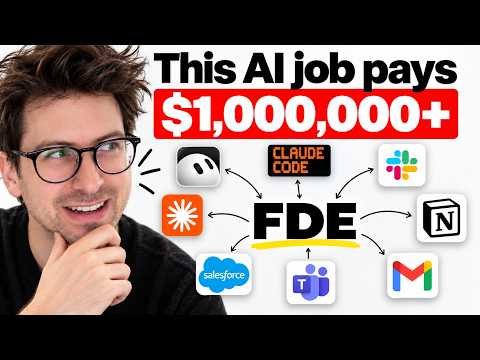
Greg Isenberg and Voss from Veric Agents argue that forward-deployed engineers (FDEs) can earn $1M/year by finding high-value enterprise processes, mapping them end-to-end, and rebuilding them with AI agents inside existing systems like Salesforce, NetSuite, and Workday. Voss shows how Veric uses human interviews, process mining, and document/system analysis to uncover hidden workflows, then splits work into four buckets (delete, deterministic code, agentic steps, and human approvals) before deploying and measuring outcomes like a drop from 17 steps to 7, invoice handling cost from $31 to $6, and straight-through invoice rate from 18% to 87%.
Key takeaways
- Forward-deployed engineering is most valuable when it starts with process discovery, because the real workflow is usually hidden across interviews, system logs, and undocumented tribal knowledge.
- Voss's four-bucket framework (delete, deterministic code, agentic steps, and human approvals) turns vague AI adoption into an operational redesign method.
- Enterprise AI deployment works best inside existing systems of record like Salesforce, NetSuite, Workday, and Slack; replacing the stack usually fails because companies have already spent years and millions on those tools.
- A real FDE engagement can materially change business economics: one accounts payable redesign cut invoice cost from $31 to $6 and raised straight-through rate from 18% to 87%.
- Most enterprise workflows do not require frontier models; the right choice is often a smaller or open-source model selected by benchmarking each workflow against multiple options.
- The best FDEs combine workflow analysis, software engineering, and model evaluation skills, plus the ability to communicate ROI in CFO-friendly terms like margin, cycle time, and cost per transaction.
Chapters
- Greg Isenberg frames FDEs as people who can drive $5M, $10M, or $25M of value and take a share of it.
- The episode promises concrete guidance on finding automatable work, deciding where agents belong, and choosing between open-source and closed-source models.
- Voss from Veric Agents is introduced as the operator sharing anonymized client engagements and deployment details.
- Greg Isenberg describes Gemini 3.8 Live as a voice assistant connected to his tools that acts like a chief of staff.
- Gemini 3.5 Transcribe cleans up voice notes by removing filler words and turning walk-and-talk ideas into readable text.
- Gemini 3.8 Flash Text-to-Speech can generate custom voices, such as a Brooklyn accent, for onboarding flows in mobile apps.
- Gemini 3.5 Live Translate is highlighted for real-time Mandarin-to-English business communication and market expansion.
- Voss argues AI transformation is really process re-engineering, not superficial tooling.
- Private equity roll-ups are a major driver: firms buy people-heavy businesses like accounting, IT, and law practices, then deploy FDEs to rebuild workflows.
- Thrive is cited as an example with 35 engineers across 70 firms, delivering outcomes like tax returns processed 30% faster at 98% accuracy.
- Voss says the first step is interviewing people in a department to uncover tribal knowledge that is never documented.
- The second step is mining systems of record such as Salesforce, NetSuite, Dynamics, Workday, and related tools to infer hidden workflows.
- The third step is reading external documentation in SharePoint, Drive, Notion, Slack, Teams, Gmail, and spreadsheets.
- He emphasizes that a large firm may have 10 years of system history, while an SMB may have almost everything trapped in employees' heads.
- A public software company with $5B in revenue and 150+ products initially described a simple quote-to-sign workflow.
- Process mining over Salesforce revealed the reality: a 20-step sales process with seven loops and 61% of requests cycling back early.
- Legal sent deals back 12% of the time, and 30% of new quotes had to repeat approval steps.
- Voss says the FDE's job is to expose the real process and then redesign it with agents and humans in the right places.
- Voss divides workflows into four buckets: delete the step, implement deterministic code, use an agent, or require a human decision.
- Examples of deterministic code include simple API calls and if-this-then-that logic with no judgment required.
- Agentic steps include quote-building or classifying invoices where historical data and judgment are useful.
- High-risk actions like approvals, negotiation, signing, and payment submission stay with humans to avoid costly errors.
- Voss strongly recommends building agents inside existing systems rather than forcing clients to move to a new AI-native surface.
- He cites customers who spent years and about $10M migrating ERPs or CRMs, making replacement pitches a nonstarter.
- Slack messages can serve as the human-in-the-loop interface, while agents operate in Salesforce or other systems behind the scenes.
- The approach reduces retraining and lowers resistance because staff already know the tools.
- When a PE firm owns 26 companies, each with different ERP/CRM stacks, Voss recommends grouping similar systems together instead of treating every company as unique.
- Examples include batches of companies on NetSuite versus Dynamics, or sales teams split between Salesforce and HubSpot.
- The FDE's job is to learn each platform's capabilities and gaps, then integrate adjacent tools like Ramp, Brex, Tipalti, BlackLine, Concur, or Expensify.
- This approach simplifies politics by working through the same CFO or buyer pattern repeatedly.
- Voss shows an anonymized accounts payable workflow uncovered in 2-3 weeks through interviews and process mining.
- The real process had 17 steps with exceptions, not the six steps the client believed existed.
- The redesign cut cycle time from 24 days to 6, reduced exception loops from 6 to 1, and raised invoice straight-through rate from 18% to 87%.
- Cost per invoice dropped from $31 to $6, an 80% reduction, while keeping humans in the loop for risky cases.
- Voss says most enterprise agent work does not require frontier models like the most expensive Anthropic or OpenAI offerings.
- He recommends benchmarking workflows across models such as Claude Sonnet/Opus, GPT, Grok, Muse, GLM, Kimi, and Qwen.
- Enterprise buyers often avoid Chinese models, even when technical concerns are more about policy than performance.
- He splits agent products into sidekick agents, like Grokbot, Muse, Instinct, and Dots, versus background agents that work silently and alert humans only when needed.
- Voss says the best FDE combines three skills: understanding how work actually gets done, shipping production code, and managing the AI layer.
- Production work must include auditability, governance, and security when agents call systems of record.
- The AI layer includes choosing the right model, deciding what the model can trust, and building evals to test quality and rollback failures.
- Greg Isenberg compares elite FDEs to top 0.1% NBA players because they can create multi-million-dollar business value.
- Voss recommends starting by mapping your own personal apps, inboxes, messaging tools, and bills to understand process complexity.
- A practical week-long exercise is: list apps on Monday, document 20 tasks, write one process step-by-step, bucket each step, then reach out to SMBs on Friday.
- He suggests starting with one workflow, offering a complete buildout, and even doing it for free to get real reps before charging five or six figures.
- Greg Isenberg notes the same method can help companies build internal FDE capability by following the same playbook.
- Voss says he has seen no real demand for on-prem GPU deployments even in regulated sectors like banking, healthcare, and pharma.
- Greg Isenberg references OpenAI's private intelligence/security announcement, including zero data retention and automated safety review.
- The practical path today is routing through Azure AI Foundry, AWS Bedrock, or Google Vertex with data-residency and no-train guarantees.
- The episode closes by reinforcing that FDEs win by measuring baselines, building once, deploying everywhere, and proving KPI gains over time.
Summary, takeaways, and chapters were generated by AI from the video's transcript and may contain errors. The video belongs to its creator, Greg Isenberg.