Linear Algebra - Lecture 17 - Fall, 2026
 Watch on YouTube →
Overview
The lecture derives the change-of-basis rule y = Px, where the columns of P express the old basis vectors in the new basis, then introduces real inner products as a foundation for length, orthogonality, and projection. It develops the polarization identity, shows that length-preserving linear operators preserve inner products, and applies the ideas to rotations, orthonormal bases, and projection; it closes with examples involving coordinate swapping and polynomial differentiation.
Key takeaways
- To convert coordinates from basis F to basis G, place the G-coordinate expansions of the F basis vectors into the columns of P; then the new coordinate column is Px.
- An inner product defines vector length through ||v|| = sqrt(<v,v>), and the polarization identity recovers the inner product from lengths alone.
- For real inner-product spaces, a linear operator preserves inner products if and only if it preserves lengths.
- An orthogonal set of nonzero vectors is linearly independent, and an orthonormal basis makes inner products equal to ordinary dot products of coordinate columns.
- Projection onto a nonzero vector w is (<v,w>/||w||²)w; subtracting it from v leaves a vector orthogonal to w.
- The stated norm of sin(t) on [0,1] is inaccurate: under the integral inner product, its squared norm is 1/2 - sin(2)/4, not 1/2.
Chapters
- For bases F and G, each old basis vector Fj is expressed as a linear combination of the G vectors, with coefficients forming the columns of P.
- If x is a vector's coordinate column in basis F and y its coordinate column in basis G, then y = Px.
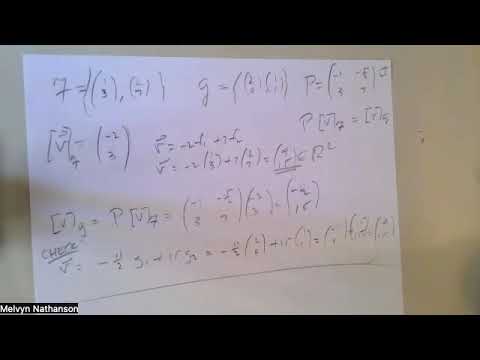
- For F = {(1,3),(2,7)} and G = {(2,0),(1,1)}, P has columns (-1,3) and (-5/2,7).
- The coordinate vector (-2,3) in F becomes (-11/2,15) in G, representing the same vector (4,15).
- A real inner product is linear in each variable, symmetric, and positive definite: the inner product of a nonzero vector with itself is positive.
- In Rn, the standard inner product is the sum of coordinatewise products, such as x1y1 + ... + xnyn.
- For continuous real functions on [0,1], the lecture gives the inner product as the integral of f(t)g(t) from 0 to 1.
- The function-space example shows how an inner product can assign geometric structure to functions, not just coordinate vectors.
- Length is defined by ||v|| = sqrt(<v,v>); for the standard inner product on R2, this recovers the Pythagorean formula.
- Expanding ||u+v||² and ||u-v||² gives the polarization identity: <u,v> = (||u+v||² - ||u-v||²)/4.
- For u = (3,-4) and v = (12,5), the lecture computes ||u+v||² = 226 and ||u-v||² = 162, yielding <u,v> = 16.
- The transcript's function example incorrectly states that the integral of sin²(t) from 0 to 1 is 1/2; its exact value is 1/2 - sin(2)/4.
- Two nonzero vectors are orthogonal when their inner product is zero.
- A linear operator T is orthogonal when it preserves inner products: <T(v),T(w)> = <v,w> for all v and w.
- An orthogonal operator preserves length, and the polarization identity proves the converse: any linear operator preserving all lengths also preserves inner products.
- Rotation by θ has standard matrix [[cos θ, -sin θ], [sin θ, cos θ]], found by rotating the basis vectors (1,0) and (0,1).
- Applying this matrix to (x,y) gives (x cos θ - y sin θ, x sin θ + y cos θ).
- Using cos² θ + sin² θ = 1 shows algebraically that rotation preserves squared length.
- In Rn with the standard inner product, the standard basis vectors are pairwise orthogonal and each has length one.
- An orthogonal basis has pairwise orthogonal vectors; it is orthonormal when every basis vector also has length one.
- Every orthogonal set of nonzero vectors is linearly independent: taking the inner product of a zero linear combination with each vector isolates its coefficient.
- For an orthonormal basis ei, vectors with coordinates x and y satisfy <v,w> = sum xi yi, the standard coordinate dot product.
- The Kronecker delta captures the basis relations: <ei,ej> is 1 when i = j and 0 otherwise.
- For nonzero w, the projection of v onto w is (<v,w>/||w||²)w, a scalar multiple of w.
- The perpendicular remainder is v minus the projection; its inner product with w is zero by direct substitution.
- This gives a decomposition of v into a component parallel to w and a component perpendicular to w, which will support constructing orthonormal bases.
- The operator T(x,y) = (y,x) is linear and satisfies T² = I because swapping coordinates twice restores the original vector.
- The fixed points of T satisfy x = y, so they form the line spanned by (1,1).
- Differentiation on real polynomials is linear; its kernel is the constant polynomials.
- The derivative operator maps onto all real polynomials because every polynomial has a polynomial antiderivative.
Transcript excerpt
0:03 This is lecture 17 in linear algebra. I gave this lecture yesterday, but it was not recorded. So, I'm just going to go over the slides again. And of course, everything is in the textbook that's online. So, we start with an n-dimensional vector space. And we have two bases for it. So, suppose script F consisting of n vectors F1 up to Fn is one basis and script G consisting of the n vectors G1 up to Gn is the second basis. So, given any vector in V, you can write it as a linear combination of the basis vectors in F. And also So, and this is the coordinate vector
0:52 for F with respect to the basis F. So, this simply means that the vector V is summation XjFj j goes from 1 to n. Similarly, you can express V as a linear combination of the basis vectors in G. And this is its coordinate vector. So, I'm using in this notation Xi's for the coordinates of V with respect to F. And Yj's for the coordinates of V with respect to G. And the question is given the coordinate vector for V with respect to one basis is there a simple way to get the coordinate vector for V with respect to a second basis? So, because F is a basis and G is a basis
1:40 every vector in F, the basis F, is a linear combination of basis vectors in G. So, I can write each Fj as some sum PijGi i goes from 1 to n. And I get this for j going from 1 to n. So, I actually can define an n by n matrix P. And this matrix P is going to be uh the change of basis matrix. So, each vector
This is the start of the transcript. Save this video free for the whole transcript, searchable and time-coded.
In this course
Related notes
Summary, takeaways, and chapters were generated by AI from the video's transcript and may contain errors. The video belongs to its creator, Nathanson math lectures.