Introduction to Philosophy: intro lecture
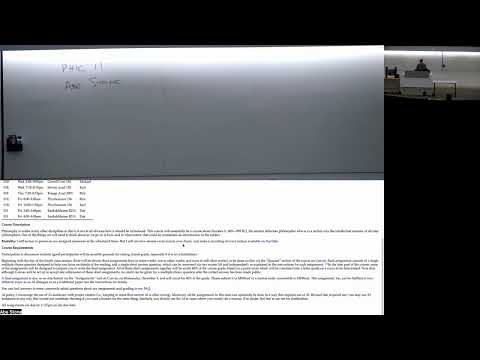 Watch on YouTube →
Overview
Abraham Stone explains the course’s assignments, participation expectations, and AI-use policy, then argues that philosophy is difficult to define in advance and is best introduced through concrete examples. He organizes the course around Socrates, using Plato’s dialogues and other ancient sources to examine what philosophy is, how its institutional traditions shape it, and why philosophical arguments must be understood in the context of their speakers and history.
Key takeaways
- Stone’s course uses Socrates as a sustained case study because a short survey of philosophy’s 2,500-year history would sacrifice the context needed to understand why particular arguments mattered.
- The optional AI route for each short assignment is designed around student interaction and commentary: students submit their prompt, the AI response, their own analysis, and a shareable transcript.
- Stone treats AI like another person for academic-integrity purposes: contributions that would require quotation or citation from a human must also be attributed when generated by AI.
- Discussion participation can improve a borderline grade but cannot hurt it, while lecture attendance and exams are not course requirements.
- Plato’s dialogues should be read as dramatic interactions as well as arguments; a weak argument or an interlocutor’s inability to object may be philosophically significant.
- Because Socrates wrote nothing, accounts of his life depend on sources such as Plato, Xenophon, and Aristophanes, each with different purposes and limitations.
Chapters
- Abraham Stone introduces Phil 11, Introduction to Philosophy, and says discussion sections begin the following week.
- The syllabus, assignments, lecture recordings, and live Zoom link are available from Stone’s courses page and through Canvas links.
- Students should contact a TA first for routine administrative requests, such as extension questions, while Stone or a TA can address course-content questions.
- Lectures take place in person, with a live Zoom feed and YouTube recordings available for flexibility.
- Stone prefers email for contact and holds office hours over Zoom; TAs will also offer office hours.
- Discussion participation means contributing constructively, not simply attending, and can raise a borderline course grade but cannot lower it.
- The course has 11 short assignments, with varying weekly frequency; the first is due on the fourth class session.
- Each assignment includes a multiple-choice question and a short-answer question, with students choosing either an independent response or an AI dialogue.
- The AI route requires students to submit their prompt, the AI’s response, their own commentary, and a shareable transcript URL.
- Stone says the AI route should involve an actual exchange, not a request for the AI to fill in the assignment fields.
- Students should add context to their prompts and ask for concise responses so they can meaningfully critique or develop the AI’s answer.
- Most short-answer credit goes to the student’s own response to the AI, while the independent route requires one response to the assignment prompt.
- The final assignment offers a traditional five-to-seven-page paper on one of two suggested topics or an AI dialogue developed over several turns.
- For the AI dialogue, students provide a thesis statement or original paragraph, request a response of about 150 words or less, and submit the exchange transcript.
- Stone applies the same attribution rules to AI as to people: disclose AI contributions that would require a citation or quotation if supplied by a person.
- Stone warns that submitting AI-written work as one’s own can lead to a plagiarism report, especially when a student cannot explain the submitted writing.
- Assignments are officially due at 11:55 p.m.; Stone asks students to keep short assignments genuinely short because five TAs serve about 300 students.
- Three course texts are available as ebooks and, where obtainable, physical books; additional readings are posted on Canvas.
- Stone compares philosophy reading to following a mathematical proof: missing a step can make the rest of the text incomprehensible.
- Repeatedly rereading the same confusing passage may not help; reading something else and returning later can provide a fresh perspective.
- Even specialists can disagree over the meaning of a single line in Plato, so difficulty is a normal feature of philosophical texts, not proof that a student lacks ability.
- Stone argues that asking “What is philosophy?” is a central and contested philosophical problem, unlike asking “What is physics?” in an introductory physics course.
- Physics can investigate philosophers and institutions as physical or social objects, but the definition of physics is not normally a central problem within physics itself.
- Students need experience with philosophical texts and discussions before they can assess what philosophy is, so an introduction should not begin by imposing a simple definition.
- Stone describes contemporary academic examples such as whether causal determinism leaves room for free will.
- Political philosophers ask when social inequality is morally permissible, including whether inequality can be justified if the least well-off benefit.
- Other examples include whether a person is identical to their brain and whether thought about a particular object depends on something inside the mind or on relations to the world.
- Starting from contemporary professional philosophy shows that philosophy is shaped by institutions, including peer review, professional bodies, and tenure decisions.
- These structures help determine what counts as philosophical work, even without a single central authority issuing a definitive list.
- Stone notes that this approach can help prospective philosophy majors see the kinds of research areas that academic institutions currently recognize.
- Professional philosophy today is not a representative sample of the entire history of philosophy, which has changed substantially over time.
- The course is aimed largely at students who will not become professional philosophers, so current academic debates alone may not answer what they want to learn.
- Stone describes philosophy as uneasy about its institutional boundaries: the field needs institutions to maintain shared work, yet remains unsure whether those institutions capture philosophy’s deeper purpose.
- A rapid survey of more than 2,500 years of Western philosophy would force the class to jump among traditions and problems without enough context.
- Philosophical debates about the soul and body can be hard to understand when their historical assumptions differ from modern views informed by physics.
- Stone chooses a sustained case study rather than a compressed list of historical highlights, allowing students to examine motivation and context in depth.
- Socrates, who lived in Athens from about 469 to 399 BCE, serves as the course’s organizing example despite not being the first Western philosopher.
- Stone says the tradition often called Western philosophy can be understood as Socratic philosophy, including later thinkers such as the Persian philosopher Avicenna, also known as Ibn Sina.
- Plato and Aristotle transmit Socrates’ influence through their work, though Stone acknowledges that describing all later philosophy as a development of their ideas is an exaggeration.
- Stone notes that modern universities descend in part from medieval institutions such as Paris and Oxford and, more indirectly, from Plato’s Academy.
- He argues that philosophy departments do not merely study philosophy as an outside subject; their living members and practices constitute the institution of philosophy.
- Stone favors openness to other traditions but is cautious about a Western academic department claiming to absorb and represent the world’s philosophies.
- Socrates left no writings, and no independent, reliable biography survives, so knowledge of him depends heavily on later texts.
- Plato’s dialogues are the course’s main source; Xenophon also wrote Socratic dialogues, while comic playwright Aristophanes portrayed Socrates in The Clouds.
- The Clouds combines philosophical and political commentary with comedy, appeared while Socrates was alive, and offers an early but deliberately distorted portrayal.
- Plato does not appear as a speaking character in his dialogues, and Stone cautions against assuming that Plato agrees with everything his Socrates says.
- Socrates may follow an interlocutor’s premises during an exchange even when he doubts them, making the dialogue’s argument and his personal position difficult to separate.
- Socrates was poor, avoided political life, and was executed after conviction for impiety and corrupting the youth; Plato’s wealth, school, and political connections made their lives very different.
- Plato’s dialogues contain philosophical arguments built from premises toward conclusions, often developed jointly by Socrates and another character.
- Stone says arguments can be abstract, nitpicking, or apparently mistaken, but their flaws may reveal what a character can or cannot recognize.
- Unlike many later philosophical works, including Aristotle’s more direct argumentative treatises, Plato’s dialogues make the interaction between specific people part of the philosophical meaning.
- The next reading comes from Diogenes Laërtius, probably a third-century CE compiler of biographies of famous philosophers.
- His accounts, especially those about early thinkers, rely on secondary sources that are now lost and preserve anecdotes whose reliability and original attribution are uncertain.
- Stone assigns the reading as a lower-intensity introduction to what ancient Greeks called wisdom, connecting the Greek roots of philosophy with the idea of love of wisdom.
Transcript excerpt
0:00 this computer. >> Okay. Hello, this is Phil 11. Introduction to philosophy. Um, is that big enough to read up there? I'm not getting any thumbs up this time. Yep. >> Yep. I'm Abe Stone. You can call me Professor Stone or you can call me Abe. Uh I'm totally fine either way. Um we have uh five TAs for this class. Um but I see
0:50 at least two of them are are joining us by Zoom right now. Where where are the other ones? I see Carl. All right. Well, you'll have to meet them in section, I guess. Um, okay. Um, so, uh, today I'm going to mostly, uh, go through the syllabus. Um, and then I'm going to give a brief introduction to the course. Maybe not that brief. We'll see how long it takes. Um, I always hope the first class won't go the whole time, but usually it does. Um, so, uh,
1:37 and oh, before I forget, there's one announcement I have to make about discussion sections, which is they'll start next week. So, there's sections tomorrow, but they won't they won't meet this week. Um, all right. So, now I'm gonna try. And by the way, people on Zoom, I hope you can see me. I'm that tiny little person in the corner, right? Um, uh, so now I'm going to try putting up my syllabus. There we go. Um, okay.
2:27 Actually, let me start here. Is that not working? This is right. This is my courses page. The URL, it's it's on the syllabus. Um, the URL is people.CSC.edu. eduilda slashcourses. This part you don't need. Um, so that's like all the courses I ever taught, but this one that I'm teaching right now is at the top, so you don't have to look at
This is the start of the transcript. Save this video free for the whole transcript, searchable and time-coded.
In this course
Related notes
Summary, takeaways, and chapters were generated by AI from the video's transcript and may contain errors. The video belongs to its creator, Abraham Stone.