Introduction to Philosophy: Clouds, lecture 2
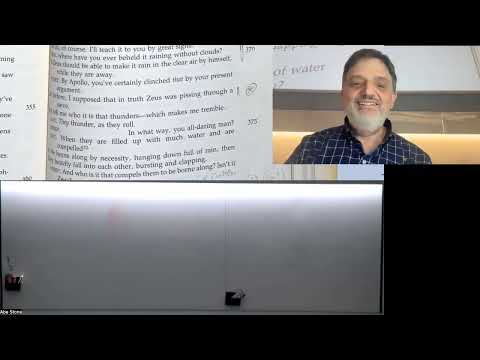 Watch on YouTube →
Overview
Abraham Stone reads Aristophanes’ Clouds as a comedy that mocks both natural philosophers and the defenders of traditional virtue, while resisting a simple choice between them. He argues that Aristophanes’ claimed wisdom lies in exposing what a city conceals, and that the play’s arguments about debt, parental authority, and justice raise serious questions about whether justice means repaying what is owed or giving people what they deserve.
Key takeaways
- Stone reads Socrates’ explanation that clouds are “necessitated” by necessity as comic circularity, not as evidence that Aristophanes is advancing a developed theory of determinism.
- Aristophanes’ claimed civic wisdom is the power to expose corruption and foolish decisions, whether through attacks on Cleon or through crude jokes about behavior people normally conceal.
- The play undermines traditional virtue through Strepsiades, who plans to evade debts and oaths before encountering the Thinkery, so new philosophy cannot be blamed for all existing corruption.
- The argument over repaying debts echoes Simonides’ definition of justice as giving people what is due: returning what is owed can conflict with giving someone what they deserve.
- Pheidippides’ claim that he may beat his father because his father beat him turns reciprocal punishment into a comic argument and exposes the limits of grounding morality in fear of future retaliation.
- Aristophanes appears to favor the Unjust Speech’s newer outlook over the Just Speech’s traditional discipline, yet the ending makes exacting what people deserve seem unsettling rather than straightforwardly just.
Chapters
- Canvas displays a possible 23 points, but each short assignment is worth 13 because students choose either the independent or AI route, not both.
- The multiple-choice question is worth 3 points and the other work is worth 10; completing the required steps on either route earns 3 baseline points.
- Abraham Stone expects typical course totals to correspond roughly to a B+ or A-, with higher totals earning an A, and says Canvas letter-grade estimates are not reliable.
- Teaching assistants grade about 60 assignments each and have contractual limits on grading time, so students can meet with a TA or Stone for more feedback.
- The reading listed for a class day is meant to be completed by that day because the lecture discusses that text.
- Stone says lectures are not a substitute or complete summary of the reading; they model how to interpret and question philosophical texts.
- Students may remember Stone’s approach to reading Plato, but most lecture comments are not material they must reproduce for a grade.
- Stone revisits two alleged links between natural science and rhetoric: both seem like forms of magic, and natural science might weaken belief in divine punishment.
- Strepsiades imagines hiring a Thessalian witch to pull down the Moon, while rhetoric appears to offer tricks for escaping debt.
- Aristophanes mocks the claim that people need natural philosophy or atheism before they can become comfortable breaking oaths.
- The Thinkery investigates questions such as how many of its own feet a flea can jump and how a gnat makes its sound.
- Stone reads these investigations as deliberately trivial, while their explanations rely on far-fetched analogies or empty-sounding language.
- The comedy presents natural philosophy as failing to deliver useful knowledge about the mysteries it claims to investigate.
- When Socrates explains thunder, he says clouds are filled with water and are “necessitated” to move by necessity, which Stone treats as circular babble rather than a theory of determinism.
- Strepsiades adopts the same necessity jargon to describe pressure from his debts and expenses.
- Stone interprets Aristophanes’ natural philosophers as idle, untrustworthy figures, including Socrates’ students’ apparent scheme to obtain dinner through trickery.
- Strepsiades initially represents older, conventional values, but he is already planning to evade debts and break oaths.
- Stone argues that Aristophanes does not simply endorse the “good old ways,” since Strepsiades shows that traditional respectability does not guarantee virtue.
- The play therefore mocks both natural philosophers and those who fear that new ideas alone will corrupt an otherwise virtuous city.
- In the parabasis, the Clouds’ chorus appears to speak for Aristophanes, making the passage a comic version of an apology, or courtroom defense.
- Aristophanes swears by Dionysus, the god of drama and wine, a choice that suits the festival but does not imply a sober or reliable authority.
- He claims to be wise and asks discerning spectators to recognize his comedy as his wisest work and award it victory.
- Aristophanes calls his comedy moderate, citing the absence of a giant leather phallus and vulgar dancing, but the play later includes torches and cries that undermine part of that claim.
- He boasts that he does not recycle material like rival poets, but instead “sophisticates” his work by introducing novel forms.
- Stone connects the Greek word for “new” or “novel” with the play’s contrast between old and new education and with the charge of introducing new divinities associated with Socrates.
- The Clouds speak on Aristophanes’ behalf, raising the question of whether they count as his new gods or are simply clouds rather than deities.
- Stone sees Aristophanes aligning himself more with newfangled sophists and the unjust speech than with defenders of traditional virtue, even as he makes fun of both sides.
- The play’s 423 BCE setting predates Socrates’ trial by 24 years, so Stone treats any connection between its wording and the later indictment as suggestive rather than a direct allusion.
- Aristophanes says he confronted Cleon when the demagogue was powerful, rather than waiting to attack him after his fall.
- Stone interprets the Clouds’ claim that they warn Athens by thunder or rain against foolish expeditions as a metaphor for comedy exposing bad civic decisions.
- The claimed public benefit of Aristophanes’ wisdom is to reveal political stupidity and corruption that the city would otherwise leave unspoken.
- Stone explains the humor of farting through a social contrast: everyone knows it happens, but polite company pretends not to notice.
- The play’s sexual jokes, including the joke about what Strepsiades has under his covers, similarly make concealed behavior explicit.
- Stone connects crude jokes and political or philosophical satire as different ways Aristophanes brings suppressed realities into the open.
- Stone interprets Socrates’ removal of Strepsiades’ cloak as exposing rather than creating Strepsiades’ corruption.
- Strepsiades already behaves as if divine punishment and conventional morality do not constrain him, so Socrates does not make him an atheist in any practical sense.
- The scene resembles Socrates’ questioning in Plato’s Ion and Euthyphro, where philosophical inquiry exposes contradictions; Stone sees Aristophanes and Socrates as occupying related territory despite their different methods.
- After the Thinkery rejects Strepsiades as too foolish to teach, he sends his son Pheidippides, who returns with rhetorical tricks.
- Pheidippides argues that debts are not due on the boundary between the old and new month, challenging the creditors’ right to collect.
- Stone notes that the argument appeals to an ambiguity in the monthly debt date and to an alleged intention of Solon, but does not regard it as a strong argument.
- Pheidippides claims he may beat Strepsiades because Strepsiades beat him as a child, although the two do not occupy equivalent positions.
- He also argues that Strepsiades deserves a beating for preferring older poets to Euripides.
- When Strepsiades warns that his future son might beat him, Pheidippides replies that he may never have a son, exposing the weakness of morality based only on anticipated retaliation.
- Stone connects Clouds’ arguments to the Republic, where Simonides’ traditional definition of justice is commonly rendered as giving each person what is due or owed.
- Those meanings can diverge: returning a borrowed sword may satisfy a debt but be unjust if its owner has gone mad and will use it to harm someone.
- Stone frames the play’s conflict as a question about whether justice means fulfilling personal obligations or giving people what they deserve.
- When Strepsiades asks whether rain is new water or water drawn back up by the Sun, a creditor says he does not know and does not care.
- Strepsiades turns the creditor’s lack of interest in natural philosophy into an argument that he does not deserve repayment.
- Stone treats this comic argument as a serious question about whether rewards and punishments should track people’s worth, while cautioning against assuming modern people are inherently smarter than ancient Athenians.
- The Just Speech defends older education, discipline, and warrior virtues, while the Unjust Speech promotes newer, more comfortable ways of life.
- Aristophanes makes the Just Speech look especially ridiculous through its rules about boys smoothing sand to hide their genital prints.
- Stone argues that Aristophanes leans toward the Unjust Speech’s side, while still making both characters comic and keeping their dispute distinct from a complete account of justice.
- When Strepsiades invokes the law against being beaten, Pheidippides asks whether a law made by people like them long ago is just merely because it is old.
- Pheidippides suggests that a law’s legitimacy depends on whether people can persuade one another that it is right, a challenge the Just Speech would rather not entertain.
- At the end, the Clouds say Strepsiades is responsible because he twisted himself into villainous affairs, turning the meaning of his name into a judgment that he gets what he deserves.
- Stone concludes that Aristophanes leaves the choice difficult: obeying tradition without question is unjust, but distributing to everyone exactly what they deserve may also be frightening.
Transcript excerpt
0:10 Okay. Hello. Hopefully you can hear me now. Uh so, um first of all, TAS, don't let me forget to give you these desk copies. [sighs] Don't don't leave without them, please. Uh [gasps] Um, okay. So, there's a few like course uh like grading and stuff related things I want to talk about. Um, first of all, uh, I sent out an announcement about this, but I want to, um, emphasize again about the grading of the short assignments that, um, first of all, it Canvas thinks there's a possible
0:59 23 points, but there's really only possible 13 points. Um, and you know, I hope everyone understands. I think there were at least one or maybe more people who who like got this confused on the first assignment. You're you're supposed to choose one of the two routes, not both. Um, right. So, but Canvas doesn't know that. So, Canvas thinks you could get 23 points by doing both, but you're only supposed to do one of them. Um and uh the other thing about that is so I mean those um those are going to be graded on a scale of one to 13. The multiple choice problem is worth three and so that's either three or zero there and then
1:48 there's 10 for the others. Um, you you basically get three free points on the AI route because, you know, if you uh enter some kind of prompt and record the response and give the URL, that's three points. Um so uh so we uh we just had a grading meeting earlier and discussed this and so we agreed that that pretty much for the independent route also three points is going to be like free in other words if you actually do it right I mean if
This is the start of the transcript. Save this video free for the whole transcript, searchable and time-coded.
In this course
Related notes
Summary, takeaways, and chapters were generated by AI from the video's transcript and may contain errors. The video belongs to its creator, Abraham Stone.