fnb100f261013b
 Watch on YouTube →
Overview
Jeff Hunk reviews income-statement terminology and connects microeconomic cost concepts to accounting: variable costs scale with output, while fixed costs and capital investment do not, and accounting spreads asset costs through depreciation. He applies the framework to Dell-style manufacturing, Nvidia GPUs and depreciation debates involving Jensen Huang and Michael Burry, then uses total-revenue and total-cost curves to explain break-even output, profit maximization at marginal revenue equals marginal cost, and shareholder-management incentives.
Key takeaways
- For a $300 unit production cost, total variable cost scales linearly with output: 1,000 computers imply $300,000 in variable cost before fixed expenses.
- A $50,000 asset depreciated over five years produces $10,000 of annual depreciation; extending the accounting useful life lowers annual expense and raises reported operating profit.
- In the total-revenue and total-cost framework, profit is positive between the two break-even output levels and is maximized where the gap between the curves is greatest.
- The economic condition for profit-maximizing output is marginal revenue equal to marginal cost, not maximum total revenue.
- Executive compensation tied to revenue can encourage managers to prioritize sales or market share over profit, creating a potential conflict with shareholders.
- A business’s cost classification can depend on its operating choices: hourly barista wages vary with hours worked, while fixed salaries and coffee-shop rent are less responsive to sales volume.
Chapters
0:00
Class Opening and Income-Statement Recap
- Jeff Hunk opens the Tuesday finance class, checks attendance, and asks students to enable cameras or otherwise confirm they are present.
- He recaps the income statement as a way to track profit generated by operating activity.
3:40
Why Jeff Hunk Distinguishes Income from Operating Profit
- Jeff reserves the term income for gross income and defines profit as income or revenue minus expenses or costs.
- He argues that calling operating profit “operating income” confuses students because income is being used for a figure already reduced by expenses.
10:00
Personal Finance Example: Paychecks, Fixed Costs, and Savings
- A paycheck is typically received after payroll tax withholding, making it comparable to disposable income in Jeff’s analogy.
- Rent, clothing, and transportation are examples of relatively fixed personal expenses, while concerts and dining out vary with how often someone chooses them.
14:00
From EBIT to EBT and Net Profit
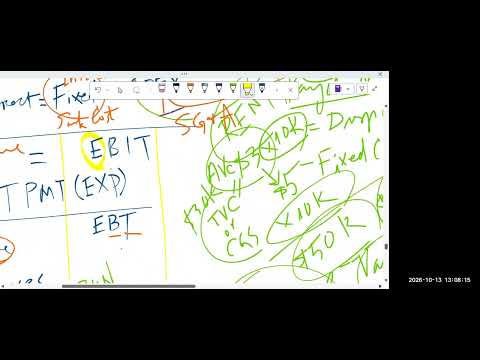
- Jeff lays out the sequence: operating profit or EBIT, minus interest to reach EBT or pretax profit, then minus taxes to reach net profit or EAT.
- He notes that accounting commonly calls both pretax and after-tax results “income,” while he prefers the more explicit profit and earnings labels.
18:00
Variable Costs, Cost of Goods Sold, and Output
- Direct costs are also called variable costs because their total changes with production quantity; accounting labels them cost of goods sold or cost of revenue.
- For a computer with a $300 unit production cost, total variable cost is $3,000 for 10 units and $300,000 for 1,000 units.
22:00
The Linear Variable-Cost Function
- Jeff expresses total variable cost as a linear relationship, y = b × x, with unit cost b of $300 and quantity x.
- Average variable cost is total variable cost divided by quantity, so multiplying average cost by quantity returns the total.
26:00
Fixed Cost and the Capital Needed to Manufacture Computers
- Fixed cost does not change with production quantity; Jeff connects the microeconomics term to initial investment and sunk cost.
- A Dell-scale computer manufacturer needs a factory and production equipment before it can make its first unit.
30:00
Dell-Style Plant Investment and Operating Expenses
- Jeff illustrates manufacturing investment with a hypothetical venture-capital funding of $3 billion for plant and equipment.
- He contrasts microeconomics’ focus on initial investment with accounting operating expenses such as rent, utilities, salaries, R&D, and marketing.
34:00
Depreciation Spreads Asset Costs Across Service Life
- A $50,000 car assigned a five-year accounting life would be depreciated at $10,000 per year under the straight-line example.
- Jeff contrasts that schedule with microeconomics’ treatment of the investment as an upfront cost, and says depreciation is included in operating expenses.
37:00
Michael Burry and Credit Default Swaps
- Jeff brings up Michael Burry and the 2008 financial crisis as context for a debate about accounting and market risk.
- He explains a credit default swap as protection against borrower default: the buyer pays premiums, and the insurer owes compensation if the credit event occurs.
41:00
Nvidia GPUs and the Importance of Data-Center Hardware
- Jeff distinguishes CPUs from GPUs and describes GPUs as hardware for large-scale computation in AI data centers.
- He points to Nvidia’s role supplying data-center GPUs and says demand for server racks full of accelerators has made the company a major market focus.
45:00
RAM Upgrades and the Value of Understanding Computer Hardware
- Jeff uses his laptop experience to explain that RAM upgrades depend on available slots and compatible module connectors.
- He encourages hands-on hardware knowledge, comparing computer upgrades with teenagers learning car maintenance in earlier generations.
50:00
Device Repair, GPU Lifetimes, and Depreciation Choices
- Jeff criticizes designs that make repairs difficult, using iPhone battery replacement as an example and contrasting it with older phones with removable backs.
- He says a longer assigned GPU service life lowers annual depreciation and raises reported data-center profit, while arguing that GPUs do not wear like car tires.
59:00
Break Between the Depreciation Discussion and Cost Graphs
- Jeff pauses class for a 10-minute break after discussing GPU useful life and accounting depreciation.
- The lecture resumes at about 70:46, when he turns to finance news, AI research tools, and the cost-and-revenue framework.
1:10:46
Using Yahoo Finance and AI to Follow Business News
- Jeff recommends checking Yahoo Finance’s market and economy coverage, including a report on JPMorgan profits and Jamie Dimon’s economic warnings.
- He demonstrates using ChatGPT to summarize an article and distinguishes ordinary AI research from agentic AI that can take follow-up actions.
1:16:00
Financial News, Interest Rates, and the S&P 500 Sector Map
- Jeff identifies persistent inflation, high interest rates, and the U.S. fiscal deficit as risks highlighted in the JPMorgan discussion.
- He points students to an S&P 500 sector heat map to compare daily movements in technology, semiconductors, banks, Visa, Mastercard, and American Express.
1:21:00
Coffee-Shop Costs: Rent, Baristas, and Ingredients
- For a specialty coffee shop, Jeff identifies rent as a fixed cost and coffee beans, milk, water, and sugar as variable inputs.
- Barista labor depends on the contract: hourly pay can vary with hours worked, while a fixed salary behaves more like a fixed expense.
1:29:00
Why Employee Contracts Affect Cost Classification
- Jeff compares production workers with clerical staff and says their classification depends on how their compensation responds to output or hours.
- A coffee shop selling $5 Americanos would need 10,000 cups to generate $50,000 in monthly revenue.
1:33:00
Total Revenue Rises, Then Flattens Under the Law of Demand
- Total revenue equals price multiplied by quantity, so it initially rises with sales volume when price remains constant.
- As a firm lowers prices from $500 to $450, $400, and $350 to attract additional buyers, revenue gains slow and can eventually reverse under the law of demand.
1:38:00
Total Cost, Fixed Investment, and the Two Break-Even Points
- Total cost includes fixed cost plus variable cost, so it begins above zero even when output is zero because the initial investment has already been made.
- Where total revenue intersects total cost, profit is zero; Jeff identifies two break-even quantities and says positive profit lies between them.
1:43:00
Profit Maximization at the Greatest Revenue-Cost Gap
- The vertical gap between total revenue and total cost represents profit, and its widest point marks the profit-maximizing output.
- Jeff says calculus can locate the maximum precisely; graphically, the revenue and cost curves have parallel tangent slopes there.
1:46:00
Marginal Revenue, Shareholder Goals, and Management Incentives
- Marginal revenue is the slope of the total-revenue curve and marginal cost is the slope of the total-cost curve; profit is maximized where MR equals MC.
- Jeff distinguishes profit maximization from revenue maximization and says revenue-linked executive pay can create conflicts with shareholder interests, though rapid market-share growth may justify that tradeoff temporarily.
Summary, takeaways, and chapters were generated by AI from the video's transcript and may contain errors. The video belongs to its creator, Jeff Hunk.