fnb100f261014a
 Watch on YouTube →
Overview
Jeff Hunk explains how a balance sheet represents capital structure: liabilities and equity show where capital comes from, while assets show how it is used. He connects debt financing to leverage, earnings per share, stock buybacks, and return measures, then explains why creditors focus on EBIT and how defaults can lead to Chapter 11 reorganization or Chapter 7 liquidation.
Key takeaways
- A balance sheet’s capital structure shows how much of a company’s assets are financed by debt versus equity; for example, $10 billion in assets funded by $5 billion of debt implies $5 billion of equity.
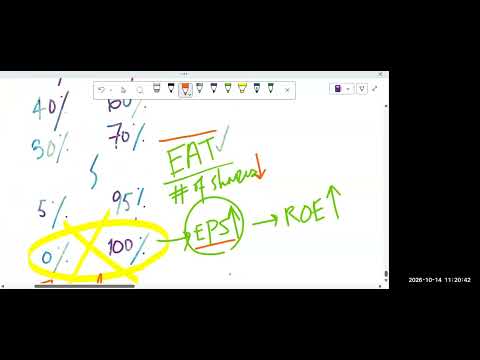
- EPS equals EAT divided by shares outstanding, so a debt-funded stock buyback can increase EPS by reducing the share count even when EAT does not rise.
- ROE is EAT divided by equity, while ROA evaluates returns against total assets, which are funded by both debt and equity.
- Creditors focus on EBIT because operating income must cover interest; when EBIT equals interest, no pretax profit remains, and when it falls below interest, default risk rises.
- Chapter 11 is presented as a route for reorganizing a potentially viable company, whereas Chapter 7 involves liquidation; shareholders can lose their value while creditors pursue repayment.
Chapters
0:00
Balance Sheets Show Sources and Uses of Capital
- Jeff Hunk recaps the balance sheet’s role in describing a company’s capital structure.
- Liabilities and equity represent sources of capital; assets represent how the company holds or uses that capital.
3:00
Capital Structure: Debt and Equity Financing
- A company with $10 billion in assets funded by $5 billion of debt has the remaining $5 billion funded by equity.
- Capital structures can use different proportions of debt and equity, such as 50/50, 40/60, or 30/70.
- Jeff Hunk notes that an all-equity structure is possible but forgoes the tax shield associated with debt.
7:15
Archimedes’ Lever as an Analogy for Financial Leverage
- Jeff Hunk connects the term leverage to Archimedes’ claim that a sufficiently long lever and fulcrum could move the Earth.
- Financial debt acts as a boost: a company uses borrowed capital alongside owners’ equity rather than relying only on shareholders’ funds.
- The lesson introduces debt as a tool that can magnify shareholder returns, while later discussion covers the risk of failing to meet interest payments.
14:04
How Debt-Funded Buybacks Can Raise Earnings per Share
- Earnings per share (EPS) equals earnings after taxes (EAT) divided by the number of shares outstanding.
- Even if EAT stays constant, EPS rises when the share count falls because the denominator is smaller.
- A company can issue bonds and use the proceeds to repurchase shares, reducing shares outstanding and changing its debt-equity mix.
19:00
Buybacks, Mature Markets, and Shareholder Returns
- Jeff Hunk describes buybacks as one way to support a stock price when a saturated market limits revenue and profit growth.
- Companies cannot indefinitely grow sales by cutting prices below their costs, so EPS and financing decisions can matter when operating growth stalls.
- The lecture links investor demand to expectations of future profit growth, rather than profit being merely positive.
24:20
Return on Equity Measures Profit Against Shareholders’ Capital
- Return on equity (ROE) is EAT divided by total equity, the book value of shareholders’ investment.
- Jeff Hunk frames equity as capital contributed at time zero and EAT as the resulting profit at time one.
- Because shareholders own the company, they are the claimants on net profit; the lecture also relates ROE to a shareholder’s return on investment.
34:30
Return on Assets and the Apple-Tree Analogy
- Total assets equal debt plus equity, so return on assets (ROA) evaluates returns generated by capital from both sources.
- Jeff Hunk compares assets such as plant and equipment to an apple tree: the asset base produces output that can generate revenue and profit.
- The apple-orchard example separates the productive asset base from the financing used to acquire it.
39:00
Why Creditors Track EBIT Rather Than EAT
- Creditors and bondholders do not own shares in net profit, so EAT is not their direct measure of the company’s ability to pay them.
- EBIT is relevant to creditors because operating income must cover interest before the company can produce pretax profit.
- If EBIT equals interest, EBT, taxes, and EAT are zero; if EBIT falls below interest, the company may be unable to meet its obligations.
43:30
Default, Creditor Claims, and Chapter 11 vs. Chapter 7
- A shortfall between EBIT and interest may be temporary, but persistent inability to pay can prompt creditors to pursue bankruptcy proceedings.
- In liquidation, creditors may seize and sell physical assets such as plant and equipment; the proceeds may still be less than total liabilities.
- Chapter 11 allows a potentially viable business to continue under reorganization, while Chapter 7 liquidates assets.
- Shareholders may be wiped out in bankruptcy; if the business continues, creditors have priority in receiving repayment.
52:30
Quiz One Deadline and Course Review
- Jeff Hunk reminds students that Quiz One is due that weekend and that they must satisfy its release conditions.
- He recommends watching the relevant videos in his YouTube playlist before taking the quiz.
Summary, takeaways, and chapters were generated by AI from the video's transcript and may contain errors. The video belongs to its creator, Jeff Hunk.