EECS 373 - Fall 2026 - Lecture 1 "Course Overview and Intro to GPIO"
Overview
Alanson Sample introduces EECS 373 as a practical course in designing resource-constrained, application-specific embedded systems, using the Infineon XMC4700 development board after a switch from STM32. He connects embedded computing to trends such as Moore's Law and IoT, outlines the course's labs and projects, then explains the microcontroller's core, memory, buses, peripherals, and how GPIO registers and push-pull circuits control physical pins.
Key takeaways
- Embedded systems specialize hardware and software for a particular task, trading general-purpose flexibility for lower cost, power consumption, or better performance.
- The XMC4700 course material is intended to teach transferable microcontroller skills: identify the correct documentation, configure registers, and connect core operations to physical hardware.
- ARM memory-mapped I/O lets the Cortex-M access peripherals using ordinary load and store operations because peripheral registers occupy addresses in the core's memory map.
- A GPIO pin combines input sampling, output storage, and direction control; its push-pull driver uses complementary PMOS and NMOS transistors to produce high and low voltage levels.
- Battery-free RFID tags can still compute and sense: they harvest energy from a reader and return data by backscattering the reader's radio signal.
- AI and IoT can reinforce each other: connected sensors provide information about the physical world that can make AI systems more useful beyond online data.
Chapters
- Alanson Sample describes research at Intel Research Seattle, including computational RFID and battery-free sensing.
- At the University of Washington, he worked on wireless power for heart implants, transmitting up to 30 W in research that reached animal trials.
- At Disney Research, he led work connecting technology with human behavior and contributed an antenna design that increased MagicBand range eightfold.
- The first homework reviews basic circuit intuition, such as switch behavior, without requiring MOSFET equations or advanced analog knowledge.
- Labs begin during the first week; pre-labs can be completed in lab this week, and deadlines vary by lab section.
- EECS 373 has moved from STM32 to the Infineon XMC4700, while keeping its focus on microcontroller concepts that transfer across platforms.
- A thermostat's basic job is to measure temperature and send a control signal to a furnace, yet the Nest example costs about $230 compared with roughly $20 for a basic thermostat.
- The Nest combines a Cortex-A8 running embedded Linux with a Cortex-M3, plus Wi-Fi, Zigbee, Bluetooth, flash, memory, sensors, and power-management hardware.
- Nest's broader strategy was to make the thermostat a home gateway that could connect other devices and bring them into the Google ecosystem.
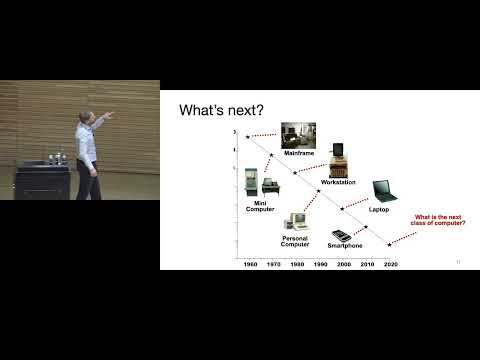
- Computing devices have become smaller, cheaper, and more widely available, progressing from mainframes and workstations to PCs, laptops, and smartphones.
- Moore's Law describes transistor counts roughly doubling every 18 to 24 months, while Dennard scaling historically reduced power and cost for a fixed transistor count.
- Wireless communication and battery energy density also shape embedded design; battery density has roughly doubled every 9 to 14 years, but battery volume limits how small some IoT devices can become.
- Bell's Law describes how a new, lower-cost class of computers can emerge roughly every decade and enable new uses and industries.
- Sample frames IoT as a likely successor to smartphones: connected devices can be smaller, more numerous per person, and rely on internet services for some intelligence.
- AI and IoT are complementary in this view: sensors and connected devices supply information about people's homes and environments that can make AI agents useful in the physical world.
- A gaming console trades general-purpose flexibility for lower cost, power use, and greater optimization for gaming compared with a high-end gaming PC.
- Sample argues that the iPhone became more general-purpose with the 2008 App Store, rather than at its 2007 launch, because users could add applications beyond Apple's original design.
- An autonomous vehicle is better understood as a robot containing embedded subsystems, such as lidar and braking control; an SD card also contains a controller for managing noisy flash memory and error correction.
- Useful definitions emphasize a programmable computer with a dedicated function, tight resource constraints, and often reactive or real-time behavior, though no single definition covers every case.
- Far-field RFID readers send power and data to tags; a tag returns information by modulating reflected radio energy rather than transmitting with its own radio.
- Sample's research prototype used an MSP430 microcontroller, an antenna-matching network, a rectifier, power management, and sensors, with no battery.
- The tag harvested energy to measure acceleration and orientation, then backscattered data; applications included detecting movement or structural strain in sensors embedded in a house foundation.
- EECS 373 teaches embedded software and hardware design through building a non-trivial system, while emphasizing knowledge that transfers to other microcontrollers.
- A central outcome is learning to find and interpret datasheet information, such as which register enables an LED or configures a timer.
- The course focuses on ARM Cortex concepts because ARM-derived architectures dominate microcontrollers, and covers memory-mapped I/O, interrupts, timers, communication buses, ADCs, and DACs.
- The course includes seven homework assignments designed as practice for exams and labs, plus seven labs that are usually completed in pairs or small teams.
- Two midterms are planned, with no final exam; the final portion of the course typically leaves lecture time for the major project.
- Students form presentation groups of three to four and teach a topic related to embedded systems, often connected to their final project.
- Homework has a 10 percent late penalty; lab deadlines and late penalties differ by section, so students should confirm their section information on Gradescope.
- Students are encouraged to use AI tools as tutorial aids, but not to have them complete assignments, since labs and exams require independent understanding.
- Sample describes the final project as a chance to combine knowledge from multiple courses and make a working device, rather than solving engineering problems only in the abstract.
- The course aims to help students inspect an unfamiliar electronic device, locate its datasheet, and work out how to build a reasonable version.
- The lab kit's XMC4700 development board includes supporting components such as regulators, buttons, and crystals, but the first lab focuses on its header pins and LEDs.
- Documentation is divided among ARM architecture references, the XMC4700 microcontroller documentation, and board-specific materials describing how the development kit is wired.
- The goal is not to memorize datasheets, but to know which document contains the information needed for a particular hardware question.
- The architecture links the Cortex core concepts from EECS 370 to the rest of the system, including SRAM, nonvolatile flash, DMA controllers, and peripherals.
- A bus transfers data between components using clocked registers; the system includes a high-performance bus structure and a peripheral bus connected through a bridge.
- Peripherals handle dedicated jobs such as timers, PWM, UART, ADC, and USB, while interrupts let external events such as a GPIO button press trigger code without constant polling.
- The XMC4700 has two DMA controllers; the course introduces the simpler peripheral-bus model even though Infineon's implementation adds control signals.
- The Cortex-M core treats device registers as memory locations, so load and store instructions can communicate with peripherals as well as SRAM and flash.
- Writing a value to a mapped address can configure a peripheral or send data to an Ethernet, USB, or DAC device; reading an address retrieves device state.
- The XMC4700 block diagram follows the same core, memory, DMA, bus, bridge, and peripheral pattern, though its peripheral bus has Infineon-specific details.
- A GPIO output is controlled by writing a value through the bus to a register made from D flip-flops; the stored bit drives a signal through the chip pin and onto the board.
- An input register samples the electrical level on a pin so the core can read it with a load instruction.
- GPIO ports group multiple pins, and separate control registers configure whether each pin acts as an input or an output.
- A push-pull output uses complementary PMOS and NMOS transistors: one connects the pin to the supply for a high level, and the other connects it low.
- The Falstad circuit simulator demonstrates how switches, pull-up resistors, and the push-pull pair create high and low logic levels.
- Interactive circuit models linked from the slides let students change pin direction and output values; the lecture closes by previewing the next class on the instruction set architecture.
Transcript excerpt
0:01 Uh so today we're mostly going to do a course intro and overview. We're going to start a little bit with GPIOs and that sort of stuff, but first I'll leave a little bit about myself. So I'm a Lance and Sample. I went to University of Washington. That's where I did my undergrad and my masters and my PhD, but I didn't really go here. I did for my undergrad, but what I really did is spent my entire time in my PhD studies at Intel Research Seattle, which was a little cute little lab, uh corporate high-end like academic style research about six blocks away from campus. So instead of actually going to class, I basically ditched as much as I could to stay there and then they eventually like turned me into a quasi full-time employee and I did most of my PhD there, which was a wild experience because corporations don't necessarily want you to publish, but yet to be an academic you need to publish. So it was
0:48 interesting time. After that I actually went back to University of Washington and uh now I'm in computer science, but there I did wirelessly powered heart implants. I worked on a project where we beamed 30 W of power into the body, safe for humans, uh did all sorts of variations to orientation distance so that we could wirelessly power heart implants and that actually went to animal trials. Then I went back to Intel as a research scientist working on IoT and wearable things and then I had a weird job. All of a sudden I went to Disney Research. They had a small lab in Pittsburgh and I started out as like a you know research scientist and worked my way up the ladder till I was a lab
This is the start of the transcript. Save this video free for the whole transcript, searchable and time-coded.
In this course
Related notes
Summary, takeaways, and chapters were generated by AI from the video's transcript and may contain errors. The video belongs to its creator, Interactive Sensing and Computing Lab.