Why Network Engineers Are Built for the AI Era
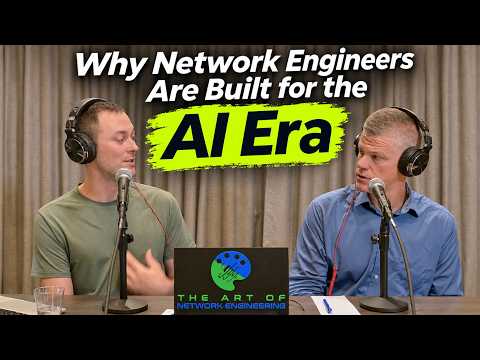 Watch on YouTube →
Overview
Andrew Lacetera and Remington Loose discuss how network engineering skills transfer to AI work, using Loose’s experience at St. Jude Children’s Research Hospital to explain models, harnesses, context, tools, skills, and agents. A solutions-architecture project grew into a multi-agent workflow of roughly 8 to 10 agents, while examples involving Claude Code, n8n, memory files, troubleshooting skills, and hooks show how to build useful systems without confusing scheduled Python scripts with autonomous agents.
Key takeaways
- Network engineers can transfer troubleshooting habits to AI: isolate failures, test assumptions, and verify outputs instead of accepting a model’s confident explanation.
- A model, harness, and context solve different problems: the model supplies capability, the harness supplies controls and tool access, and context supplies task-specific information and memory.
- Cron-driven Python scripts are effective for fixed tasks such as collecting daily metrics, while agents are useful when inputs, questions, or desired outputs need flexible interpretation.
- Reusable Markdown memory and skills can capture project context and operational lessons, but they consume context-window capacity and should be maintained deliberately.
- Natural-language instructions alone are not reliable safety controls; sensitive actions need enforceable mechanisms such as hooks, along with trace-based monitoring.
- AI should assist with execution and analysis while people remain accountable for the rationale, system design, and verification of consequential results.
Chapters
- Andrew Lacetera welcomes Remington Loose, who works at St. Jude Children’s Research Hospital, an academic institute focused on catastrophic childhood diseases.
- Loose connects AI adoption to the challenge of trusting systems with large blast radiuses, much like validating a network vendor through a proof of concept.
- Lacetera frames the discussion around practical AI use beyond familiar tasks such as searching logs.
- Loose says his AI work began about nine months earlier, after a principal infrastructure security architect proposed addressing the shortage of time for solutions architecture.
- The goal was to capture experts’ architectural knowledge, document deployments, and provide a source of truth for later troubleshooting.
- The initial idea expanded into roughly 8 to 10 agents in a multi-step flow that took on an operational workload.
- St. Jude has sovereign AI capabilities for both its open science environment and a protected environment.
- Loose compares a model to a bulldozer, a harness to its controls, and context to the information and memory needed to use it effectively.
- An agent combines those components and can pursue a goal through a loop, continuing until it reaches a defined outcome.
- A model’s flexibility helps it handle inputs that were not completely specified in advance, unlike a fixed script.
- An orchestrator agent receives a request, determines what is being asked, and identifies missing information needed to complete it.
- St. Jude compared agent results against hundreds of human-written examples of successful solutions architecture.
- When technical questions remained, a research sub-agent searched online and returned structured answers for the workflow.
- Lacetera’s daily media-kit process uses Python scripts and cron jobs to collect changing metrics from six social platforms, YouTube, and a podcast host.
- Loose distinguishes this deterministic automation from an agent, which uses a model to interpret flexible requests and select actions.
- AI-generated applications can still be valuable: Lacetera’s scripts automate routine work, even if they are not autonomous agents.
- Loose describes n8n as an orchestration platform that can connect a model, tools, and data sources such as a vector database.
- Lacetera’s sponsor workflow has separate applications for prioritizing companies, checking non-competes, and finding marketing contacts, but lacks a coordinating layer.
- An orchestrator can route requests across those capabilities and support more flexible questions, such as filtering prospects by wireless focus.
- Loose notes that an agentic session in tools such as Claude Code or Codex can be deployed for ongoing interaction or use by other agents.
- A model does not inherently remember prior sessions; a new session starts with a blank slate unless the harness supplies context.
- Memory may be stored in Markdown files, while a long-running session can also use compaction to summarize an increasingly full context window.
- Tools, memory, and conversation history all consume context-window capacity, so persistent memory should be managed deliberately.
- Loose recommends saving project state before resetting a session rather than assuming the model will retain it.
- Project-specific context, preferences, and instructions can be organized in Markdown files and synced through Git for reuse or sharing.
- A global Claude MD file can load automatically in Claude Code sessions; removing or changing it can help create a cleaner starting point.
- Lacetera considers documenting recurring contexts, such as business priorities and a writing voice guide, to avoid repeatedly explaining them.
- Loose cautions that memory can improve continuity but is limited, editable, and part of the context budget.
- Network troubleshooting trains engineers to isolate causes, test hypotheses, and validate results, habits that transfer directly to debugging AI behavior.
- Network engineers already reason about information flow between systems, a useful skill when coordinating agents that must share context.
- System design depends on details and sequence: Loose uses an incompatible request for 25-gig RJ45 copper as an example of catching a flawed requirement early.
- Lacetera connects this systems thinking to the job’s core reality: networks are interconnected, not isolated devices.
- Loose distinguishes tools, which let an agent perform actions such as reading or writing a database, from skills, which explain how to use those tools.
- He created a script-writing skill with requirements such as loud failures, status output, and idempotent behavior.
- After spending about 12 hours debugging an MTU issue in a container deployment, Loose captured the lessons in a reusable troubleshooting skill.
- A later issue was resolved in about four minutes; he also updated the script to detect and set MTU values rather than assume one fixed value.
- A troubleshooting skill supplies a repeatable method and accumulated experience, but it does not necessarily prevent a model from considering other explanations.
- Loose separates a tool from a skill with the bulldozer analogy: the tool is the equipment, while the skill describes how to use it.
- A vague goal such as building a lake still requires tools and skills for surveying, digging, grading, and checking whether the requested location is appropriate.
- The agent must be given enough context to pursue the intended outcome rather than merely follow the literal wording.
- Instructions such as a maximum spend limit can be ignored or misinterpreted, so Loose distinguishes ordinary instructions from stronger guardrails and hooks.
- A hook can enforce a hard stop; Loose used one to require adversarial code review before handing over a script.
- His credit-based workflow prevented a script from being delivered until review occurred, though he says agents may still forget or try to work around procedural requirements.
- Lacetera asks about monitoring agent behavior; Loose identifies traces, dashboards, and alerts as ways to inspect agent activity.
- Loose recommends that people retain responsibility for why a task matters and use AI for parts of the how and what, while verifying confident answers.
- He uses AI to compare 2,800 routes after a maintenance window, then treats its explanation as a hypothesis to test rather than unquestioned truth.
- The useful outcome matters more than whether a workflow is labeled a script, single agent, or multi-agent system.
- Loose and Lacetera emphasize hands-on practice, comparing AI learning to building networking muscle memory through labs and real troubleshooting.
Transcript excerpt
0:00 This is the Art of Network Engineering. Where technology meets the human side of IT, whether you're scaling networks, solving problems, or shaping your career. We've got the insights, stories, and tips to keep you ahead in the ever-evolving world of networking. >> Welcome to the Art of Network Engineering podcast. My name is Andrew Lacetera, and we are having a [music] party here in Santa Clara, California. I am with my good friend Remington Loose. How are you doing, Rem? >> I'm doing great, [music] thank you. I managed to get a full night's sleep despite an early departure, so I'm I'm doing awesome. Thanks. >> Throw it in my face. I'm so happy for you. >> I'm sorry. >> Can I say? >> You have the best name. It's like a Hollywood name, Remington Loose, right? I feel like it's like a rockstar name or something. >> Yes. Uh, I do the downside to that is that when you get called into the principal's office, there is zero doubt who they're calling in. Like you [laughter] definitely know it's you. There's just one.
0:46 >> Remington Loose, please come to the principal's office. Oh, no. >> Yes, [laughter] exactly. But your coffee's usually yours, you know. >> That is true. And you go by Well, I won't tell people what you go by cuz it's none of their business. >> Yeah. I mean, whatever you want to call me. >> Only me and a select few people. >> I prefer not profanity, but you know, if you need to, go for it. >> I probably should have done this research ahead of time and referenced the episode you were in previously. So, uh, in episode blah blah blah, uh, Rem was a previous guest on the show. You want to tell people where you
This is the start of the transcript. Save this video free for the whole transcript, searchable and time-coded.
Related notes
Summary, takeaways, and chapters were generated by AI from the video's transcript and may contain errors. The video belongs to its creator, The Art of Network Engineering.